A busy Saturday night service with an untrained team and no food and beverage SOP is every F&B manager’s nightmare. And it happens more often than it should in Indian hotels. One server forgets the sequence of service. Another doesn’t know how to handle a Jain guest’s dietary request. A third pours wine before presenting the label. None of this is carelessness. It’s a training and documentation failure. If you’re serious about running a consistent F&B operation, hospitality management courses and a solid food and beverage SOP framework are where you start.
F&B SOPs sit inside a broader hotel standards architecture, so if you need the full cross-departmental picture first, our guide to hotel standard operating procedures covers every department from front office to kitchen. This guide covers the food and beverage sop requirements for every major F&B outlet: restaurant, bar and lounge, banquet, in-room dining, poolside, and minibar. We’ve also built in FSSAI compliance checkpoints and the multilingual staff realities of Indian hospitality throughout, not as an afterthought, but woven into each section.
Key Takeaways
– A food and beverage sop covers service sequences, hygiene, beverage standards, and compliance across all F&B outlets
– Indian hotels need a separate food and beverage SOP for each outlet because no two departments share the same risk profile or service rhythm
– FSSAI Schedule 4 compliance requires documented procedures for temperature control, personal hygiene, and receiving inspection
– The biggest SOP failure isn’t writing the wrong procedures. It’s not training staff to follow them
What Is a Food and Beverage SOP
A food and beverage SOP (standard operating procedure) is a written, step-by-step document that standardises how recurring tasks are performed across F&B outlets, covering everything from restaurant service sequences and bar opening routines to kitchen hygiene protocols and room service delivery. SOPs ensure consistency across shifts, support FSSAI compliance, and dramatically reduce onboarding time for new staff.
The reason SOPs matter more in India than elsewhere comes down to three realities: high attrition in F&B departments, multilingual teams running the same kitchen, and increasingly stringent FSSAI audits. You can’t rely on institutional memory when your team turns over every 12 months. The SOP has to carry that knowledge.
There are broadly three types of food and beverage sop:
- Service SOPs: guest-facing procedures (sequence of service, order taking, billing, complaint handling)
- Production SOPs: kitchen-side procedures (food handling, storage, HACCP critical control points, mise en place)
- Safety and compliance SOPs: hygiene, temperature monitoring, pest control, personal protective equipment
Every F&B outlet needs all three categories, calibrated to its specific service context.
Most hotel F&B manuals we’ve seen collapse all three types into one document and call it a “service manual.” The problem: your restaurant service captain doesn’t need to read HACCP documentation. Your kitchen team doesn’t need the wine service protocol. Segregating SOPs by type and role is the first step toward an SOP that staff actually use.
Restaurant Service SOPs
A well-written restaurant food and beverage sop covers the entire service cycle, from the moment a guest walks in to the moment the cover is reset. Done right, it runs about 35-40 individual steps. Here are the core ones your team needs documented.
Opening Procedures
The opening checklist is where service quality is either locked in or left to chance. Your restaurant opening food and beverage SOP should cover:
- Physical check of all equipment (coffee machine, POS terminals, hot plate, ice machine)
- Table setup: cover layout, glassware placement, napkin fold, condiment positions
- Briefing: 10 minutes before service, covering the day’s specials, VIP arrivals, dietary pre-notifications
- Mise en place confirmation: bread baskets, butter, water jugs, service stations stocked
In Indian hotel restaurants with both a vegetarian and a non-vegetarian section, the opening SOP must explicitly document separate cutlery handling, separate serving platters, and tong discipline. This isn’t optional. It’s the kind of detail that causes guest complaints (and sometimes public social media incidents) when it’s skipped.
Sequence of Service
The sequence of service is the backbone of any restaurant food and beverage sop. Document it step by step:
- Guest greeting within 30 seconds of arrival (use the guest’s name if known), eye contact always
- Escort to table. Don’t point; walk the guest
- Seating with ladies first, then elders
- Menu presentation: vegetarian menus marked clearly, allergen cards available
- Water service within 90 seconds of seating
- Beverage order taken first, food order second
- Order confirmation with read-back, especially for dietary restrictions
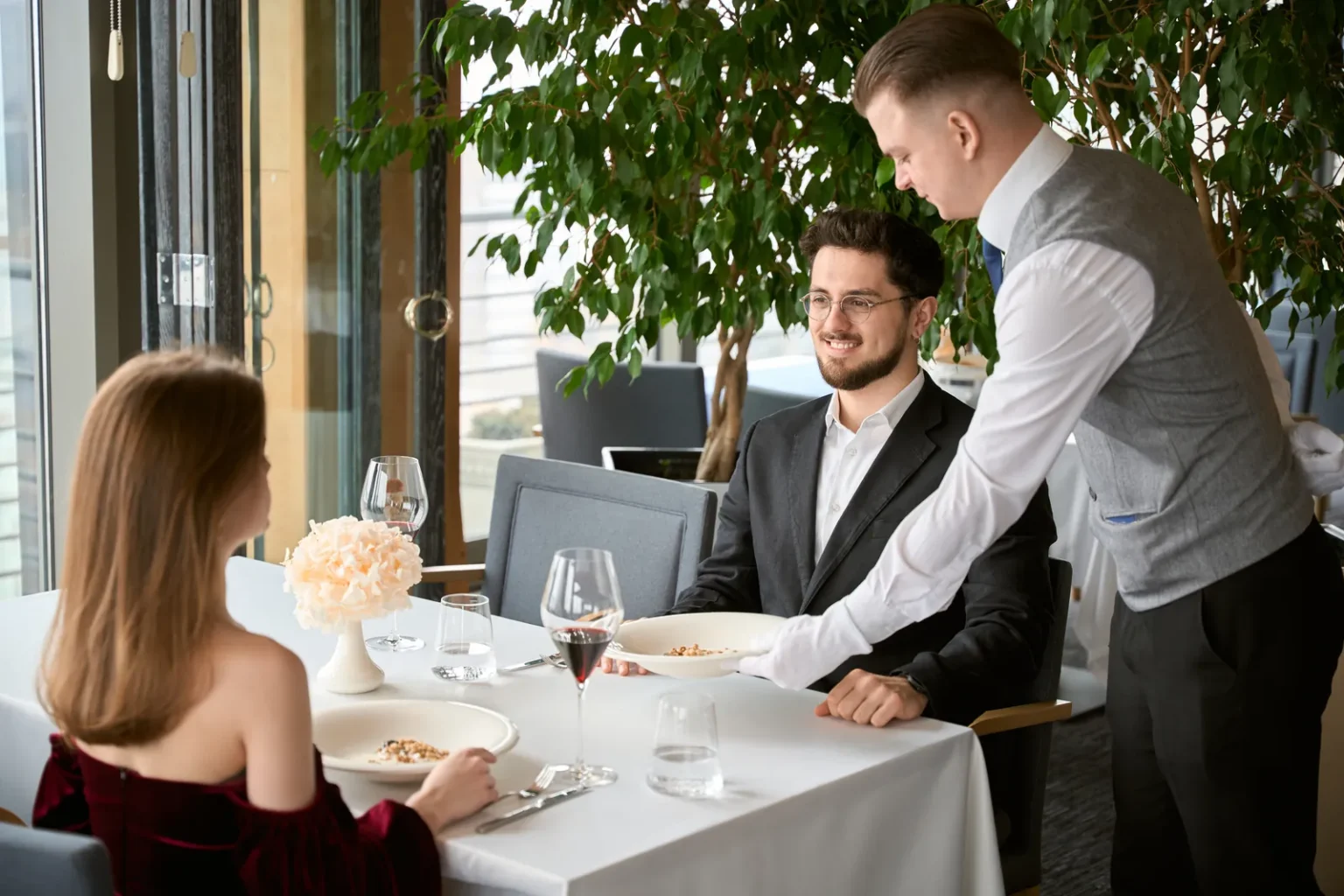
- Food service: ladies first, host last
- Table maintenance between courses: clear used cutlery, crumb the table
- Bill presented only when requested, never dropped unsolicited
For Jain guests, the SOP needs an additional branch: no root vegetables (potatoes, onions, garlic, carrots), no cross-contamination with regular prep surfaces. Train your service team to flag Jain orders to the kitchen immediately via a coded note on the KOT (kitchen order ticket).
In our work training restaurant teams across South India, the most common service failure we see isn’t technical. It’s the read-back. Servers take the order, walk away, and “fill in the gaps” from memory. One missed allergen note later and you’re looking at a guest incident. The read-back step isn’t bureaucracy. It’s your last checkpoint before food leaves the kitchen.
Closing Procedures
In any food and beverage SOP, the restaurant closing section is often the most neglected. Cover these four areas:
- table reset and linen removal
- POS reconciliation and petty cash count
- stock count of beverage par levels
- a written handover log for the next shift
The handover log matters because the closing manager’s knowledge shouldn’t disappear with the shift.
Bar and Lounge SOPs
Bar food and beverage sop procedures carry a different kind of risk than restaurant SOPs. You’re dealing with controlled substances, cash-heavy transactions, and guests who may become intoxicated. State-specific liquor licence conditions in India add another compliance layer that the bar SOP must address.
Bar Opening and Setup
Your bar opening food and beverage SOP should run through:
- Glassware inspection: cracks, chips, lipstick stains. Reject and replace before service
- Garnish prep: citrus cut, olives, maraschino cherries, mint sprigs ready
- Beverage par stock check against the requisition: flag shortfalls to the manager before service
- POS login, drawer count, and till balance confirmation
A point many Indian hotel bars skip: the speed rail layout. Document it. Bartenders swap shifts. If the rail layout changes every time, speed drops and consistency disappears.
Beverage Service Standards
Pouring standards are the single biggest controllable cost in bar operations. Your bar food and beverage sop must document:
- Standard peg measures: 30ml (small) and 60ml (large) as per Indian excise norms
- Free-pour discipline: measure every pour with a jigger, no exceptions during service
- Wine service: present the bottle to the host (label forward), confirm the selection, open and pour a 30ml tasting measure, wait for approval, then pour for other guests
- Beer service: 45-degree tilt to avoid excessive head, serve with branded glassware
Intoxicated guest protocol is a mandatory section of any Indian hotel bar SOP. You must document the escalation path: bartender identifies the guest, informs the shift manager, manager assesses and makes the decision to refuse service. Refusing service to an intoxicated guest is not a customer service failure. It’s a legal obligation under most state excise acts.
Bar Closing and Inventory
A food and beverage SOP for bar closing prevents shrinkage. Cover bottle count against the opening inventory, spillage and wastage log (every spillage signed off by two staff), cash reconciliation, and refrigeration check. Teach your team: the bar closing SOP is also the audit trail that protects them if cash discrepancies appear the next morning.
Banquet and Events SOPs
Banquet operations run at a scale that makes informal coordination impossible. An Indian wedding banquet can run 800-2000 covers across multiple food stations, multiple cuisines, and multiple dietary requirements, all in a single service. The banquet food and beverage sop has to be bulletproof.
Pre-Event Preparation
The Banquet Event Order (BEO) is the source document for every banquet SOP step. Before any event, the SOP should mandate:
- BEO review meeting with all department heads 48 hours prior
- Staff briefing on the day of the event: dietary notes, VIP seating, service timing
- Room setup per the approved floor plan: no improvisation on table positioning
- AV equipment test: microphone, projector, lighting cues confirmed 2 hours before doors open
For Indian banquet service specifically, the food and beverage sop must address halal kitchen management (separate utensils, designated prep areas, no cross-contact with non-halal items) and the vegetarian/non-vegetarian segregation at buffet stations. Colour-coded serving tongs and marked serving spoons are non-negotiable.
In our experience across banquet operations at properties in Bangalore, Chennai, and Hyderabad, the most frequent service failure is the buffet replenishment gap: dishes run out midway through service when the kitchen-to-banquet communication breaks down. A simple radio protocol between the banquet captain and kitchen supervisor, documented in the SOP, eliminates most of these incidents in our experience.
Service Execution
Buffet setup and replenishment should follow a documented sequence: hot dishes placed last (within 20 minutes of service start), chafing dish fuel checked every 45 minutes, food items labelled in both English and the regional language, serving spoons separate per dish. For sit-down banquet service, document the number of servers per table (1 server per 8 covers is the standard), pre-set items, and beverage service timing.
Post-Event Procedures
Post-event breakdown steps matter in any banquet food and beverage SOP for two reasons: inventory accuracy and the next day’s setup. Cover inventory reconciliation (beverage count vs. opening stock), food disposal documentation (FSSAI requires records of food waste at licensed premises), and a written event debrief note with guest feedback and any service failures flagged.
Ready to implement your food and beverage SOP across the full operation? Adevo’s food and beverage training courses are built for Indian hotel and restaurant teams, with on-site delivery and multilingual materials. They ensure your procedures are understood and followed consistently by every shift.
Room Service (In-Room Dining) SOPs
Room service is where the food and beverage SOP directly affects guest satisfaction scores because there’s no team to recover a failure. It’s just the tray, the guest, and the room.
Order Taking
Document the answer standard: phone picked up within 3 rings, greeting with the property name and operator name, order taken with full repeat-back including estimated delivery time. That delivery time estimate is a commitment. If the SOP says 30 minutes, the kitchen and service team have to operationally support that number.
Dietary confirmation is mandatory at the order-taking stage. The order taker must ask: “Do you have any dietary requirements or allergies?” Not as a courtesy. As a mandatory documented step.
Tray and Trolley Setup
The room service food and beverage SOP should define: tray cloth placement, cutlery position, condiment set, napkin fold, and hot/cold separation (hot food covered, cold items with appropriate chilling). Any alcoholic beverage included must have the room charge verification step documented: the server cannot hand over alcohol without age confirmation per hotel policy.
Door knocking protocol: knock three times, announce “Room Service,” wait 10 seconds, knock again. If no response after the third attempt, call the room from the floor phone.
Tray Collection
This is the most overlooked section of room service SOPs. Document a corridor sweep schedule: every 60-90 minutes, room service staff check corridors for trays left outside rooms. Follow-up calls to guest rooms: 30 minutes after delivery, confirm satisfaction. It sounds excessive until you realise that uncollected trays in corridors are a hygiene, security, and brand perception problem simultaneously.
Poolside and Outdoor Service SOPs
The poolside food and beverage SOP has constraints that no other outlet shares: water proximity, heat exposure, and the physical environment around a pool create service and safety challenges you don’t face in a restaurant.
Mandatory requirements to document:
- Plastic or shatterproof glassware only near the pool area: no glass, no exceptions
- Non-slip serving trays for wet surfaces
- Food temperature monitoring: India’s summer heat (40°C+) means food safety windows are shorter than FSSAI’s standard holding times suggest. In peak summer months, hot food should be consumed within 1 hour of preparation, cold food within 30 minutes of leaving the refrigeration unit
- Active guest circulation: servers should do a round every 15 minutes and not wait for guests to call
Towel and amenity requests should be coordinated with housekeeping through a radio channel, documented in the SOP so that F&B staff know exactly who to contact rather than making guests wait while someone figures out the process.
The poolside F&B SOP should also address sun protection for staff (part of the wellness SOP), sunscreen availability, and hydration breaks during peak heat hours.
Minibar SOPs
The minibar food and beverage SOP is a revenue protection document as much as a service document. Poor minibar management costs hotels in two ways: unposted charges and expired stock.
Document these four areas:
- Daily restocking schedule: minibar restocking happens during room cleaning, never when the guest is present (except for explicit guest request)
- FIFO rotation: First In, First Out. Older stock moves to the front, new stock goes to the back. Check expiry dates on every visit
- Charge posting: whether your property uses automated sensor technology or manual minibar cards, the SOP must define exactly when a charge is posted and the dispute resolution process
- Temperature monitoring: minibar refrigerators must maintain 4°C or below per FSSAI cold-chain requirements. Log temperatures twice daily
The minibar SOP is also where you document what happens with partially consumed items: a half-empty bottle is still a charge, and the SOP needs to tell your housekeeping team exactly how to handle it.
Kitchen SOPs Every F&B Manager Must Know
The kitchen food and beverage SOP operates under FSSAI Schedule 4, which sets binding requirements for licensed food establishments. These aren’t best practices. They’re legal obligations with inspection implications.
Food Handling and Hygiene
FSSAI Schedule 4 requires temperature control across three zones: below 5°C for cold storage, above 60°C for hot holding, and the zone between 5°C and 60°C is the danger zone where bacterial growth accelerates. Your food handling SOP must document:
- Colour-coded chopping boards: red for raw meat, green for vegetables, yellow for cooked poultry, white for dairy. This is an FSSAI requirement, not a preference
- Separate raw and cooked storage (separate refrigerators or clearly designated shelves)
- Personal hygiene: hairnets, gloves for ready-to-eat food, clean uniform policy, and annual medical fitness certificates for all food handlers
FSSAI inspects licensed food businesses regularly, and under its Food Safety and Standards Regulations (covered in full in our hotel SOP guide) penalties range from advisory notices to licence cancellation for non-compliant establishments. The kitchen SOP is your compliance documentation.
For understanding how to structure the training that supports these kitchen procedures, our article on FSSAI food safety training for hospitality covers the certification and audit readiness angle in detail.
HACCP and Food Safety
HACCP (Hazard Analysis Critical Control Points) is the framework your kitchen SOP should sit inside. Critical control points in an Indian hotel kitchen include: receiving (temperature and condition check for raw materials), chilled storage (daily temperature log), cooking (minimum internal temperature achieved), hot holding (above 60°C), and service.
Document your receiving inspection SOP: every delivery is checked for temperature (chilled items below 8°C on delivery), packaging integrity, and expiry dates. Rejected items must have a written rejection note signed by the receiving supervisor.
Keep pest control records. FSSAI inspectors ask for them. A minimum of monthly pest control treatment with signed contractor reports.
The cluster siblings (kitchen SOP, bar SOP, sequence of service, and banquet event order) each deserve their own deep-dive treatment. This guide gives you the framework; those articles will give you the step-by-step documentation for each.
How to Train Your Team on Your Food and Beverage SOP
Here’s the part most hotel training programmes get wrong: writing a food and beverage SOP document is not the same as training staff on it. You can have perfect SOPs and still run a chaotic operation.
The SOP-to-training gap is the most common failure mode in Indian F&B departments. The SOP exists as a PDF in the training manager’s laptop. Staff are shown it once during induction. Then the SOP becomes a compliance artefact while actual service runs on informal norms that drift further from the document every month.
Closing this gap requires four things:
- Visual SOPs for multilingual teams: In an Indian hotel kitchen where your team speaks Hindi, Kannada, Tamil, and Telugu, a text-heavy SOP document is inaccessible to a significant portion of your staff. Pictorial guides, illustrated step sequences, and bilingual signage make SOPs usable by everyone, not only English-literate supervisors
- Daily briefings as SOP reinforcement: A 10-minute pre-shift briefing covering one SOP checkpoint per day means your team completes the full SOP cycle roughly once a month. Over six months, it’s six complete refreshes without any formal training programme required
- Mystery guest audits: Have someone pose as a regular guest and score the service against your SOP. It’s the fastest way to identify where execution diverges from documentation
- Accountability structures: An SOP without consequences isn’t a standard. It’s a suggestion. Document who is responsible for verifying each SOP step, and include SOP compliance in performance reviews
India’s tourism and hospitality sector supports 46.5 million jobs, according to Invest India, and high frontline attrition is a persistent feature of that scale, not an exception. SOPs designed for rapid onboarding (short, visual, role-specific) are not a nice-to-have. They’re the only way to maintain service standards when your team changes constantly.
Each food and beverage SOP in this guide is one piece of your complete hotel SOP documentation across all departments and outlets.
Conclusion
A food and beverage SOP is only as good as the training behind it. The procedures in this guide, across all six outlets with FSSAI compliance built in, give you the framework. But a document on a shelf doesn’t train a server to greet a guest within 30 seconds or a bartender to refuse service to an intoxicated guest without an incident.
Start with one outlet, document its opening, service, and closing procedures, train the team on them in daily briefings, and audit execution before moving to the next outlet. Adevo’s F&B courses can run that rollout with your team on site, and the head of your food and beverage department should own it. An operation that runs six outlets on verified, practised SOPs will outperform one with a perfect manual nobody has read.
Frequently Asked Questions: Food and Beverage SOP
Q: What is a food and beverage SOP?
A: A food and beverage SOP is a written, step-by-step document that standardises how recurring tasks are performed across F&B outlets, covering everything from restaurant service sequences and bar opening routines to kitchen hygiene protocols and room service delivery. In Indian hotels, a good food and beverage SOP also incorporates FSSAI compliance requirements and accounts for multilingual staff teams.
Q: What are the most important F&B SOPs in a hotel?
A: The five most critical food and beverage SOP categories are: restaurant sequence of service, food handling and hygiene (FSSAI Schedule 4 compliant), beverage service standards, in-room dining delivery procedures, and banquet event execution. Each outlet (restaurant, bar, banquet, room service, poolside, minibar) needs its own tailored F&B SOP set.
Q: How often should F&B SOPs be updated?
A: Review your food and beverage SOP annually at minimum, and immediately whenever there’s a regulatory change (FSSAI amendments), a new product or menu introduction, a significant guest complaint traceable to a procedure gap, or a new outlet opening. SOPs are living documents. They should reflect how the operation actually runs, not how it ran two years ago.
Q: What is the sequence of service in a restaurant?
A: The standard restaurant sequence of service has 10 steps: guest greeting within 30 seconds, escort to table, seating (ladies first), menu presentation, water service, beverage order, food order with allergen confirmation, food service (ladies first), table maintenance between courses, and bill presentation on request. Each step should be documented in your restaurant food and beverage SOP with timing standards.
Q: How do you train staff on new SOPs?
A: The most effective approach uses four methods together: visual SOPs with pictorial guides for multilingual teams, daily pre-shift briefings covering one SOP checkpoint at a time, mystery guest audits to verify execution, and SOP compliance included in performance reviews. A new F&B SOP should be introduced in a structured briefing, demonstrated by a trainer, practiced by staff under supervision, and then assessed before staff are cleared to operate independently.