Picture this: it’s a busy Saturday evening at a 150-cover restaurant in Bengaluru. Three servers handle the same table type, a family of five, and every single one does it differently. One brings water before menus. Another takes the drinks order before the family’s even sat down properly. The third disappears for twelve minutes. The food’s the same. The kitchen’s the same. But the guest experience? Completely inconsistent. That’s exactly what a defined sequence of service in a restaurant is designed to fix. It’s the connective tissue between your hospitality management courses and what actually happens on the floor. Without it, every table is a gamble, regardless of how good your kitchen SOP is.
Key Takeaways
– The sequence of service in a restaurant covers 11 distinct steps from pre-arrival prep to farewell and table reset
– Fine dining, casual dining, buffet, and bar service each require a modified version of the core sequence
– India-specific service realities (veg/non-veg separation, UPI payments, multi-language teams) must be built into any training programme
– Most service failures trace back to gaps at a specific step, not a general lack of effort
What Is the Sequence of Service in a Restaurant
The sequence of service in a restaurant is the fixed order of guest-facing steps a server follows from the moment a guest arrives to the moment they leave. It covers greeting, seating, order taking, food and beverage service, clearing, billing, and farewell. It exists so that every guest receives a consistent experience regardless of which server handles the table, which shift it is, or how busy the floor gets.
Think of it less as a script and more as a framework. The exact words change. The timing adjusts. But the order doesn’t. A server who knows the sequence of service in a restaurant never has to improvise the structure of a guest interaction, they only have to personalise it. That’s the difference between a trained professional and someone who’s figuring it out as they go.
The sequence is sometimes called “steps of service” or “restaurant service standards.” Whatever label your property uses, the underlying logic is identical: define the order, train to it, assess against it. The sequence of service sits within the broader hotel SOP framework that governs all departmental operations.
Why the Sequence of Service in a Restaurant Matters
Inconsistent service is one of the top reasons guests don’t return. Not bad food. Inconsistent service. A guest who enjoys great food but experiences a slow greeting, an order mix-up, or a premature bill is unlikely to come back, and far more likely to leave a negative review.
Industry reporting from FHRAI’s trade publications, the apex body for Indian hotels and restaurants, points to a sector serving hundreds of millions of covers annually while training investment per front-of-house employee lags behind global hospitality norms. The gap between what guests expect and what undertrained staff deliver is where revenue leaks.
There’s a direct operational case too. When servers know the sequence of service in a restaurant, they work faster, make fewer errors, and require less supervision. New hires reach acceptable service standards in days rather than weeks. Floor supervisors spend less time firefighting and more time coaching.
For properties running multi-cuisine menus, Indian, Continental, and Chinese sections under one roof, the service sequence is especially critical. Each cuisine section has different prep times. Without a defined front-of-house sequence connecting to your kitchen SOP, courses arrive out of order, starters land cold, and mains come before the table is cleared.
The sequence of service in a restaurant isn’t just a training tool. It’s a revenue protection mechanism.
The Complete Sequence of Service in a Restaurant, 11 Steps
This is the core framework. Every restaurant type adapts it, but all 11 steps exist in some form across fine dining, casual, buffet, and bar service.
Step 1: Reservation and Pre-Arrival Preparation
Before guests walk through the door, the service sequence has already started. Confirm bookings, check for VIP notes, dietary flags, and special occasions. Assign tables based on party size and preference. Pre-set covers according to your restaurant type: full cutlery placement for fine dining, simplified settings for casual, nothing but a clean table and napkins for buffet.
Brief your team at the pre-service meeting. Share the 86 list from the kitchen, flag any VIP tables, and confirm which servers are covering which sections. This is also the moment to align with your kitchen SOP, if the sous chef is running short on a special, the floor team needs to know before service starts, not mid-table.
Step 2: Guest Greeting and Seating
Acknowledge every arriving guest within 30 seconds. That’s not a suggestion. It’s the standard that separates professional service from amateur hour. The greeting doesn’t have to be elaborate, “Good evening, welcome” with eye contact and a genuine smile is enough. What guests notice is being seen.
Escort the party to their table. In Indian hospitality, ladies are traditionally seated first. Pull chairs. Once seated, present menus, open, not dropped on the table. Introduce the server by name: “My name is Rahul, I’ll be taking care of you this evening.”
The service sequence begins the moment a guest crosses the threshold. Not when they sit down.
Step 3: Water Service and Initial Beverage Order
Serve water immediately after seating, from the right side. In Indian restaurants, always ask the preference: chilled, room temperature, or warm (a surprisingly common request, especially for older guests and those with dietary requirements). If the property has a signature welcome drink, this is when it comes out.
Once water is served, offer aperitifs, mocktails, or signature beverages. Don’t rush this, the beverage order is the first revenue opportunity of the service flow. A server who skips it or hurries past it is leaving money on the table.
Step 4: Menu Presentation and Order Taking
Allow 5 to 7 minutes for the guests to review the menu before returning to take orders. Don’t hover. Don’t disappear for 20 minutes. That 5 to 7 minute window is real.
When you return, recommend specials. Clarify allergens and dietary requirements proactively, don’t wait for guests to ask. Repeat the order back clearly. Use seat numbers to map each dish to its guest: “Starter of paneer tikka for seat two, main of butter chicken for seat three.” This is called seat-number sequencing, and it eliminates the amateur’s habit of auctioning food at the table (“Who had the biryani?”).
In India, clarify veg and non-veg preferences early. Many guests at multi-cuisine restaurants have strict requirements, and some have religious observances that affect not just what they eat but how it’s served and what utensils touch the plate. This is a step that no global service guide covers, but it’s the operational reality for anyone running a restaurant in India.
In our experience training restaurant teams across Bengaluru and beyond, the order-taking step is where the most service failures originate. Not because servers don’t listen, but because they haven’t been trained on repeat-back protocol or seat-number sequencing. Both are trainable in a single session.
Step 5: Placing the Order with the Kitchen
Transmit the order to the kitchen via POS or KOT (Kitchen Order Ticket) immediately after leaving the table. Every second of delay affects timing. Specify allergy flags, modifications, and any special instructions clearly. This is the point in the service cycle where front-of-house meets back-of-house.
This is also where your kitchen SOP and the floor sequence must be in sync. Clear KOTs, allergy flags, and course-pacing signals depend on the kitchen following its own procedures. If the kitchen SOP says “fire mains only after starter clearance signal from floor,” both teams need to have agreed on what that signal looks like. A verbal call? A POS status update? A physical ticket? This coordination is what separates a restaurant that runs smoothly from one that has constant timing complaints.
Kitchen Order Ticket (KOT): the physical or digital record of a guest’s order transmitted from the floor to the kitchen, used to coordinate preparation and course timing.
Step 6: Serving Food and Beverages
Serve food from the right. Clear from the right. In Indian hotel service, this is standard protocol, and it’s worth drilling into every new hire, because it’s one of the first things a senior guest will notice if it’s wrong.
Announce each dish as you place it: “Your Dal Makhani, ma’am.” Brief, clear, respectful. Serve ladies first, then other guests by seniority, host last. Before stepping away from the table, visually check temperatures, presentation, and garnish. A wilted garnish or a cold plate that left the kitchen that way is caught here, not at the guest’s first bite.
For restaurants observing veg/non-veg plate separation: serve veg guests first, from dedicated serviceware. This isn’t optional. It’s a trust signal that Indian guests from specific communities rely on.
Step 7: The Two-Minute Check-Back
Return to the table within two minutes of serving the main course. Not to ask “Is everything okay?”, that question invites a reflexive “yes” even when something’s wrong. Ask instead: “Is everything to your satisfaction?” Watch the non-verbal cues. An untouched plate after two minutes is a problem. A confused expression is a problem. A guest trying to catch a server’s eye is a problem.
Top up water at this point. Offer bread refills. This step in the service sequence is about maintaining the guest relationship through the meal, not just opening and closing the transaction.
Step 8: Clearing and Crumbing
Clear only when all guests at the table have finished. This is a rule that many restaurants break under pressure, especially during busy covers. Removing a plate while one guest is still eating signals to that guest that they’re being rushed. It breaks trust and changes the entire mood of the table.
Clear from the right. Stack plates discreetly, never scrape or stack at the table in view of guests. In fine dining, crumb the table between courses using a crumber and a service plate. In casual dining, a quick surface wipe before dessert is the minimum standard.
Step 9: Dessert, Coffee, and After-Dinner Service
Present the dessert menu or suggest house specialities verbally. This is the final revenue opportunity of the service flow, and it’s consistently under-used by untrained servers who assume guests don’t want dessert because they look full.
In India: don’t overlook the chai and filter coffee upsell. Regional preferences matter. A guest from South India at a North Indian restaurant may be delighted to find filter coffee on the menu, if the server knows to mention it.
Serve dessert cutlery, clear dessert plates, and only then move toward the bill.
Step 10: Presenting the Bill and Payment
Never present the bill while guests are still eating. Never before they’ve asked, unless the table has been sitting for significantly longer than your average cover time and the restaurant has a waiting queue. Present the bill in a folder, placed on the table, not handed directly to one specific person. In a group setting, handing the bill to someone implies that person is paying, an assumption that regularly creates awkward moments.
Offer all payment options clearly: card, UPI, or cash. UPI is standard in Indian restaurants now, not an afterthought. Process promptly. If change is due, return it fully, never assume a guest is leaving the remainder as a tip.
The UPI handoff is a point of friction many restaurants haven’t thought through. Who shows the QR code? On what device? If the server fumbles with their phone or the POS screen isn’t visible, the experience degrades right at the finish line. Build the UPI step into your service sequence explicitly, not as an improvised afterthought.
Step 11: Farewell and Post-Visit
Thank the guest by name if you’ve learned it during the meal. Assist with chairs. Escort the party to the exit, or at minimum, acknowledge them clearly as they leave.
Post-visit: if your restaurant has a digital feedback system, the server or host should invite guests to leave a review or fill a short feedback card. This closes the loop on the service cycle and provides the data that makes the next service better.
Getting all 11 steps to happen consistently, on every shift, comes down to structured training. Adevo’s food and beverage training courses are designed to build exactly this kind of step-by-step service competence, and our trainers bring 80+ years of combined experience across Taj, Oberoi, Le Meridien, and TGI Fridays. If your restaurant needs structured service training that accounts for India-specific realities, talk to us about what that looks like for your property.
How the Sequence Changes by Restaurant Type
The 11-step core applies across formats, but each restaurant type requires a modified approach. This is the section that no generic global guide covers in a single article. Here’s how the service sequence adapts.
Fine Dining Service Sequence
Fine dining extends the core sequence with additional layers. Expect amuse-bouche presentation before starters, inter-course clearing with full crumbing, tableside service for certain dishes (gueridon service for carving or flambé), and a structured wine service protocol: present the bottle, open tableside, offer a taste to the host, pour clockwise for all guests.
Timing is slower by design: 90 to 120 minutes per cover is normal, with courses paced 15 to 20 minutes apart. Multi-server coordination becomes essential, at a formal Indian fine dining restaurant like the Taj Tasting Room or ITC Bukhara, dishes are delivered by multiple servers simultaneously to ensure all guests at the table are served at the same moment.
The fine dining service flow demands more choreography, more coordination with the kitchen, and more individual attention per guest. Each step of the sequence takes longer and requires more precision.
Casual Dining Service Flow
Casual dining compresses the sequence without eliminating steps. Greeting to seating to order takes under five minutes. The two-minute check-back still happens. Clearing protocol still applies. But the pacing is built around a 45 to 60 minute cover time and faster table turnover.
At casual dining chains like Barbeque Nation or Mainland China, the sequence adapts further to accommodate shared-table formats, live counter service, and continuous replenishment models. Servers in these formats manage more tables simultaneously and need a tighter mental model of where each table is in the service cycle.
Buffet Service Sequence
In a buffet format, guests self-serve food, but the service sequence for staff is still active. Table assignment, water service, and beverage taking happen exactly as in table service. Staff monitor and replenish buffet stations, clear plates continuously throughout the meal, and handle dessert and beverage service directly at the table.
Indian hotels run heavy buffet operations for breakfast, Sunday brunch, wedding banquets, and corporate events. The veg/non-veg separation in a buffet context means physical station separation, dedicated serving utensils per station, and clear labelling, all of which are staff responsibilities within the service sequence.
For banquet buffets with 200+ covers, the service sequence scales into a team-based model with dedicated station attendants, a floor captain coordinating clearance, and a beverage team working the floor independently.
Bar Service Sequence
Bar service follows its own track within the broader sequence. The bar SOP guides drink preparation and timing, but the front-of-house sequence applies:
- greet the guest at the bar
- take the drink order
- prepare and serve
- check back
- manage the tab
- facilitate payment
Responsible beverage service is built into the bar SOP, ID verification for guests who appear underage, monitoring consumption, and a clear refusal protocol for guests who’ve had too much. State-specific liquor regulations in India mean bar service procedures vary by location, which makes documented bar SOPs critical for any property operating across multiple states.
For restaurant staff training checklists that cover both floor and bar roles, having a unified service sequence framework makes cross-training significantly easier. A floor server covering bar duty or vice versa needs to understand both sequences.
Common Service Failures and How to Fix Them
Most service failures in a restaurant aren’t random. They cluster at specific steps of the sequence. Once you know which step a failure belongs to, training the fix is straightforward.
| Failure | Step | Impact | Fix |
|---|---|---|---|
| Slow greeting (over 60 seconds) | Step 2 | Guest feels ignored; negative first impression | Station a host at entrance; brief team on 30-second greeting standard |
| Order errors | Steps 4-5 | Wrong dishes; food waste; guest frustration | Implement repeat-back protocol; use seat-number system; confirm via POS |
| Auctioning food (“Who had the biryani?”) | Step 6 | Unprofessional; breaks guest confidence | Train on seat-to-dish mapping from order-taking stage |
| Premature plate clearing | Step 8 | Rushes guests; creates anxiety | Rule: clear only when every guest at the table has finished |
| Hovering or ignoring | Step 7 | Either intrusive or negligent | Train “zone coverage”, attentive presence at scheduled intervals |
| Bill presented too early | Step 10 | Guest feels pushed out | Wait for guest signal; never bring bill with the last course |
Connecting the Sequence to Kitchen and Bar SOPs
The service flow doesn’t operate in isolation. It’s the front end of a system that includes your kitchen SOP and bar SOP. When these three are aligned, service is smooth. When they’re not, guests feel the friction.
Here’s the specific connection. The kitchen SOP determines how orders are received, when each course is fired, and how allergy flags are communicated. The service cycle determines when the floor signals the kitchen to fire the next course. If the kitchen fires mains independently of any floor signal, you’ll have a main course arriving at the table before the starter plates are cleared. That’s not a kitchen failure or a floor failure, it’s a coordination failure.
The FSSAI hygiene rating scheme exists precisely because food safety compliance in Indian restaurants remains inconsistent. Building food-handling touchpoints directly into the service sequence, serving temperatures, utensil separation, allergen communication, is one of the most practical ways to reduce compliance risk at the floor level.
The bar SOP connection works similarly. Drink orders should be transmitted before food orders in most formats so aperitifs arrive before starters. Digestifs coordinate with dessert service. If the bar team and floor team aren’t on the same sequence, guests experience a fragmented experience even when both teams are working hard.
Multi-cuisine kitchens with separate Indian, Continental, and Chinese sections have an additional coordination layer. Each section runs on different prep times. The floor captain needs to know these timings to sequence courses correctly. A daily pre-service briefing between the floor captain and kitchen sous chef, aligned on timing, VIP notes, 86’d items, and expected cover count, is the practical answer.
How to Train Your Team on the Sequence of Service
Knowing the service sequence is one thing. Training it consistently across a high-turnover workforce is another. Here’s how to do it:
Step 1, Document the sequence as a written SOP. A laminated card at the service station or a digital reference in your restaurant’s app. Visual SOPs work especially well for staff with limited English proficiency, a real operational reality in most Indian restaurants.
Step 2, Shadow training. New servers observe experienced staff for two to three shifts before handling tables independently. They’re watching for the service flow in action, not just reading about it.
Step 3, Role-play practice. Simulate each step in pre-service meetings. Focus on one step per session. Step 4 (order taking with repeat-back) in Monday’s briefing. Step 6 (serving protocol and veg/non-veg separation) in Tuesday’s.
Step 4, Micro-skills approach. Break the 11-step sequence into individual, assessable skills. Can this server do a correct two-minute check-back? Can they present a bill without handing it directly to one guest? Assess each skill before combining into full service flow.
Step 5, Live coaching. A floor supervisor provides real-time feedback during service, discreetly, never in front of guests. “After this table, let’s talk about the clearing sequence” is coaching. “Why did you clear that plate early?” shouted across the floor is not.
Step 6, Assessment and sign-off. A weekly checklist where supervisors score each server on all 11 steps. This creates a visible standard and gives servers a target.
This six-stage approach works for new hires learning the service cycle for the first time, and for experienced servers stepping into floor supervisor roles.
The sequence of service is one of the hotel SOP components your F&B teams rely on for consistency.
Frequently Asked Questions: Service sequence
Q: What is the service flow?
A: The service cycle is the fixed order of steps a server follows from guest arrival to departure, covering reservation prep, greeting, seating, beverage taking, order taking, food service, check-back, clearing, dessert, billing, and farewell. It ensures consistent guest experiences regardless of which server handles the table.
Q: What are the 11 steps of service in a restaurant?
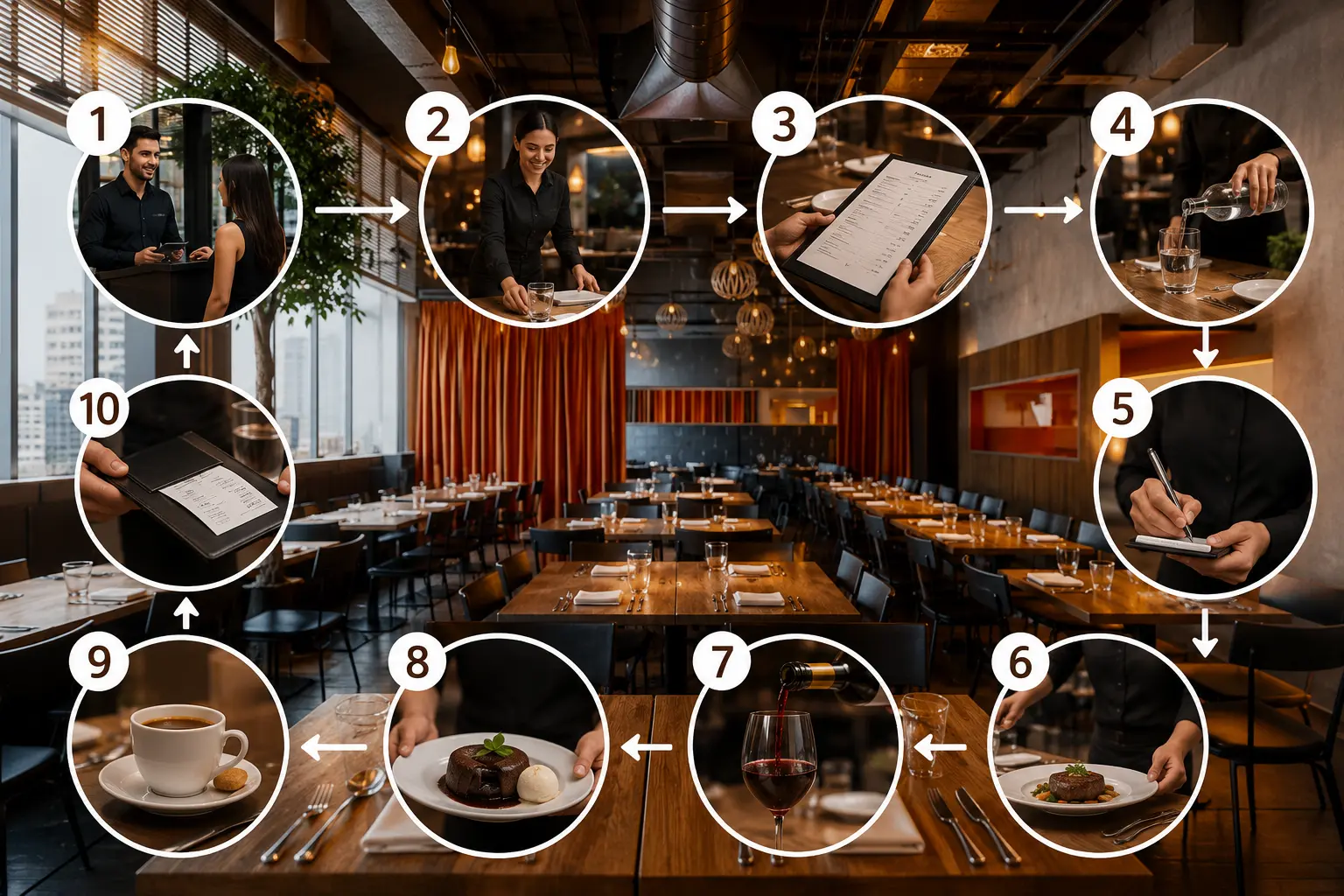
A: The 11 steps in the service sequence are: (1) reservation and pre-arrival preparation, (2) guest greeting and seating, (3) water service and initial beverage order, (4) menu presentation and order taking, (5) placing the order with the kitchen, (6) serving food and beverages, (7) the two-minute check-back, (8) clearing and crumbing, (9) dessert, coffee, and after-dinner service, (10) presenting the bill and payment, (11) farewell and post-visit.
Q: How does the service sequence differ between fine dining and casual dining?
A: In fine dining, the service flow is extended with additional steps: amuse-bouche, inter-course crumbing, gueridon service, and coordinated multi-server delivery. Cover times run 90 to 120 minutes. In casual dining, the same core sequence applies but compressed into 45 to 60 minutes, with faster table turnover and fewer ceremony steps.
Q: What is the connection between the sequence of service and kitchen SOP?
A: The service cycle is the front-of-house procedure. The kitchen SOP governs back-of-house operations. They must be synchronised at the course-firing stage: the floor signals the kitchen when to fire the next course based on clearing status. Without this coordination, courses arrive out of order or land at the table before it’s cleared.
Q: How do you train restaurant staff on the sequence of service?
A: Training the service sequence works in six stages: document the sequence as a written SOP, shadow training for two to three shifts, role-play practice on individual steps, micro-skills assessment of each step separately, live coaching during service, and weekly supervisor sign-off checklists. Multi-language visual SOPs are essential in Indian restaurants with diverse staff.
Q: What is the buffet service sequence in a restaurant?
A: In a buffet format, the service flow covers table assignment, water and beverage service, ongoing plate clearance, buffet replenishment, and direct dessert and beverage service at the table. Staff manage veg/non-veg station separation, chafing dish temperature compliance per FSSAI standards, and high-volume cover management during peak service periods like wedding banquets.
Conclusion
The service cycle isn’t complicated. It’s eleven steps. But those eleven steps, trained consistently across every server on every shift, are what separate a restaurant guests recommend from one they tolerate. Get the sequence right and the guest experience takes care of itself. Skip the training and you’ll spend every busy Saturday putting out fires that the sequence was designed to prevent.
The cluster of SOPs that surround this sequence, hotel sop, kitchen sop, bar sop, food and beverage sop, and banquet event order, all connect to what happens on the floor during service. The service sequence is the thread that ties them together.
If your restaurant team is working without a defined sequence of service, start with the 11 steps above. Document them, train them, assess them. That’s the whole system.