Most Indian commercial kitchens run on verbal instructions. Chef tells CDP, CDP tells commis, commis guesses the rest. It works until it doesn’t. Your senior cook calls in sick on a Saturday banquet day, your new batch of staff has never seen a proper receiving procedure, and suddenly your entire mise en place is guesswork. That’s not a staffing problem. That’s a kitchen SOP problem.
If you’re running a hotel kitchen, a standalone restaurant, or a multi-outlet F&B operation and you don’t have your procedures documented, you’re building on sand. Hospitality management courses at Adevo exist because operational consistency starts with training. Training starts with knowing exactly what “correct” looks like on paper.
This guide gives you 8 operational kitchen SOPs for Indian hotel and restaurant conditions: FSSAI-aligned, checklist-ready, ready to hand to a new hire on day one.
Key Takeaways
– A kitchen SOP documents the exact steps for every kitchen task, eliminating the senior-chef dependency problem
– FSSAI Schedule 4 requires every food business to maintain documented food safety procedures
– Every FBO with 25 or more food handlers must have at least one FoSTaC-certified Food Safety Supervisor on staff
– Eight SOP categories cover the full shift cycle: opening, receiving, hygiene, cooking, cleaning, closing, safety, and training
What Is a Kitchen SOP
Kitchen SOP (Standard Operating Procedure) is a documented, step-by-step instruction set for a specific kitchen task. It tells a staff member exactly what to do, in what order, to achieve a consistent result every time, regardless of who is on shift.
A kitchen SOP answers the “how.” A checklist verifies the “what.” Your closing checklist tells you the gas valve was turned off. Your closing SOP tells you the sequence for shutting down every station, who signs off, and what happens if something’s left on. One catches gaps; the other prevents them.
Kitchen SOPs sit within the broader hotel sop framework that governs every department. For the complete overview including front office, housekeeping, and F&B operations, see our comprehensive guide to hotel SOP. For F&B specifically, they connect to the food and beverage sop structure covering everything from bar service to banquet event order. The kitchen is the production engine.
Why Every Indian Commercial Kitchen Needs Written SOPs
Undocumented kitchens are a regulatory risk. Written kitchen SOPs are a legal requirement, not a luxury.
FSSAI Schedule 4 mandates that every licensed food business operate a documented food safety management system. This includes written procedures for receiving, storage, preparation, cooking, cleaning, and waste disposal. If your kitchen is inspected and you can’t produce documented procedures, you’re in violation.
The FoSTaC mandate is equally clear: any food business with 25 or more food handlers must employ at least one FoSTaC-certified Food Safety Supervisor, according to the FSSAI FoSTaC programme.
Beyond compliance, there’s the attrition reality. Staff turnover in Indian hospitality runs high. When your CDP leaves without documented knowledge, the next hire needs weeks instead of days to reach competency.
In our experience working with hotel and restaurant kitchens across India, the properties with the fewest food safety incidents aren’t necessarily the ones with the most experienced chefs. They’re the ones where the procedures are written, displayed, and actually followed during daily service. Experience gets you through. Systems keep you consistent.
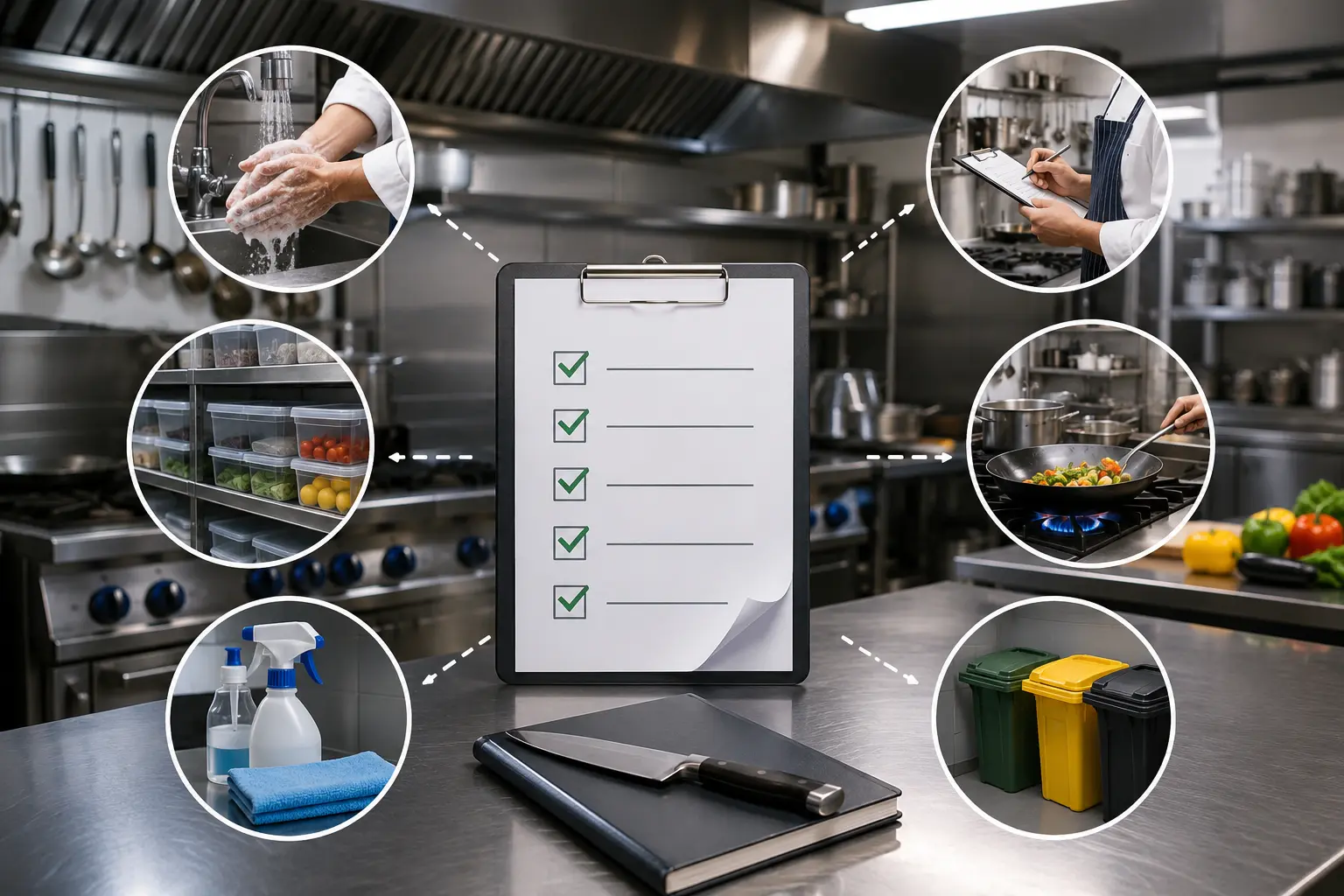
The numbered list below summarises what a complete kitchen SOP system must cover:
- Kitchen Opening SOP
- Food Receiving and Storage SOP
- Kitchen Hygiene and Personal Safety SOP
- Cooking and Food Preparation SOP
- Kitchen Cleaning and Sanitation SOP
- Kitchen Closing SOP
- Kitchen Safety and Emergency SOP
- Kitchen Staff Training SOP
Kitchen Opening SOP: Before the First Order
A well-run opening sets the entire shift’s baseline.
Equipment check is first. Before anyone fires a burner, your opening cook verifies that all major equipment is functioning: gas burners, pilot lights, oven thermostats, fryer oil temperature, exhaust hood fans, and bain marie water levels. Anything not working gets logged and reported to the F&B Manager before service begins.
Temperature verification is non-negotiable. Check every refrigerator and freezer. Walk-in chiller should read 1-4°C; walk-in freezer at -18°C or below. Log the readings with the time and your initials. If a unit is out of range, call maintenance, move the product, and document it.
Mise en place comes next. Each station preps to par levels from the recipe card, using the day’s cover count and function sheet, not instinct.
Staff briefing closes the opening sequence: menu changes, any 86’d items, VIP dietary requirements, the day’s specials, and one kitchen SOP reminder. Keep it tight.
Opening SOP Checklist
- [ ] All burners and pilot lights tested
- [ ] Oven and fryer temperatures verified and logged
- [ ] Walk-in chiller temp logged (target: 1-4°C)
- [ ] Walk-in freezer temp logged (target: -18°C or below)
- [ ] All cutting boards clean and in station
- [ ] Mise en place prepared to par levels
- [ ] Date labels on all prepped items
- [ ] Uniform and personal hygiene check completed for all staff
- [ ] Pre-service briefing completed (note: menu changes, VIP, 86’d items)
- [ ] Opening supervisor sign-off
Food Receiving and Storage SOP
This is where most Indian commercial kitchens lose the food safety battle. Open-market receiving, no sealed packaging, variable temperatures. The risks start at the back door.
Delivery inspection protocol: Every delivery gets checked against the purchase order before anything enters the kitchen. Temperature is checked immediately: chilled produce must arrive at or below 5°C; frozen items at -18°C or below. If a delivery arrives at 10°C when it should be at 4°C, that’s a rejection. No exceptions, even if it’s your regular supplier.
In Indian kitchens, the open-market reality is different from global guides. Your vegetable vendor arrives with produce that hasn’t seen a temperature log. Your fish supplier’s ice may have partially melted. Your meat delivery might come in a van with no refrigeration. The kitchen SOP for receiving must explicitly address these situations: check internal temperature with a probe thermometer, inspect for freshness markers (smell, colour, firmness), verify quantity against the delivery note, and reject anything that doesn’t meet spec, even if it means the day’s menu changes.
FIFO labelling is mandatory. Every item that enters storage gets labelled: date received, best before date or use-by date, and the staff member’s initials. Labels go on before the item goes on the shelf. Not after. Not “in a few minutes.”
Storage hierarchy prevents cross-contamination. Ready-to-eat food (desserts, salads, cooked items) goes on the top shelf. Raw vegetables in the middle. Raw proteins (chicken, fish, red meat) on the bottom, each in sealed containers. Never reverse this order, even when you’re under time pressure.
Dry storage rules: temperature between 10-21°C, all items stored at least 15cm off the floor, 45cm from the walls, with clear aisle space for inspection. No cardboard boxes directly on the floor. No dented tins on the shelf.
Receiving and Storage Checklist
- [ ] Delivery checked against purchase order
- [ ] Temperature of chilled items verified (≤5°C)
- [ ] Temperature of frozen items verified (≤-18°C)
- [ ] Packaging intact (no tears, pest evidence, or moisture damage)
- [ ] Expiry dates verified
- [ ] FIFO labels applied (date received + use-by + initials)
- [ ] Raw proteins stored at bottom of refrigerator
- [ ] Ready-to-eat items stored at top of refrigerator
- [ ] Dry goods stored off-floor and away from walls
- [ ] Rejected items documented and returned with reason noted
Kitchen Hygiene and Personal Safety SOP
FSSAI’s “4 Cs” framework defines the core of every kitchen hygiene SOP: Cleaning (removing dirt and food residue), Cooking (reaching safe internal temperatures), Chilling (keeping cold food cold), and Cross-contamination prevention (keeping raw and ready-to-eat food separate).
Handwashing is the most basic and most violated kitchen SOP in Indian commercial kitchens. The standard: 20-second minimum wash with soap, five-step method (wet, lather, scrub, rinse, dry with single-use paper or air dry), at designated handwash stations only, not at prep sinks and not at pot wash. Hands must be washed after handling raw protein, after using the toilet, after handling waste, after touching the face, and after every task change. This isn’t a suggestion.
Uniform standards: Clean whites at the start of every shift. Hair nets or skull caps mandatory for all kitchen staff. No jewellery except plain wedding bands (and even those are better removed). Closed-toe non-slip shoes. No nail polish. Aprons changed between raw prep and service.
Cross-contamination prevention goes beyond colour-coded boards, though those matter. Red board for raw red meat, yellow for raw poultry, blue for raw fish, green for vegetables and fruit, white for dairy and cooked food. Separate knives for each category. Separate storage for allergen-containing ingredients. Clear labelling on everything.
One thing no kitchen SOP template addresses for Indian conditions: managing betel leaf, paan, and tobacco habits in kitchen staff. It’s a real operational issue. Nicotine and paan stains on uniform cuffs, staff leaving the kitchen to smoke, saliva contamination risks. Your hygiene SOP must explicitly state the rules: no tobacco, paan, or betel in the kitchen premises, a designated smoking area outside the kitchen boundary, mandatory handwash on return, and zero tolerance for violations during service.
Our detailed guide on kitchen staff food safety training in India covers how to train your team on hygiene protocols in a way that actually sticks, including for semi-literate staff and multilingual teams.
Cooking and Food Preparation SOP
Safe cooking temperatures aren’t suggestions. They’re science. Your kitchen sop for cooking and prep needs to specify exact temperature targets, not “cook until done.”
Internal temperature targets every Indian kitchen needs documented:
| Food Type | Minimum Safe Internal Temperature |
|---|---|
| Poultry (chicken, duck, turkey) | 74°C |
| Ground meat | 71°C |
| Fish and seafood | 63°C |
| Whole cuts of red meat | 63°C (with 3-min rest) |
| Reheated food | 74°C |
| Hot holding | 63°C minimum |
Cooling protocol is where kitchens create the most risk. Cooked food must cool from 60°C to 21°C within 2 hours, then from 21°C to 5°C within the next 4 hours. Don’t put a full pot of hot dal in the walk-in at the end of service and assume it’s fine by morning. Use shallow pans (no more than 5cm depth), blast chiller if you have one, or ice bath with frequent stirring. Log the temperature drop with times.
Thawing: refrigerator thawing only for large items (overnight in the chiller). For quick thaw, use running cold water with product in sealed packaging. Never thaw at room temperature. This is a basic kitchen SOP point that gets ignored under service pressure.
Tandoor and live-cooking station safety is specific to Indian kitchens. Tandoor pre-heating protocol: check for cracks in clay lining before lighting, ensure adequate ventilation, use proper charging tools only, never lean over an active tandoor. Live cooking stations at buffets: open flame safety, minimum clearance from guests (recommended 1 metre), dedicated safety marshal during service.
Portion standardisation: recipe cards with weights, not “a handful” or “to taste” (except for final seasoning). Photo references for plating. This is your kitchen SOP for consistency across shifts and staff.
Kitchen Cleaning and Sanitation SOP
“Clean as you go” is the single most important culture point in a commercial kitchen. It’s not a slogan. It’s a kitchen SOP.
During service: every station cleans as product moves. Boards wiped between uses. Spills cleaned immediately. Waste bins emptied before they overflow. Equipment surfaces wiped with sanitiser solution, not just a dry cloth.
Between meal periods: full station breakdown. All prep surfaces cleared, washed with hot water and detergent, sanitised with approved sanitiser (100ppm chlorine solution or food-safe quaternary ammonium at correct dilution). Equipment that was used for raw protein goes through this process before anything else touches it.
Deep cleaning schedule: your kitchen SOP must specify what gets cleaned daily, weekly, and monthly.
| Frequency | Tasks |
|---|---|
| Daily | All prep surfaces, equipment exteriors, floors, walls near cooking stations, exhaust filters, handwash stations, refrigerator exteriors, waste bins |
| Weekly | Inside refrigerators and freezers, oven interiors, fryer full clean, behind and under equipment, dry storage shelves, walk-in walls and floors |
| Monthly | Full exhaust hood cleaning, grease trap service, floor drain clearing, pest control treatment, walk-in condenser coils |
Chemical handling: all cleaning chemicals must have a Material Safety Data Sheet (MSDS) accessible in the kitchen. Chemicals stored in original labelled containers, away from food storage areas. Dilution ratios must be posted at the point of use, not memorised. Written on the wall. Staff must wear gloves when handling cleaning chemicals.
Getting all of this to stick with a busy kitchen team takes more than a laminated sheet. If you want structured, hands-on training that turns these procedures into daily habits, explore Adevo’s food and beverage training courses built for Indian hotel and restaurant kitchens. Your SOPs are only as good as the team trained to follow them.
Kitchen Closing SOP: End-of-Service Procedures
A sloppy closing creates tomorrow’s problems. Your kitchen closing SOP protects product, equipment, and people.
Food storage closedown: nothing gets left uncovered. Every item in the kitchen is labelled (date, time, staff initials), covered, and stored in the correct temperature zone. Leftovers from service that meet food safety standards get dated and stored. Anything that’s been in the temperature danger zone too long gets discarded. No guessing.
Equipment shutdown sequence:
- Turn off all cooking equipment (burners, ovens, fryers, bain marie, salamander)
- Close all gas valves at the point of use
- Close the main gas isolation valve
- Switch off electrical equipment (mixers, slicers, blenders, till warmers)
- Leave exhaust fans running for 10 minutes after cooking stops (clears heat and fumes)
- Switch off exhaust fans and lights last
Temperature log: final reading for all refrigeration units before leaving. If a unit has drifted out of range during service, it gets flagged and maintained until back in range. Do not leave it and hope for the best.
Handover note for the next shift: what was 86’d, what needs to be restocked, any equipment issues, any food safety incidents during service, VIP requirements for the next day if known.
Closing SOP Checklist
- [ ] All food labelled, covered, and stored
- [ ] All cooking equipment switched off and verified
- [ ] Gas valves (point of use) closed
- [ ] Main gas isolation valve closed
- [ ] All refrigerator temps logged
- [ ] Floors swept and mopped
- [ ] Waste removed and bins cleaned
- [ ] Handover note completed
- [ ] Closing supervisor sign-off
- [ ] Storeroom locked
Kitchen Safety and Emergency SOP
Accidents happen in kitchens. The kitchen SOP for safety and emergencies tells your team exactly what to do when they do.
Fire safety: every kitchen staff member must know the location of every fire extinguisher, the location of the fire suppression system activation switch, and the evacuation route. Extinguisher type matters: a CO2 or dry powder extinguisher for electrical and grease fires, a wet chemical extinguisher for deep fryer fires. Do not use water on a grease fire.
Burns and cuts (the most common kitchen injuries): for a burn, cool under running water for 20 minutes minimum. Not ice. Not butter. Nothing else. Wrap with a clean non-fluffy dressing. Report and document. For a cut, apply pressure, cover with a blue waterproof plaster (blue is visible in food), and if the bleeding doesn’t stop, the staff member is off food prep until it does.
Gas leak procedure: this matters especially in Indian standalone restaurants using cylinder-based gas. If you smell gas: do not turn any electrical switches on or off, do not use any open flame, close the cylinder valve immediately, open all doors and windows, evacuate the kitchen, and call maintenance and emergency services from outside the building. Post this sequence on your kitchen wall.
Cylinder gas safety (Indian-specific): cylinders must be stored upright and secured with a chain or bracket. Never store in confined spaces without ventilation. Check the rubber hose for cracks weekly. Replace hoses every two years regardless of appearance. Keep a minimum gap of 1 metre between the cylinder and any open flame.
Slip and fall prevention: non-slip mats at every workstation and near wet areas. Floors cleaned and dried immediately after spills. Staff wearing closed-toe non-slip shoes (part of the hygiene SOP, but enforced here too). Any floor damage (cracked tiles, missing grout) reported and cordoned off until repaired.
Incident documentation: every accident, near-miss, or food safety incident gets written up in the kitchen incident log within 24 hours. Who, what, when, where, immediate action taken, follow-up required. This isn’t paperwork for its own sake. It’s the data that tells you which kitchen SOPs need updating.
How to Train Your Kitchen Team on SOPs
Writing the kitchen SOP is the easy part. Getting your team to actually follow it is the real work.
Visual SOPs beat text-heavy documents in Indian commercial kitchens. A photograph-based SOP card showing each step (laminated, posted at the workstation) works better than a 2-page Word document stored in the manager’s office. Your kitchen staff are working fast, under heat and pressure. They don’t read paragraphs. They glance at a visual reference.
Multilingual delivery matters. A kitchen team in South India might include staff who speak Kannada, Tamil, Telugu, and Hindi, sometimes all four in the same section. SOPs posted only in English leave a large share of the team guessing. Adevo’s multilingual training platform delivers kitchen SOP content in multiple Indian languages, so your staff actually understand what they’re being asked to do, not just what they’re being told.
Need structured training to go with your kitchen SOP rollout? Adevo’s food and beverage training courses designed for Indian hotel and restaurant teams cover how to implement kitchen SOPs with your staff so they’re actually followed, not just filed.
Daily pre-service briefings are your SOP reinforcement mechanism. Five minutes, one topic. Monday: handwashing protocol. Tuesday: receiving temperature standards. Wednesday: closing gas valve sequence. By Friday, you’ve covered five SOPs without a single formal training session. Over a month, that’s 20 touchpoints. This is how kitchen SOPs move from paper to practice.
Buddy system for new hires: pair every new kitchen staff member with a trained buddy for the first two weeks. The buddy’s job isn’t to do the work for them. The buddy’s job is to walk them through the kitchen SOP for each task before they do it independently.
Monthly SOP refresher: pick one kitchen SOP each month, gather the full team before or after a service, walk through it step by step, take questions, and update it if something doesn’t match current practice. The kitchen SOP should be a living document, not a filing cabinet item.
Assessment by demonstration, not written test. In a kitchen environment, competency means doing it correctly, not describing it. Assess new hires by watching them execute the procedure. If they can do it right in front of you, they know it. If they can only describe it, they don’t.
If your operation has more than one outlet or you’re managing multi-property training, structured food and beverage training courses from Adevo cover everything from FSSAI compliance to kitchen safety SOPs, with delivery methods built for Indian kitchen teams: on-site, multilingual, and practical.
Under the FSSAI Food Safety and Standards Regulations, food businesses are required to ensure all food handlers receive adequate food safety training appropriate to their role. Documented SOPs and structured training aren’t separate requirements. They work together.
Frequently Asked Questions: Kitchen procedure
Q: What is a procedure?
A: A kitchen procedure (Standard Operating Procedure) is a documented, step-by-step guide for completing a specific kitchen task correctly and consistently. It covers the exact sequence of actions, safety checks, and quality standards for tasks like opening a kitchen, receiving deliveries, cooking to temperature, cleaning stations, and closing procedures. SOPs ensure every staff member follows the same process, regardless of shift or experience level.
Q: What are the main types of SOPs in a commercial kitchen?
A: A complete procedure system covers eight operational areas: opening procedures, food receiving and storage, hygiene and personal safety, cooking and preparation, cleaning and sanitation, closing procedures, safety and emergency response, and staff training protocols. Each type addresses a different phase of the kitchen’s daily cycle and must be documented separately with specific checklists.
Q: What does FSSAI require for kitchen procedures?
A: FSSAI Schedule 4 requires every licensed food business to maintain documented food safety management procedures covering receiving, storage, preparation, cooking, cleaning, and waste disposal. Any food business with 25 or more food handlers must also employ at least one FoSTaC-certified Food Safety Supervisor responsible for ensuring SOPs are implemented and followed. Non-compliance is grounds for licence suspension.
Q: How is a procedure different from a kitchen checklist?
A: A kitchen procedure explains how to do something: the full step-by-step procedure, the standards, the sequence, and the safety checks. A kitchen checklist verifies that the steps were completed. The SOP trains the behaviour; the checklist audits it. Both are needed, but the SOP must come first. Writing a checklist without an SOP is like checking a box without knowing what the box is for.
Q: How do you write a procedure for an Indian hotel or restaurant?
A: Start with the task you’re documenting. Break it into numbered steps, written in plain language at the level of your lowest-skilled staff member. Add the “why” for any non-obvious step. Specify temperature targets, chemical dilutions, and time limits in exact numbers. Include a verification step (who checks and signs off). Add photographs for each step. Translate into the languages your team speaks. Test it with a new hire. If they can do the task correctly using only the SOP, it’s good. If they need guidance, revise it.
Q: What is the sequence of service and how does it connect to kitchen procedures?
A: The sequence of service is the front-of-house counterpart to the procedure system. It governs how servers interact with guests from greeting through settlement. In a hotel or restaurant, both the kitchen procedure and the sequence of service must be aligned so kitchen output timing matches floor service flow. In hotel operations, the banquet event order (BEO) ties these together for events, while the bar sop and food and beverage sop govern the full F&B operation.
Conclusion
A kitchen without written SOPs runs on the knowledge of whoever showed up today. That’s not consistency. It’s luck. The eight procedures in this guide cover every phase of the commercial kitchen’s operating cycle, from the first temperature check at opening to the final gas valve verification at close.
The gap in most Indian kitchens isn’t skill. It’s documentation. Your chefs know how to cook. Your receivers know what good produce looks like. Your cleaners know how to clean. What’s missing is the written standard that ensures everyone does it the same way, every shift, regardless of who’s in charge.
Start with one SOP. Laminate it. Post it at the workstation. Run it in the next pre-service briefing. Then do the next one.
Structured support for building kitchen procedures and training a team to follow them consistently is part of what on-site SOP development, multilingual training delivery, and FSSAI compliance preparation are built for.
For context on how kitchen SOPs fit into your complete operational system, see hotel SOP – the complete procedures across all departments.