Waiter skills are the habits and techniques that let a server look after guests safely, politely and on time: clear speech, accurate order taking, steady tray handling, good memory, hygiene, composure and teamwork. Trainees often think the job is only about carrying plates, yet guests remember how they were treated far longer than how fast the plate arrived. This guide lists the skills to practise first and shows how to build each one. For structured training for service teams, see Adevo’s F&B training programmes.
Key Takeaways
- Waiter skills fall into five groups: communication, service technique, memory and accuracy, hygiene and grooming, and teamwork.
- Communication and composure under pressure matter as much as tray handling, and both can be practised.
- Short daily drills build waiter skills faster than occasional long classes.
- Managers get better results when they train one skill at a time and give trainees a visible standard to copy.
Which Waiter Skills Matter Most for F&B Trainees?
The skills that matter most are the ones a guest notices within the first few minutes: a warm greeting, a correct order, a clean table and a calm manner. Technical skills such as laying a cover and carrying a tray come with practice. Attitude skills such as listening and patience decide whether guests return.
Training bodies group these skills in similar ways. A value-added course on basic F&B skills from Dr. B.R. Ambedkar University covers grooming and etiquette, serving food and drinks, clearing tables and handling spillage, buffet service, and managerial skills such as dealing with complaints. That list shows that waiter skills combine technique, presentation and people handling.
The sections below take each group in turn, starting with communication.
How Do Communication Waiter Skills Work at the Table?
Communication is the first of all waiter skills, because every other task starts with a conversation. It covers greeting, listening, explaining dishes and speaking in a tone that suits the table.
Practise these habits:
- Greet within a minute: smile, make eye contact and use the guest’s language where you can.
- Listen to the full request: let the guest finish before you respond.
- Explain dishes simply: describe the main ingredient, the spice level and the portion in plain words.
- Repeat the order back: it catches mistakes before they reach the kitchen.
- Watch body language: a guest who looks around is often ready to order or ask for something.
Communication skills appear in formal hospitality training too. The Indira Gandhi National Open University’s Certificate in Food and Beverage Service Operations includes a paper on communicative skills and personal grooming, and its IGNOU term-end paper asks candidates about body language, handling guest complaints and time management.
Kavya, a trainee at a busy cafe in Bengaluru, struggled when guests spoke in Kannada while she was more comfortable in Hindi and English. Her captain taught her ten useful Kannada phrases for greeting and ordering. Guests noticed the effort, and her section soon had the shortest complaint list on the floor.
Many trainees also strengthen confidence with short soft skills training courses that cover speaking, listening and teamwork, which are the base of good communication at the table.
Which Service Waiter Skills Should You Practise First?
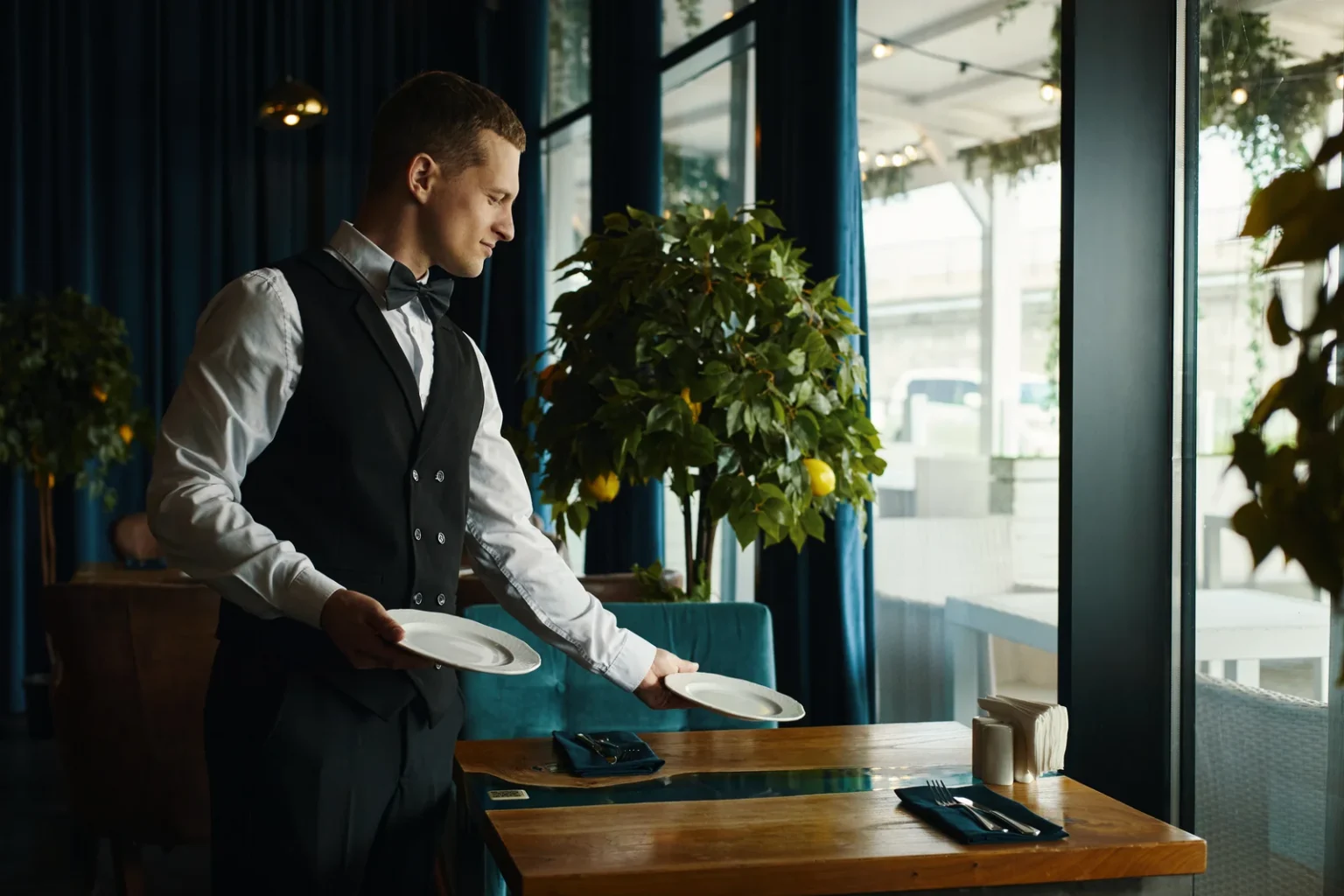
Service technique is the physical side of waiter skills. Practise the basics until they feel natural, because a nervous hand shows quickly in front of guests.
Start with these four:
- Tray handling: balance the weight, keep the tray flat and carry it at shoulder height with the free hand ready to open doors.
- Laying a cover: place cutlery, glass and napkin in the correct position for the menu being served.
- Serving and clearing: serve from the correct side, hold plates by the rim and clear only when everyone at the table has finished.
- Pouring and topping up: hold bottles with a cloth, pour without dripping and refill water before guests ask.
Repeat each drill with empty plates first, then with real service ware. Ask a senior to watch your grip and posture and give one correction at a time.
Why Is Memory One of the Most Underrated Waiter Skills?
Memory keeps orders accurate and tables calm. A waiter who remembers who ordered what, which guest wanted less spice and which table is waiting for water saves time and avoids errors.
Simple methods help trainees build memory:
- Number the seats: start from a fixed point, such as the seat nearest the door, and take orders in that order.
- Use short codes: write quick notes on the pad for dishes and special requests.
- Repeat each item aloud: hearing it again helps you hold it.
- Link guest to dish: attach a small detail, such as the guest in the blue shirt who wants no onion.
Dinesh, a trainee in a Chennai restaurant, mixed up two tables’ orders on his first busy night and had to apologise twice. His supervisor taught him to number the seats and repeat the order at the table. Within three weeks his order errors stopped, and the captain let him handle a section alone.
For a deeper view of how service steps fit together, read Adevo’s F&B service training guide, which explains how to teach each step to a new team.
Do Hygiene and Grooming Count as Waiter Skills?
They do, and guests judge them before anything else. Clean hands, a pressed uniform, tied-back hair and trimmed nails tell guests that the kitchen and the floor take care.
Build these habits from day one:
- Wash hands before service, after breaks and after handling money or waste.
- Hold glasses by the stem or base and plates by the rim.
- Keep tongs and serving spoons clean and use them instead of bare hands.
- Report spills, breakages and any illness before service starts.
- Note allergy details at the table and pass them to the kitchen at once.
Allergy handling deserves extra care. If a guest names an allergy, repeat it back, tell the kitchen immediately and deliver the dish yourself so the right plate reaches the right guest.
Which Waiter Skills Help You Handle Complaints?
Complaints test every other waiter skill at once. Listening, calm speech, quick action and teamwork all come into play.
Use this four-step response:
- Listen without interrupting: let the guest finish, then thank them for telling you.
- Apologise simply: say sorry for the problem, without blaming the kitchen or a colleague.
- Offer a fix: replace the dish, adjust the bill within your authority or call the captain.
- Follow up: return after a few minutes to check that the guest is happy.
Priyanka, a trainee at a hotel restaurant in Pune, froze when a guest complained that a dish was cold. Her captain showed her the four steps and stood beside her for the next complaint. By the end of the month she handled most issues alone, and guests began writing her name on feedback cards.
Want your trainees to practise these skills in a structured way? Talk to us about a short programme built around your own outlet and menu.
How Can Trainees Practise Waiter Skills Every Week?
Skills grow through repetition. A simple weekly plan keeps practice focused:
| Week | Focus | Practice |
|---|---|---|
| 1 | Grooming and greeting | Mirror check, greeting role-plays |
| 2 | Tray and cover skills | Empty-tray drills, laying covers |
| 3 | Order taking and memory | Seat numbering, repeat-back drills |
| 4 | Complaints and teamwork | Role-plays, handover practice |
Add a short review at the end of each week. Ask what felt hard, what improved and what to practise next.
To see how waiter skills connect to the full order of a meal, read the guide to the sequence of service in a restaurant, which shows what happens from seating to the bill.
How Should Managers Train Waiter Skills?
Train one skill at a time and make the standard visible. Show a photo of a correctly laid table, a sample order slip and a short greeting script. Let trainees practise in pairs, then give feedback the same day.
Pair each trainee with an experienced server for the first two weeks. Review mistakes without blame and praise specific improvements. Teams that learn this way become consistent faster, and consistency is what guests remember.
Conclusion
Waiter skills cover communication, service technique, memory, hygiene and teamwork, and each one can be learned with practice. Start with greeting and order accuracy, add tray and cover skills, then build calm complaint handling. Trainees who practise a little every day grow into captains and managers faster than those who rely on occasional classes.
Ready to build a stronger service team? Ask about Adevo’s F&B training for your outlet built around your menu and your guests.
Frequently Asked Questions: Waiter Skills
Q: What are the most important waiter skills?
A: The most important waiter skills are clear communication, accurate order taking, good memory, steady tray handling, hygiene and calm complaint handling. Attitude and listening matter as much as technique.
Q: How can a trainee improve waiter skills quickly?
A: Practise one skill at a time with short daily drills, ask a senior to give one correction per shift and role-play greetings and complaints. Weekly reviews help you see progress.
Q: Are soft skills part of waiter skills?
A: Yes. Listening, speaking, patience and teamwork shape how guests feel about a meal. Many hospitality courses teach communication and grooming alongside service technique.
Q: How do waiters remember orders without writing everything?
A: Number the seats, repeat each item aloud and link each dish to a small detail about the guest. Always write allergy details down, even if you remember the rest.
Q: Can waiter skills lead to a better career?
A: Yes. Strong waiter skills help trainees become captains, supervisors and outlet managers. Employers notice staff who stay calm, learn the menu and keep guests happy.