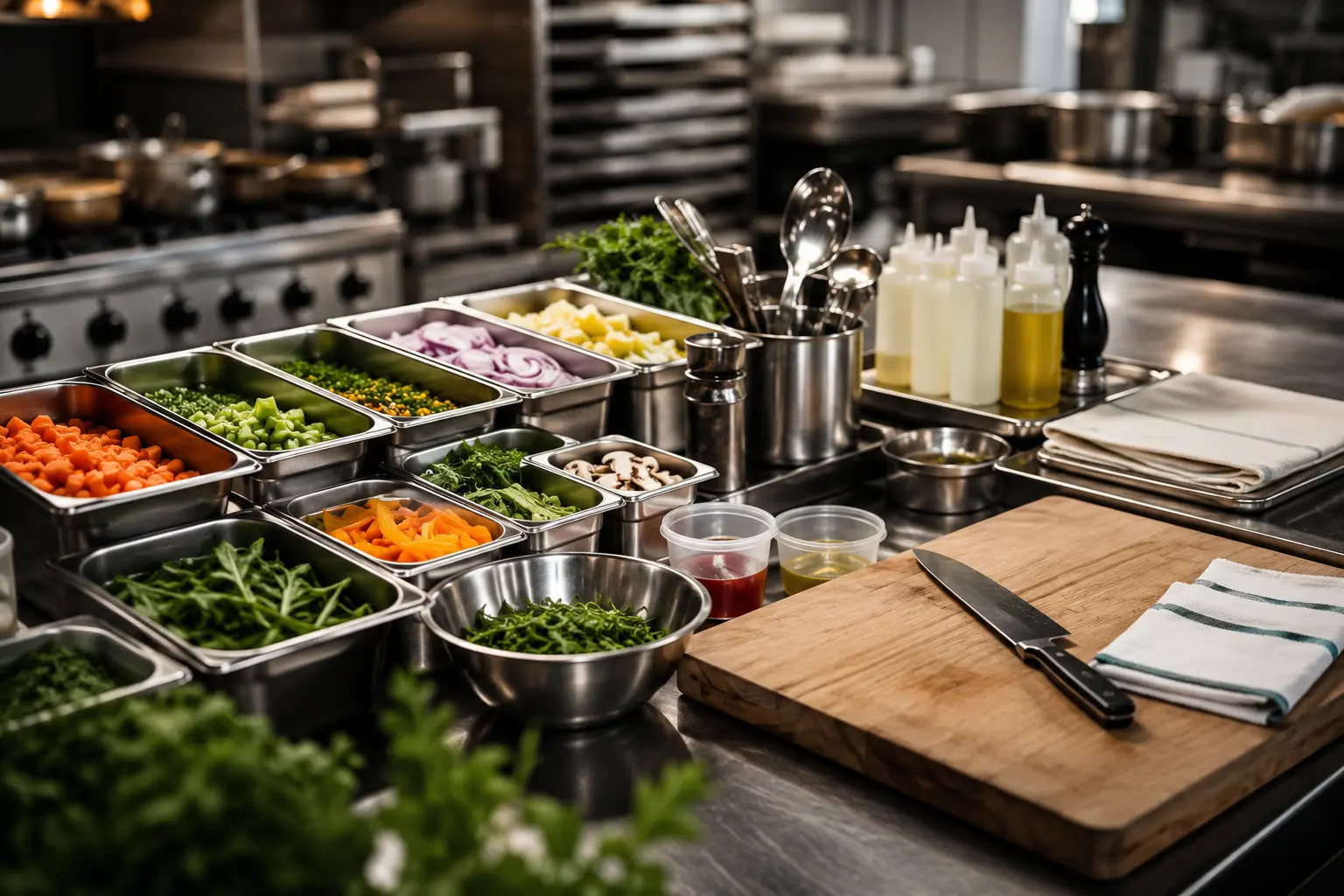
Walk into any professional kitchen two hours before service. The best ones are silent, organised, and ready. Every ingredient portioned. Every tool in reach. Every station set for what’s coming. That’s mise en place in action. If you’re training through hospitality management courses or working your way up the kitchen brigade, this is the first discipline you need to master – and the one that separates professional kitchens from chaos.
Mise en place isn’t just a French phrase for a culinary school poster. In a working Indian hotel kitchen running three to five cuisines simultaneously, it’s the operating system. Get it right, and 500 covers move smoothly. Skip it, and the first busy Saturday night will bury you.
This guide covers what mise en place actually means in a professional kitchen, how to practice it step by step, and why Indian hotel kitchens – with their multi-cuisine complexity and banquet-scale operations – need it more than any single-concept Western restaurant.
Key Takeaways
- Mise en place means “everything in its place” – but in professional kitchens, it’s a complete preparation system, not just ingredient organisation.
- Indian hotel kitchens running 3-5 cuisines simultaneously make mise en place exponentially more complex than Western single-cuisine setups.
- The 6-step process: read, organise station, gather ingredients, complete prep, label and store, clean as you go.
What Is Mise en Place? Meaning, Definition and Pronunciation
Mise en place (pronounced “meez on plahs”) is a French culinary term that translates literally to “everything in its place.” In a professional kitchen, mise en place means the complete preparation and organisation of ingredients, tools, and equipment before cooking begins.
The concept was formalised by Auguste Escoffier in the mid-19th century alongside the kitchen brigade system. Escoffier understood something that still holds true: a kitchen can’t function at speed unless every element is prepared, portioned, and positioned before the first order comes in.
But here’s what the textbook definition misses. Mise en place isn’t just about having your onions diced and your sauces ready. It’s a discipline. A way of thinking about kitchen work that starts before you pick up a knife and doesn’t end until your station is clean for the next shift. In professional kitchens, chefs who treat mise en place as a task get overwhelmed during service. Chefs who treat it as a habit run smooth operations.
The difference between “mise en place meaning” as taught in culinary school and mise en place as practiced in a working kitchen? About 300 covers and a banquet manager asking if the wedding dinner is on schedule.
Why Mise en Place Is the Foundation of Every Professional Kitchen
Mise en place determines whether your kitchen runs on control or on panic. There’s no third option.
Speed Without Rushing
A chef with complete mise en place doesn’t cook faster. They cook without interruption. No stopping mid-saute to search for salt. No walking across the kitchen for a ladle. No realising halfway through service that the stock wasn’t reduced. Every second spent searching or improvising during service is a second that breaks the flow for every station downstream.
Consistency Across Every Cover
When prep is standardised – same cuts, same portions, same sauce volumes – the food tastes the same whether it’s the 10th plate or the 200th. This is what hotel chains like Taj and Oberoi demand. A guest eating dal makhani on Monday should get the same dish on Friday. Mise en place is how that happens.
Safety and Hygiene
An organised station is a safe station. Knives in designated spots, not buried under towels. Hot pans on marked surfaces. Raw and cooked proteins separated before service starts, not sorted out during a rush. Cross-contamination incidents drop dramatically in kitchens that enforce mise en place before every shift.
Waste Reduction
Portioned prep means less waste. When you’ve measured exactly how much cream goes into each portion of pasta, you don’t end up with two litres left over at the end of service. In Indian hotel kitchens where food cost targets sit between 28% and 35% of revenue, mise en place is a cost control tool as much as a cooking tool.
How to Practice Mise en Place: Step by Step
Whether you’re a first-day commis or a CDP managing a station, the process is the same. Six steps, every shift, no shortcuts.
Read the full menu or recipe before touching anything. Know what you’re making, how many covers you’re prepping for, and what’s changed from yesterday’s menu. Check the banquet event order if you’re in a hotel kitchen. Surprises during service mean your mise en place failed.
Organise your station. Tools within arm’s reach. Cutting board positioned for your dominant hand. Bins for trim and waste on your non-dominant side. Towels folded and stacked. This takes five minutes and saves thirty during service.
Gather and measure all ingredients. Everything you need for the shift, pulled from cold storage, weighed, and placed on your station. If something is missing or short, you find out now – not at 7 PM when the walk-in is locked and the supplier has gone home.
Complete all prep work. Knife cuts done to specification. Marinades started on time. Par-cooking finished. Sauces portioned into service containers. This is where mise en place gets physical – the bulk of the work happens here.
Label, date, and store correctly. Every container gets a label with contents and date. This isn’t optional – it’s an FSSAI compliance requirement. Unlabelled food in cold storage is a food safety violation and a hygiene audit failure waiting to happen.
Clean as you go. Mise en place includes the state of your station, not just the food on it. Wipe down surfaces between tasks. Put tools back in position. Clear waste bins before they overflow. The chef who finishes prep with a clean station is the one who handles service without drowning.
This six-step mise en place process works whether you’re running a single station or coordinating prep across an entire kitchen.
Mise en Place in Indian Hotel Kitchens: Multi-Cuisine Complexity
Every article about mise en place assumes a single-cuisine Western kitchen. One menu. One flavour profile. One prep list. Indian hotel kitchens don’t work that way.
A five-star hotel kitchen in India might run a continental line, a tandoor station, a North Indian section, a Chinese wok station, and a bakery – all in the same service. Each cuisine has different prep requirements. The tandoor station needs marinated proteins hours in advance. The continental line needs reduced stocks and compound butters. The Chinese station needs wok-ready vegetables cut in a completely different style from the continental mise en place.
From managing multi-cuisine kitchen operations at properties across India, we’ve seen that the biggest mise en place failure in hotel kitchens isn’t laziness. It’s miscoordination. Station A finishes prep by 4 PM and sits idle. Station B is still scrambling at 6:30 PM because their proteins arrived late from the butchery. The Sous Chef who prevents this coordinates mise en place across ALL stations, not just their own. That’s the operational skill that gets noticed.
Banquet mise en place is another level entirely. An Indian wedding serving 800 covers across vegetarian, non-vegetarian, and Jain menus requires prep that starts two days before the event. The mise en place checklist for a single banquet can run to three pages. Portioning 800 servings of paneer tikka, 800 servings of dal, 400 servings of mutton – this is industrial-scale mise en place, and it’s where Indian hotel kitchens operate at a complexity no Western restaurant guide can teach.
The Kitchen Brigade System and Mise en Place
Mise en place and the kitchen brigade system were created together. Escoffier designed both to solve the same problem: how to feed hundreds of people efficiently from a single kitchen.
In the brigade system, mise en place responsibility flows down the hierarchy. The Executive Chef sets the menu and standards. The Sous Chef plans overall prep requirements and timelines. The Chef de Partie (CDP) owns their station’s mise en place – every item, every portion, every tool. The Commis does the actual prep work under the CDP’s direction.
Understanding this hierarchy matters for your career. A Commis who treats mise en place as a chore gets their onions diced and stops thinking. A Commis who understands the WHY behind their mise en place – that every cut, every portion, every label connects to a guest experience downstream – is the one who gets promoted to CDP.
If you’re building a career in culinary arts and want to run a kitchen rather than just work in one, mise en place is where your operational thinking starts. It’s the first skill that proves you understand kitchen management, not just cooking. For the full set of operational skills that build on mise en place discipline, read our guide on kitchen operations skills.
Mise en Place vs Mise en Scene: Kitchen vs Dining Room
Mise en place covers the kitchen. Mise en scene covers the dining room. Both mean “setting the stage,” but for different audiences.
Mise en scene in F&B service includes table layout, glassware positioning, napkin folding, condiment setup, and service station preparation. The front-of-house team runs through their own mise en scene checklist before every service, just as the kitchen team runs through mise en place.
Why does this matter for a chef? Because the two must sync. Your kitchen mise en place produces food at a certain pace and quality. The dining room mise en scene determines how that food is presented and served to the guest. When they’re out of alignment – kitchen ready but dining room behind, or tables turning faster than the kitchen can keep up – the guest experience breaks.
In Indian hotels, this coordination becomes critical during banquet events. The kitchen’s banquet mise en place and the banquet team’s mise en scene need to be planned together, not separately. If you’re interested in the service side of this coordination, Adevo’s Bakery & Confectionery Training covers F&B presentation standards alongside production skills.
Common Mise en Place Mistakes and How to Fix Them
Over-prepping. Preparing more than you’ll use means waste. Check cover counts and historical sales data before deciding quantities. A CDP who consistently over-preps by 20% is adding 20% to their station’s food cost.
Inconsistent cuts. If your brunoise is 3mm on one carrot and 6mm on the next, those carrots will cook at different rates. Mise en place means precision, not just completion. Practice cuts until they’re uniform without thinking about it.
Skipping labels and dates. It feels like unnecessary paperwork during a busy prep. It’s not. Unlabelled containers in cold storage are a food safety risk and an FSSAI violation. One inspection failure costs more than the 30 seconds each label takes.
Not cleaning as you go. Mise en place isn’t just food prep – it includes your station’s condition. A clean station during prep means a clean station during service. Let it slide during prep, and you’ll be fighting clutter during the dinner rush when you can least afford it.
Treating mise en place as a task instead of a discipline. The chef who does mise en place because they have to will always be slower than the chef who does it because they’ve internalised it. It’s the difference between following a checklist and running on instinct.
How to Train Your Kitchen Team on Mise en Place
Teaching mise en place to a team of 15 commis chefs – who might speak Hindi, Tamil, Kannada, and Malayalam – is a communication challenge as much as a training challenge.
We’ve found that visual SOPs work far better than written manuals in multilingual Indian kitchens. A laminated station setup card with photos showing exactly where each tool and container goes eliminates language barriers entirely. The commis doesn’t need to read English to see that the cutting board goes on the left and the mise en place containers line up in order on the right.
Daily pre-service station checks reinforce the discipline. The CDP walks the station before every service, confirms mise en place is complete, and flags anything missing. This takes three minutes per station. Those three minutes prevent 30 minutes of chaos during service.
The biggest training mistake we see? Teaching mise en place as a list of tasks instead of explaining the WHY. When a commis understands that their precise 200-gram chicken portion means the guest gets the same dish every time – and that consistency is what keeps the hotel’s online rating at 4.5 stars – they take mise en place seriously. Without the why, it’s just another instruction from the CDP.
Structured training programmes that cover mise en place as part of a broader kitchen operations curriculum can compress months of on-the-job learning. The fundamentals don’t change across properties, so training once transfers everywhere.
Your Next Step
Mise en place is where professional cooking begins. Not when you turn on the stove. Not when the first ticket prints. Two hours before service, when every ingredient is portioned, every tool is positioned, and every station is ready.
In Indian hotel kitchens – where multi-cuisine menus, multilingual teams, and 500-cover banquets are normal – mise en place isn’t a nice-to-have skill. It’s the operating system. The commis who masters it gets promoted. The CDP who teaches it to their team gets noticed. And the Sous Chef who coordinates it across every station in the kitchen is the one who becomes Head Chef.
Start with your own station. Run the six steps every shift until they’re automatic. Then look beyond your station and start thinking about how the entire kitchen’s mise en place fits together. That’s where the career shift from cook to kitchen manager begins.
Frequently Asked Questions
What does mise en place mean?
Mise en place is a French culinary term meaning “everything in its place.” In professional kitchens, it refers to the complete process of organising, preparing, and positioning all ingredients, tools, and equipment before cooking begins. It’s the preparation system that enables kitchens to serve hundreds of covers consistently and efficiently.
How do you pronounce mise en place?
Mise en place is pronounced “meez on plahs” – three syllables with the stress on “plahs.” The “s” in “mise” is voiced (like “z”), and the final “e” in “place” is silent. It comes from French, where it literally translates to “putting in place.”
What is the difference between mise en place and mise en scene?
Mise en place refers to kitchen preparation – organising ingredients, tools, and workstations before cooking. Mise en scene refers to dining room preparation – setting tables, positioning glassware, folding napkins, and preparing service stations. Both are “setting the stage,” but mise en place covers back of house and mise en scene covers front of house.
Why is mise en place important in a professional kitchen?
Mise en place determines a kitchen’s speed, consistency, safety, and cost efficiency. Without it, chefs waste time searching for ingredients during service, portion sizes vary, cross-contamination risks increase, and food costs rise from waste. In Indian hotel kitchens running multiple cuisines simultaneously, mise en place is the only system that prevents operational breakdown during high-volume service.
What are the steps of mise en place?
The six steps of mise en place are: (1) read the full menu and check cover counts, (2) organise your station with tools in reach, (3) gather and measure all ingredients, (4) complete all prep work including cuts, marinades, and par-cooking, (5) label, date, and store all prepped items correctly, and (6) clean your station as you go.
Can you practice mise en place at home?
Yes. The principles translate directly to home cooking. Before starting a recipe, read it completely, gather all ingredients, measure portions, complete prep work (chopping, marinating), and set up your workspace. Home cooks who practice mise en place report faster cooking times, fewer mistakes, and less stress. The discipline transfers from professional kitchens to any cooking environment.