India’s tourism and hospitality sector is expected to yield revenue exceeding US$ 59 billion by 2028, according to IBEF. Behind that growth sits a massive, unmet need for trained cooks. Yet only 1% of the 5.8 million people entering this workforce have any real culinary arts training at all (THSC Skill Gap Study, 2024). That gap between what hotels need and what the market supplies is the defining fact of Indian culinary arts today, and it is the single biggest opening for anyone stepping into the trade. If you’re exploring hospitality management courses or weighing a move into professional kitchens, this guide walks through culinary arts from training routes to career growth to real kitchen mastery. We are Adevo, built by operators with 80-plus years across Taj, Oberoi, and Le Meridien kitchens, and this is the guide we wish we’d had when we started out.
Key Takeaways
- Culinary arts covers cooking skill, kitchen operations, food safety, team leadership, and running a business, not just cooking food.
- India has 490-plus culinary colleges, but quality swings wildly, and NSDC/THSC accreditation is the one credential that opens five-star doors.
- The kkitchen brigade goes from Commis (Rs 10,000/month) to Executive Chef (Rs 4 lakh+/month), and the biggest salary jump lands at CDP-to-Sous. Structured Leadership and Management Skills training at CDP and Sous Chef level shortens that climb by a good stretch.
- Specialising in Indian regional food, pastry, or vegetarian and Jain cooking carries tangible salary premiums, and demand for all three keeps climbing.
What Are Culinary Arts?
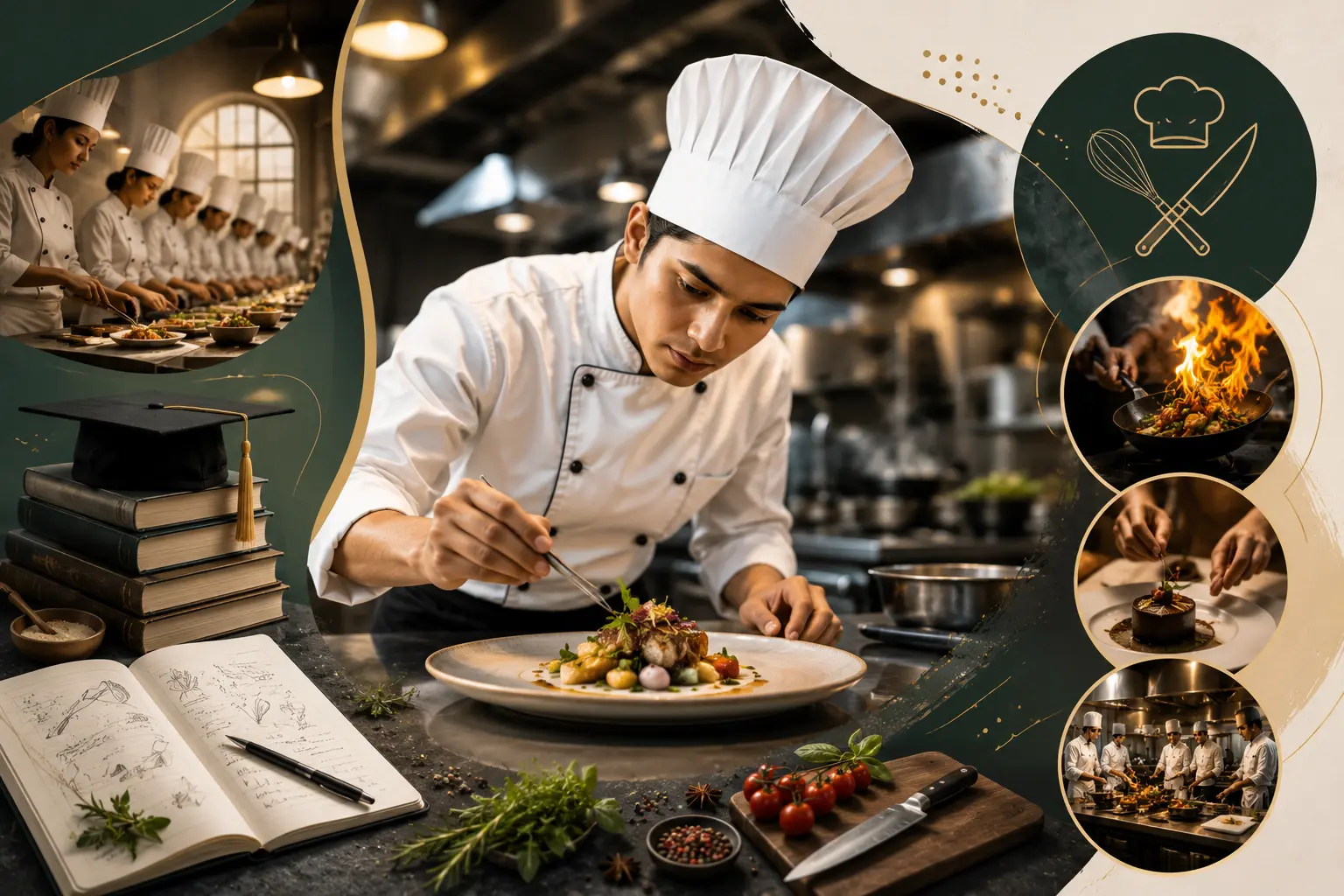
Culinary arts is the professional field of preparing, cooking, plating, and serving food. The word comes from the Latin culinarius, “of the kitchen.” But on the job, culinary arts reaches well past cooking itself. It pulls in food science, nutrition, kitchen management, menu design, food safety, and the business side that keeps restaurants and hotel kitchens running, and that distinction matters, since a home cook makes meals, while a professional runs a food production system: sourcing, costs, a kitchen team, hygiene, all at once, and in Indian hotel kitchens, one service might cover continental, Indian regional, Chinese, tandoor, and bakery sections together, so culinary arts is as much an operating discipline as a creative one, and it was Auguste Escoffier who built modern culinary arts into shape in the mid-1800s by inventing the kitchen brigade system and setting down mise en place, the prep method every professional kitchen still runs on today. His framework turned cooking from a loose craft into a concrete profession, complete with set roles, career ladders, and quality standards.
Today, India’s culinary arts craft is growing fast, and demand keeps outrunning supply at every rung, from entry-level cooks up to executive chefs. Whether you’re 18 and picking a path straight after 12th, or 30 and thinking about a jump from IT into the kitchen, knowing what the cooking trade really involves is the first genuine step toward a career that is hard, creative, and paying better each year. Kitchens reward grit and humility over flair.
How Has the Culinary Arts Landscape in India Changed?
India’s culinary arts world has shifted hard over the last decade, moving well past five-star restaurants and standalone dhabas. Cloud kitchens, food delivery apps, airline and railway catering, and the booming wedding trade have all opened fresh demand for trained cooks.
Three forces are shaping professional cooking in India right now.
The training gap. Formally trained candidates remain rare, and hotels say a skilled kitchen manager is harder to find than a skilled cook. That shortfall opens ground for anyone who invests in floor skill.
The rise of Indian regional food: for decades, the culinary trade in India leaned Continental and French, but that’s changing, and premium restaurants now dig into Chettinad, Awadhi, Malvani, and Kashmiri styles, where chefs who go deep earn premiums Continental-only cooks do not see.
Tech and scale. Cloud kitchens and food-tech platforms have opened paths that did not exist five years back, and a chef who gets both cooking and tech has options past generations never had.
We have trained staff across 50-plus properties in India, and demand for skilled graduates beats supply at every level. Hotels are not short on applicants, only on ones who can run a station, manage food cost, and lead a team.
What Does Culinary Arts Education in India Cover?
Culinary education in India is a patchwork: over 490 colleges run programmes, and quality swings wildly, so knowing your options, and which credentials count, is the single biggest call you will make.
Certificate Courses (3-6 Months)
Short-term courses teach the basics: knife skill, core methods, food safety, and a cuisine or two, for Rs 50,000 to Rs 1,50,000. These fit career switchers and cloud kitchen owners, but most carry no NSDC/THSC accreditation, which caps your hotel options later.
Diploma Programmes (9-12 Months)
Most hotel kitchen careers run through this path. An NSDC/THSC-accredited diploma gives 70%-plus hands-on training, a real internship, and the credential five-star HR teams look for, at Rs 1-5 lakh. Graduates enter at Commis Grade 1 (Rs 15,000-18,000/month) instead of Grade 3 (Rs 10,000-13,000).
BHM Degree (3-4 Years)
A Bachelor of Hotel Management spans cooking skill alongside F&B, front office, and strategy. Government IHMs charge Rs 3-6 lakh; private institutes extend to Rs 5-15 lakh. This fits a management-track career with a shot abroad.
Food Safety Certifications
FOSTAC, FSSAI’s official programme, is mandatory across all food businesses, one certified Food Safety Supervisor per 25 handlers. Past FOSTAC, HACCP and ISO 22000 carry weight for cooks aiming at Executive Chef.
The single largest factor across every path? Accreditation. NSDC or THSC recognition opens five-star doors; a brand-name institute without it caps you at standalone restaurants and QSRs, a different track entirely.
What Core Culinary Arts Skills Do Employers Expect?
Kitchen training demands both hands-on skill and a sharp read on operations. Technical skill gets you hired. Operational sense is what gets you promoted.
Kitchen Technique and Cuisine Knowledge
The base layer: knife skills, heat and cooking method, sauce work, protein prep, baking and pastry basics, stretched further by multi-cuisine work, since a five-star chef often juggles Indian, Continental, and Pan-Asian food in one single service.
Mise en Place: The Operating System of Professional Cooking
Mise en place, French for “everything in its place,” is the prep discipline that makes a kitchen truly run: reading the menu, setting up your station, measuring ingredients, finishing prep, storing it right, and cleaning as you go. Running five cuisines side by side makes it far more complex than in a single-cuisine kitchen.
Food Safety and Hygiene
A trained cook manages compliance across a whole team: FSSAI rules, HACCP setup, temperature control, cross-contamination, and India-specific headaches like monsoon damp and keeping veg and non-veg apart.
Kitchen Operations Management
Here cooking turns into a management job: workflow, keeping food cost within target, stock, a multi-language team, and the pass with front-of-house. Chefs who build these skills are the ones who jump from CDP to Sous Chef, the biggest pay leap in the craft.
Across India, the cooks who climb fastest are rarely the most gifted at the stove. They build strong teams, hold food cost tight, and fix problems before a guest sees them.
Soft Skills
Talking clearly across several languages. Handling conflict mid-service, under actual pressure. Coaching new hires. Taking guest feedback without getting defensive. These soft skills are the hidden layer that splits a career CDP from a Sous Chef earning three times as much.
Explore Adevo’s Kitchen Operations & Culinary Training for structured programmes that build these operational and soft skills alongside honest cooking technique.
How Does the Culinary Arts Career Ladder Work in India?
The kitchen brigade system, Escoffier’s brigade de cuisine, sets the shape of every culinary career path in India, and knowing it gives you solid, grounded expectations about timelines and pay, laid out below
| Role | Experience | Monthly Salary | What You Do |
|---|---|---|---|
| Commis Grade 3 | 0-1 year (certificate) | Rs 10,000-13,000 | Basic prep, learning stations |
| Commis Grade 1 | 0-1 year (diploma) | Rs 15,000-18,000 | Station work, some autonomy |
| Chef de Partie (CDP) | 2-4 years | Rs 20,000-40,000 | Own a station, train commis |
| Sous Chef | 4-7 years | Rs 45,000-90,000 | Second in command, menu planning |
| Head Chef | 7-12 years | Rs 80,000-1,80,000 | Full kitchen responsibility |
| Executive Chef | 12+ years | Rs 1,50,000-4,00,000+ | Multi-outlet oversight, P&L |
The first two years run tight on money, a Commis in Mumbai on Rs 15,000 sits below the city’s comfort line, but the curve climbs sharply past CDP. From Sous Chef up, service charge adds Rs 8,000-25,000 on top of base pay, a piece many guides skip.
The single biggest jump sits right at CDP-to-Sous. A CDP on Rs 35,000 can jump to Rs 60,000-plus. It rides less on cooking skill and more on whether you can hold food costs, lead 15 people, and sync with service through a 500-cover banquet.
At Executive Chef level in chains like Taj, Oberoi, and ITC, total pay can clear Rs 4 lakh a month once you count base salary, service charge, housing, and meals.
Which Culinary Arts Specialisations Are in Highest Demand?
- Continental and European cuisine, the traditional five-star track, still the strongest route abroad.
- Indian regional cooking (Chettinad, Awadhi, Malvani), high and rising demand, with authentic premiums over Continental-only cooks.
- Bakery and pastry, its own track inside the brigade, commanding a real pay premium over hot-kitchen chefs.
- Vegetarian and Jain cooking, uniquely strong demand for big events and weddings, growing fast in tier-2 cities.
- Institutional and bulk cooking (QSRs, airline catering, railway work), high-volume, steady, with clear career ladders.
How Do You Start a Culinary Arts Career in India?
- Pick your entry point. After 10th (craft certificate), after 12th (diploma or degree), or as a career switcher at any age.
- Finish an accredited programme. An NSDC/THSC-linked diploma is the path most hotel careers run through, so check accreditation before you sign up.
- Build technical and soft skill side by side. Cooking skill gets you hired; talk and leadership get you promoted.
- Treat your internship like a six-month job interview. Hotels fill most Commis openings straight from their intern pool.
- Climb the brigade with intent. Commis, then CDP, then Sous Chef, then Head Chef, then Executive Chef, building real skill at each rung.
What Mistakes Do Culinary Arts Students Make in India?
- Picking a course by name, not accreditation. An Instagram-worthy campus does not open five-star doors. NSDC/THSC accreditation does.
- Ignoring operations. Skill gets you hired at Commis level; food costs, leadership, and floor sync get you promoted past it.
- Underrating the first two years. Low pay and tough hours push many talented people out. The ones who stay end up running kitchens.
- Skipping food safety training. FSSAI rules are not optional. A FoSTaC-certified chef stands out at every shortlist.
- Only chasing metro cities. Goa, Jaipur, Kochi, and Chandigarh offer real growth with far less competition.
Frequently Asked Questions: Culinary Arts in India
Q: What are professional kitchen training? A: Culinary arts is the craft of preparing, cooking, plating, and serving food, reaching into food science, menu design, food safety, and kitchen business. In India, careers span five-star hotels, standalone restaurants, cloud kitchens, and catering firms.
Q: Is a culinary career a good career in India? A: Yes. India’s hospitality sector is growing fast, and formally trained cooks remain rare. Pay starts modest, but the climb from Commis to Executive Chef opens a path to Rs 1.5-4 lakh a month over 12 to 15 years, and the gap between demand and supply gives trained cooks real weight in this job market.
Q: What qualifications do I need for kitchen training? A: A 9 to 12 month diploma with NSDC/THSC accreditation is the floor for hotel careers. Certificate courses (3 to 6 months) fit entrepreneurship, a BHM degree (3 to 4 years) targets management, and FOSTAC food safety certification is mandatory across every commercial kitchen.
Q: How much do chefs earn in India? A: Pay ranges from Rs 10,000 a month (Commis G3) up to Rs 4 lakh-plus (Executive Chef, five-star chains), with Chef de Partie at Rs 20,000-40,000 and Sous Chef at Rs 45,000-90,000 plus Rs 8,000-25,000 in service charge. Pastry chefs fetch a real premium over hot-kitchen chefs at the same level.
Q: What is the difference between this craft and hotel management? A: Culinary training zeroes in on food prep, cooking technique, and kitchen operations, while hotel management spans the wider business: front office, housekeeping, F&B, and strategy. A BHM degree folds culinary training in as one piece of a bigger picture.
Q: Can I study culinary arts after 12th? A: Yes. After 12th, you can take a culinary diploma (9 to 12 months), a B.Sc in the cooking trade (3 years), or a BHM degree (3 to 4 years). The diploma route gets you into hotel kitchens fastest. IHM Pusa, CAI Hyderabad, Symbiosis Pune, and ICI Tirupati rank among the top culinary schools in India, and our guide to how a professional kitchen brigade is structured is worth reading once you pick a school, so you know exactly where each rung on the ladder leads.
Your Next Step
Culinary arts in India stands at a real turning point. The trade is growing fast. The training gap means qualified cooks face almost no real competition. And the career climb, from Rs 15,000 at Commis to Rs 4 lakh-plus at Executive Chef, is steeper than most trades ever offer.
Start with accreditation. Build technical skill right alongside operational and soft skill. Get through the first two years with patience and a clear reason why. This trade rewards the ones who treat it as a real discipline, not just a job.
The kitchen is waiting. The only question left is whether you are ready to take kitchen training as seriously as it actually demands.