
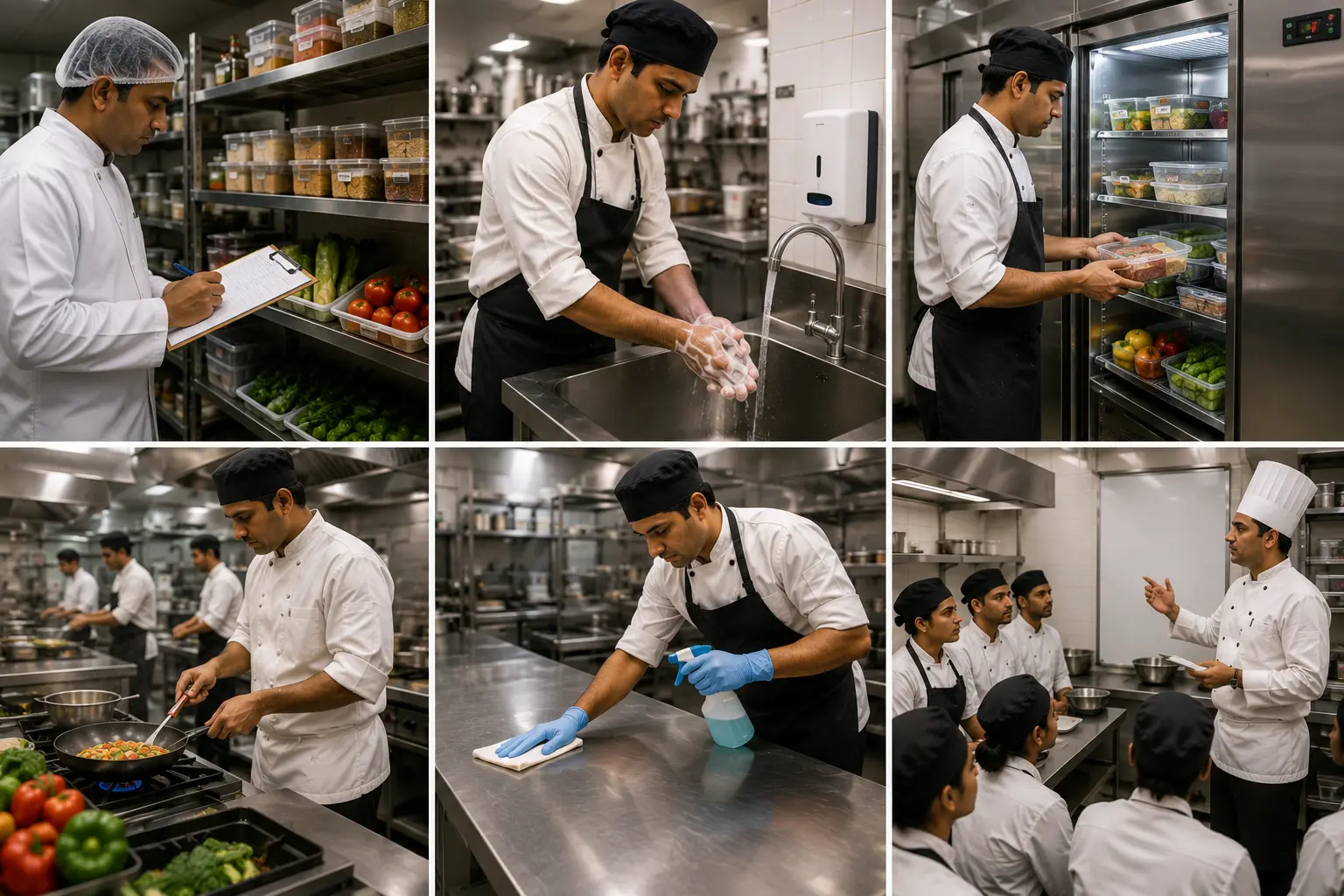
A single FSSAI inspection can shut a kitchen down in an afternoon. Most owners treat food safety standards in India as a license to obtain once and forget, not a system that has to run correctly every single service. This guide covers the regulations, the standards behind them, and what compliant practice actually looks like on the floor and in the kitchen, including the online skill development courses that turn a license on the wall into daily practice.
Key Takeaways
– Operating a food business without an FSSAI license carries imprisonment up to 6 months and a fine up to ₹5 lakh under Section 63 of the FSS Act, 2006.
– GMP (Good Manufacturing Practices) governs premises, equipment, and process flow under Schedule 4 of the FSS Regulations.
– A Food Safety Management System (FSMS) is a structured system your staff run daily, not a certificate bought once.
– Compliance is sustained by trained staff following SOPs, not by the license itself.
What Are Food Safety Standards in India?
Food safety standards in India are the set of legal requirements and operational practices, established under the Food Safety and Standards Act, 2006 and enforced by FSSAI, that govern how food businesses handle, store, prepare, and serve food safely. They cover everything from who needs a license to how hot food must be held during service.
The Food Safety and Standards Act, 2006 and FSSAI’s Role
The FSS Act, 2006 consolidated India’s earlier, fragmented food laws into a single framework and created the Food Safety and Standards Authority of India (FSSAI) as the body responsible for setting food safety standards in India and enforcing them nationally.
Who Needs FSSAI Registration or a License?
Every food business operator in India, from a roadside stall to a five-star hotel kitchen, needs either a Basic Registration, a State License, or a Central License, depending on annual turnover and scale of operation. There is no exemption for “informal” or small-scale food service — licensing is one of the food safety standards in India that applies uniformly, regardless of business size.
What License Type Does Your Restaurant or Hotel Need?
Basic Registration vs. State License vs. Central License
Basic Registration applies to the smallest operators, a State License to mid-size single-state businesses, and a Central License to large or multi-state operations. The correct tier depends on annual turnover, and getting it wrong is one of the most common compliance failures FSSAI inspectors flag. India’s Ministry of Food Processing Industries works alongside FSSAI on the wider regulatory and formalisation push this licensing structure sits inside.
Renewal Timelines and What Happens If You Miss One
Licenses and registrations aren’t a one-time formality — Central and State Licenses run on multi-year validity periods that a business chooses at the time of application, and a lapsed license puts a food business in the same position, legally, as one that never applied at all. Building license renewal into a fixed operational calendar, rather than reacting to an expiry notice, avoids the gap entirely.
What Is GMP in the Food Industry, and Why Does It Matter?
Good Manufacturing Practices Under Schedule 4 of the FSS Regulations
GMP (Good Manufacturing Practices) is the set of hygiene and process standards a food business must follow, laid out under Schedule 4 of the FSS Regulations, covering everything from premises design to raw material handling to finished product storage. It’s the operational backbone every FSSAI inspection checks against, and it’s one of the core food safety standards in India that inspectors verify whether or not they name it explicitly.
GMP in the Kitchen: Premises, Equipment, and Process Flow
In practice, GMP means a kitchen laid out to prevent raw and cooked food from crossing paths, equipment maintained and cleaned on a fixed schedule, and staff who follow a consistent process flow from receiving to plating — not habits that shift depending on who’s on shift. (See GMP in the Food Industry for the full breakdown of Schedule 4 requirements.)
What Is a Food Safety Management System (FSMS)?
HACCP, ISO 22000, and India’s IndiaGHP/IndiaHACCP Schemes
A Food Safety Management System is a structured, documented approach to identifying and controlling food safety risks at every stage of preparation. HACCP (Hazard Analysis and Critical Control Points) and ISO 22000 are the internationally recognized frameworks; India’s own IndiaGHP and IndiaHACCP certification schemes adapt these food safety standards in India for local food businesses. (For a full step-by-step build guide, see Food Safety Management System for Restaurants and Hotels.)
Building an FSMS Your Staff Can Actually Follow
An FSMS only works if the people running the kitchen understand why each control point exists, not just that a checklist requires it. A system built around a checklist nobody was trained to interpret fails the first time an untrained staff member covers an unfamiliar shift.
What Are the Most Common Reasons Restaurants Fail an Inspection?
Most inspection failures aren’t dramatic contamination events — they’re small, preventable gaps that compound:
- A temperature log filled in at the end of a shift instead of in real time
- A pest-control schedule that was posted once and never checked on again
- A newly hired cook who was shown the handwashing station on day one and never observed doing it correctly since
None of these require negligence, just the absence of a system that catches small lapses before an inspector does.
Documentation Gaps vs. Operational Gaps
Inspectors distinguish between two failure types: documentation gaps, where the practice is happening but isn’t recorded, and operational gaps, where the practice itself isn’t happening consistently. Documentation gaps are usually the easier fix — a missing log format, not a missing habit. Operational gaps are the more serious flag, because they mean the food safety standards in India the business claims to follow were never actually built into daily routine, only assumed.
What Do FSSAI Inspectors Actually Check?
Storage Temperatures and Cross-Contamination Controls
FSSAI’s Schedule 4 guidance places hot food above 60°C and cold food below 5°C — the range in between is the temperature danger zone where bacteria multiply fastest. These are among the food safety standards in India inspectors check most directly, along with whether raw and cooked items are stored and prepared separately. (For the full checkpoint framework behind these checks, see Quality Control in the Food Industry.)
Personal Hygiene and Pest Control Standards
Handwashing protocol, uniform cleanliness, and documented pest-control schedules are all standard inspection checkpoints — small, easily overlooked details that are also among the easiest to fail an inspection on. (See Personal Hygiene in the Food Industry for the full standards and a ready-to-use checklist.)
What Happens If You’re Not Compliant?
Penalties Under the FSS Act
Operating a food business without the required license carries imprisonment for a term which may extend to six months and a fine which may extend to five lakh rupees, under Section 63 of the Food Safety and Standards Act, 2006. Ignoring food safety standards in India at this level isn’t a paperwork risk — it’s a criminal liability. Selling unsafe food carries separate, more severe penalties depending on whether it causes injury.
The FSSAI Hygiene Rating Scheme (Voluntary but Valuable)
FSSAI’s Hygiene Rating Scheme lets a food business display a voluntary 1-to-5-star rating based on an independent hygiene audit. It isn’t mandatory, but it’s a visible trust signal for guests and a useful internal benchmark for tracking hygiene standards over time, separate from license renewal. (For a full breakdown of what a formal audit covers and who conducts it, see Food Safety Audit for Restaurants and Hotels.)
How Do You Keep Compliance Current Year-Round, Not Just Before an Inspection?
Building an Internal Compliance Calendar
Treating license renewal, hygiene rating renewal, staff medical checkups, and equipment maintenance as calendar events — not reactive tasks triggered by a deadline notice — is what keeps a kitchen ahead of food safety standards in India instead of scrambling every time an inspection is announced. A named person responsible for the calendar, even in a small operation, is what makes it actually get followed rather than quietly slip.
Why “Passing Last Time” Doesn’t Mean Compliant Now
A kitchen that passed its last inspection can still drift out of compliance in the months between visits — a new hire who skipped onboarding, a maintenance issue that was patched instead of fixed, a supplier switch that wasn’t checked against the same standards as the last one. Meeting food safety standards in India isn’t a status you achieve once; it’s a standard a kitchen either keeps running or doesn’t, inspection or no inspection.
How Do You Build a Culture of Compliance, Not Just a License?
A license proves you applied. A trained team proves you comply — every day, not just on the day an inspector visits. The gap between the two is exactly where most food safety failures happen: not from ignorance of the rules, but from staff who were never trained to execute them consistently under service pressure. Adevo’s food and beverage training courses build FSSAI-aligned hygiene and food safety practice directly into staff onboarding and ongoing refreshers, so compliance survives staff turnover instead of walking out the door with whoever trained on it first.
For a deeper look at building staff-level food safety discipline, see Adevo’s guide to food allergen training for restaurant staff.
FAQ
Q: What are food safety standards in India based on?
A: The Food Safety and Standards Act, 2006, enforced by FSSAI, along with Schedule 4 GMP requirements and structured food safety management systems like HACCP and IndiaGHP/IndiaHACCP.
Q: What license does a restaurant need under FSSAI?
A: Basic Registration, a State License, or a Central License, depending on annual turnover and scale — the wrong tier is a common compliance failure.
Q: What is GMP in the food industry?
A: Good Manufacturing Practices, the Schedule 4 hygiene and process standards covering premises, equipment, and process flow that every FSSAI inspection checks against.
Q: What is a food safety management system?
A: A structured, documented system for identifying and controlling food safety risks at every stage, built on frameworks like HACCP, ISO 22000, or India’s IndiaGHP/IndiaHACCP schemes.
Q: What is the penalty for operating without an FSSAI license?
A: Imprisonment up to six months and a fine up to ₹5 lakh under Section 63 of the FSS Act, 2006, for manufacturing, selling, storing, or distributing food without the required license.
Q: What temperature should hot and cold food be held at?
A: Hot food above 60°C and cold food below 5°C, per FSSAI’s Schedule 4 guidance — the range between is the danger zone where bacteria multiply fastest.
Conclusion
Meeting food safety standards in India is a system, not a certificate. GMP and FSMS give you the framework; trained staff are what make that framework hold up on a busy Saturday, not just on inspection day.
Book a free demo of Adevo’s F&B training modules to build food safety compliance that survives staff turnover.