
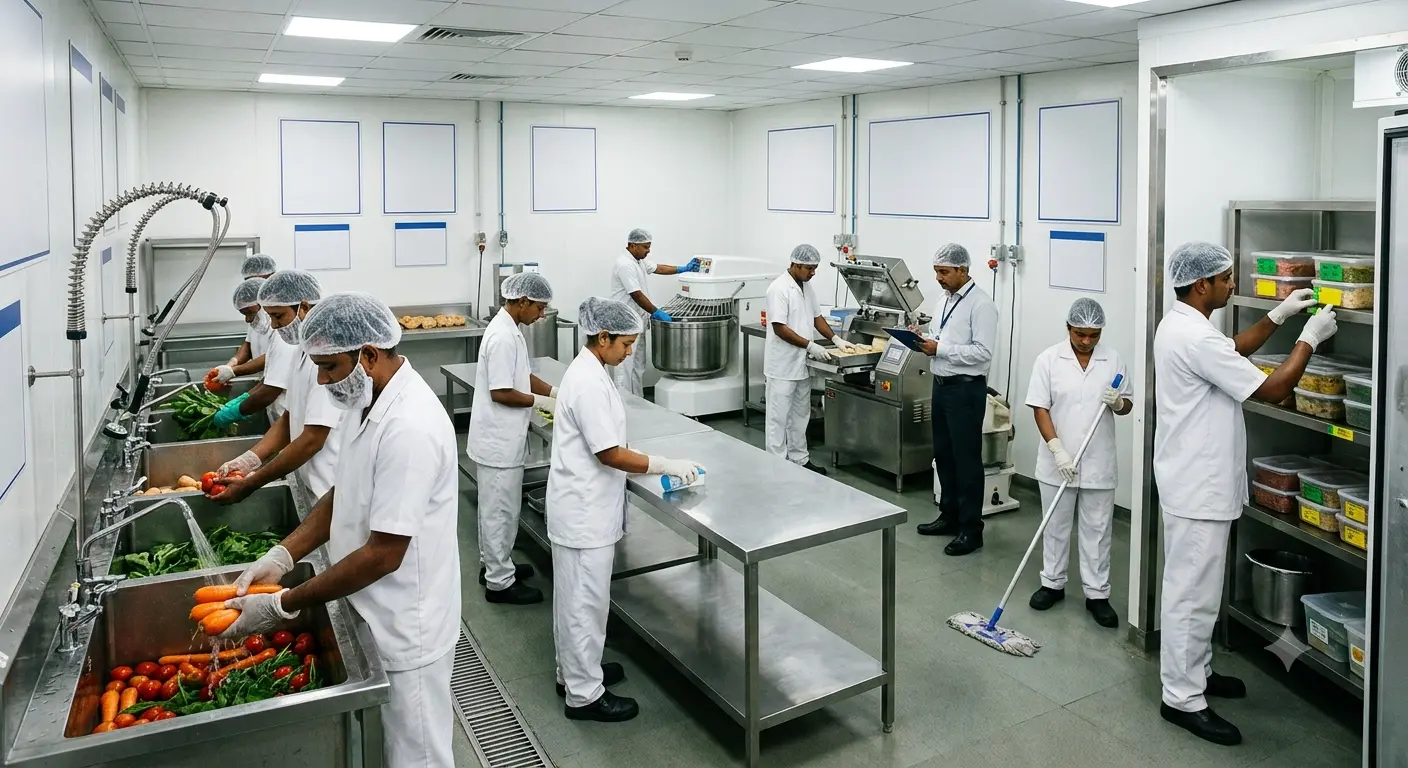
An audit failure isn’t really a paperwork problem — it’s a training gap that finally became visible. Most owners scramble to prepare in the week before an audit instead of running audit-ready operations year-round. This guide breaks down what a food safety audit actually covers, who conducts it, and how hospitality management courses build the kind of daily discipline that makes “preparing for an audit” unnecessary. It builds directly on the standards covered in Food Safety Standards in India.
Key Takeaways
– Failing to comply with a Food Safety Officer’s direction carries a penalty up to ₹2 lakh under Section 55 of the FSS Act, 2006.
– Since August 2019, FSSAI Central License holders in high-risk sectors — including large-scale caterers, hotels, and restaurants — must undergo annual third-party audits.
– Audits cover licensing, premises, personal hygiene, temperature control, and documentation, scored against FSSAI’s inspection matrix.
– Audit readiness is really staff-training readiness — the audit just measures whether that training held up.
What Is a Food Safety Audit?
It’s a formal, structured assessment of a food business’s compliance with FSSAI’s hygiene, safety, and documentation standards, conducted either by a government inspector, an FSSAI-recognized third-party agency, or internally by the business itself.
What Does This Compliance Check Cover in Indian Restaurants and Hotels?
Four areas get checked every time:
- Licensing and documentation — correct license tier, training logs, temperature logs, pest control schedules
- Premises, pest control, and water quality — kitchen layout, waste disposal, water source
- Personal hygiene and food handling — handwashing, uniforms, staff health records
- Temperature control — hot/cold holding, logged in real time not retroactively
License and Documentation Checks
During a food safety audit, auditors verify the correct license tier is held and current, along with records proving ongoing compliance — training logs, temperature logs, and pest control schedules, not just the license certificate itself.
Premises, Pest Control, and Water Quality
Kitchen layout, waste disposal, pest-control documentation, and water source quality are all checked against FSSAI’s Schedule 4 GMP standards.
Personal Hygiene and Food Handling Practices
Handwashing protocol, uniform standards, and staff health records are checked directly — often through observation during service, not just document review.
Temperature Control and Monitoring
Hot and cold holding temperatures, and whether they’re actually logged in real time rather than filled in retroactively, are a standard audit checkpoint.
Who Conducts This Kind of Compliance Check — FSSAI, Third-Party Agencies, or Internal Teams?
When a Third-Party Audit Is Mandatory vs. Voluntary
Since August 2019, FSSAI Central License holders in high-risk sectors — including large-scale caterers, hotels, and restaurants — must undergo third-party audits annually. State License and Basic Registration holders aren’t subject to this mandatory cycle, though running voluntary internal audits is still good practice.
How FSSAI-Recognised Auditing Agencies Are Selected
A valid food safety audit must be conducted by agencies FSSAI has formally recognized and empanelled — a business can’t simply hire any consultancy and call the result a compliant third-party audit.
How Are Indian Food Safety Standards and GMP Connected to Audit Outcomes?
An audit is essentially a structured verification of whether GMP and hygiene standards, covered under Schedule 4, are actually being followed day to day. A kitchen that treats GMP as a documentation exercise rather than daily practice is the kitchen most likely to fail an audit on exactly the items it assumed were “handled.”
How Should Hotels and Restaurants Prepare for This Kind of Inspection?
Build an Internal FSMS Team and Appoint an Internal Auditor
A named internal auditor, even in a smaller operation, creates accountability for keeping the FSMS current between official audits rather than letting it lapse until the next scheduled visit.
Run Mock Audits Using the FSSAI Checklist Format
Running an internal mock food safety audit against the same checklist categories an official auditor uses catches gaps while they’re still cheap to fix.
Train Staff on Hygiene, GMP, and Documentation Discipline
Every checkpoint an audit measures — hygiene, temperature logs, documentation — depends on a staff member who was actually trained to execute it, not handed a policy to read once. Adevo’s Food and Beverage training courses build that discipline into onboarding and refreshers, so it holds up whether or not an inspector is scheduled that week.
What Do Auditors Check First — The Highest-Risk Areas in an FSSAI Inspection
Food Safety Officers conducting routine inspections typically prioritise the areas with the highest risk of foodborne illness, which means the beginning and end of the cold chain get the most scrutiny:
- Temperature records — the first physical check is usually whether temperature logs are present, current, and filled in correctly, not retroactively
- Staff hygiene at the point of service — uniform cleanliness, handwashing access, and whether staff handling ready-to-eat food hold the medical certificates they are required to maintain
- Storage layout and labelling — whether raw protein is stored below ready-to-eat items, and whether stock is date-labelled with FIFO visible in practice, not just policy
- Pest control evidence — active contract with a licensed operator, recent service records, and no visible evidence of pest activity in food storage or prep areas
These are not arbitrary priorities — they represent the specific failure points FSSAI’s own enforcement data shows cause the most food safety incidents in Indian food service operations. Getting these four areas audit-ready as a year-round standard, rather than a pre-inspection exercise, is what distinguishes operations that pass consistently from those that scramble each cycle.
What Happens After the Audit — Grading, Penalties, and Corrective Action?
Failing to comply with a Food Safety Officer’s direction carries a penalty which may extend to ₹2 lakh under Section 55 of the FSS Act, 2006, confirmed via the Act’s own text — separate from license-specific penalties covered elsewhere in the Act. Most audits also require a documented corrective action plan for any non-compliant item, with a follow-up timeline to verify the fix actually held.
FAQ
Q: What is a food safety audit for restaurants and hotels?
A: A formal assessment of compliance with FSSAI hygiene, safety, and documentation standards, conducted by FSSAI, an FSSAI-recognized third-party agency, or an internal team.
Q: Who conducts these compliance checks in India — FSSAI or private agencies?
A: Both — FSSAI conducts direct inspections, while FSSAI-recognized third-party agencies conduct the mandatory annual reviews required of high-risk Central License holders.
Q: Is a third-party compliance review mandatory for all restaurants?
A: No — it’s mandatory since August 2019 specifically for Central License holders in high-risk sectors, including large-scale caterers, hotels, and restaurants.
Q: What is GMP in the food industry and how does it affect an audit outcome?
A: GMP sets the facility and process standards under Schedule 4 that inspections directly verify — most failures trace back to a GMP standard that wasn’t actually being followed daily.
Q: How often should a hotel run an internal compliance check?
A: Quarterly at minimum for high-risk operations, so gaps are caught well before the next mandatory or official review cycle.
Q: What happens if a restaurant fails its FSSAI audit?
A: A documented corrective action plan is required, with a follow-up timeline; failing to comply with a Food Safety Officer’s direction can carry a penalty up to ₹2 lakh under Section 55 of the FSS Act.
Conclusion
A food safety audit doesn’t test your paperwork — it tests whether your training system actually held up under scrutiny. Build audit-ready habits year-round, and the audit itself becomes a formality, not a scramble.
Book a free demo of Adevo’s F&B training modules to build the daily discipline that makes audit prep unnecessary.