Most hotel training programs spend 80% of their time on systems, SOPs, and compliance. The remaining 20% covers “soft skills” as a vague category that gets a half-day workshop and then never comes up again.
That’s why your team knows how to operate the PMS but doesn’t know how to calm a frustrated guest at checkout. If you’re a hotel manager or L&D head looking to fix this gap, investing in online skill development courses that focus specifically on interpersonal capabilities is the highest-return decision you’ll make this quarter.
This guide identifies the 7 soft skills for hospitality staff that actually matter, explains what each one looks like on the floor, and gives you a practical framework for building them into your existing training. For a complete overview of all soft skills in hospitality, see our comprehensive guide on soft skills examples that covers 15 essential capabilities every property should develop.
Key Takeaways
- India’s hospitality market hits USD 24.36 billion in 2025 at 14.76% CAGR, magnifying the cost of weak soft skills for hospitality staff (Mordor Intelligence, 2025).
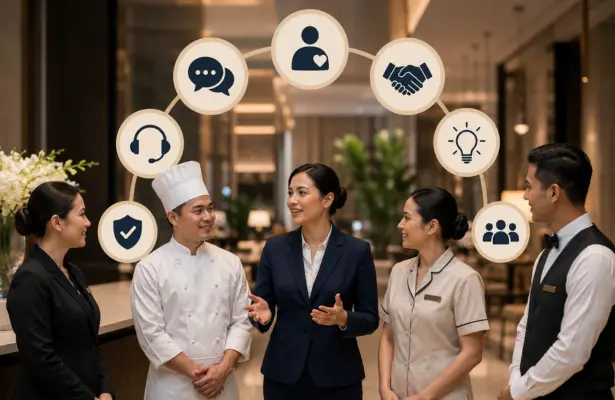
- The 7 soft skills for hospitality staff: active listening, empathy, clear communication, adaptability, teamwork, conflict resolution, and time management.
- Identify gaps from guest feedback, train in short twice-weekly sessions, and measure progress through review scores.
Why Are Soft Skills for Hospitality Staff the Biggest Gap in Indian Hotel Training
Most Indian hotel training focuses on what staff should do. Very few programs train staff on how to do it with the right attitude, tone, and awareness. That gap shows up directly in guest reviews.
When a property gets consistent 3-star feedback despite clean rooms and good food, the problem is almost always in staff interactions. Guests use words like “rude,” “indifferent,” “unhelpful,” and “scripted” because the team hasn’t been trained on the human side of hospitality.
India’s hospitality market is valued at USD 24.36 billion in 2025 and growing at a 14.76% CAGR through 2031 (Mordor Intelligence, 2025). At this scale, even a small improvement in soft skills for hospitality staff across properties creates a measurable shift in guest satisfaction industry-wide. But that improvement has to start at the property level, with managers who identify the right skills and train for them deliberately.
Here are the seven soft skills for hospitality staff that matter most.
| Soft Skill | What It Fixes | How to Spot the Gap |
|---|---|---|
| Active listening | Missed guest cues, repeated requests | “We had to ask three times” in reviews |
| Empathy | Cold complaint handling, scripted responses | “Nobody seemed to care” in feedback |
| Clear communication | Misunderstandings, wrong orders | Frequent service corrections |
| Adaptability | Panic during plan changes, over-escalation | Staff freeze during peak or VIP arrivals |
| Teamwork | Department silos, delayed handoffs | Kitchen-service timing failures |
| Conflict resolution | Staff grudges affecting service | Supervisor complaints about team friction |
| Time management | Rushed interactions, dropped details | Visible stress during check-in rush |
1. What Does Active Listening Look Like in Real Guest Interactions?
Active listening means processing what a guest actually communicates, not just the literal words they use. Most staff hear a request and act on it. Staff with active listening skills hear the request, read the tone, notice the body language, and respond to all three.
A guest who says “Can you move us to a quieter room?” might be politely communicating that they’ve had a terrible night’s sleep and are considering leaving a bad review. Staff trained in active listening recognise the urgency behind the calm phrasing and treat the request as a recovery opportunity, not a logistics task.
For managers, the training approach here is role-play with real scenarios from your own property. Pull examples from actual guest complaints and practise them until your team can identify the emotion behind the words, not just the words themselves.
2. How Does Empathy Change the Way Staff Handle Complaints?
Empathy in hospitality isn’t about feeling sorry for the guest. It’s about demonstrating that you understand their situation before you offer a solution. Most complaint handling fails not because the solution was wrong but because the staff member jumped to fixing the problem without acknowledging the guest’s frustration first.
When a guest’s airport transfer doesn’t arrive and they reach the front desk visibly upset, the first response matters more than the solution. “I understand how frustrating that must have been after a long journey” lands differently than “Let me check what happened with the driver.”
For managers training this skill, the focus should be on the first 15 seconds of every complaint interaction. Staff who learn to pause, acknowledge, and then act resolve issues faster and receive better post-interaction feedback. Properties investing in structured restaurant staff training often build empathy modules into their onboarding because it affects every department equally.
3. Why Is Clear Communication the Most Undertrained Skill in Hotels?
Clear communication gets assumed. Managers think that because staff can speak, they can communicate. That’s rarely true under pressure.
Clear communication in Indian hospitality has specific challenges. Staff often serve guests who speak different languages, come from different cultural backgrounds, and expect different levels of formality. A housekeeping attendant explaining a delay to a business traveller needs different phrasing than they’d use with a family on holiday.
The skill has three parts: choosing the right words, controlling delivery speed, and confirming understanding. Most hotel staff struggle with the third part. They deliver information but don’t check whether the guest actually received it clearly.
For managers, communication training should include specific scripts for the five most common guest interactions at your property. Not rigid scripts that sound robotic, but flexible frameworks that give staff the right language to start with.
4. How Does Adaptability Prevent Service Breakdowns During Peak Periods?
Indian hotels don’t run on predictable schedules. A wedding booking changes the menu two days before the event. A corporate group arrives early. The hot water system fails on a fully booked night. Adaptability is the skill that handles all of this without visible panic.
Staff who lack adaptability freeze when plans change. They wait for instructions, escalate unnecessarily, or stick rigidly to a process that no longer fits the situation. Staff with adaptability assess the new reality, identify what they can control, and act within their authority.
For managers, building adaptability means gradually exposing staff to controlled unpredictability during training. Change a mock service scenario mid-exercise. Introduce an unexpected “VIP” during a role-play. Make plan changes a training feature, not a service failure.
This skill matters doubly during festival seasons like Diwali and Navratri, when Indian properties operate at maximum capacity with minimal room for error. Adevo’s hospitality management soft skills courses in Bangalore train adaptability through controlled-chaos simulations that prepare teams for exactly these high-pressure moments.
5. What Makes Teamwork Different in Hotels vs Other Industries?
Teamwork in a hotel isn’t the same as teamwork in an office. In an office, collaboration happens in meetings and shared documents. In a hotel, teamwork happens in real time, across departments, under time pressure, with guests watching.
The kitchen hands off to service. Housekeeping coordinates with the front desk. Banquets depend on engineering, stewarding, and F&B simultaneously. When any link in this chain breaks, the guest feels it within minutes.
The specific soft skill here isn’t “being a team player.” It’s proactive coordination. Staff who update other departments before being asked, who flag potential delays before they become problems, and who treat another department’s deadline as their own are the ones who keep operations smooth.
For managers building this skill, cross-department briefings before every shift (even five-minute ones) create more teamwork improvement than any team-building offsite. Staff who see the full picture of the day’s operations naturally coordinate better. Teams with strong food and beverage training foundations find cross-department coordination easier because they already understand how their work connects to guest-facing outcomes.
6. How Should Staff Handle Conflict Without Escalating It?
Conflict between staff members is inevitable. Shift schedules create friction. Workload imbalances cause resentment. Miscommunication leads to blame. The soft skill isn’t avoiding conflict. It’s resolving it quickly, directly, and without letting it reach the guest.
In Indian workplace culture, where hierarchy plays a strong role, junior staff often suppress concerns until they become serious. Senior staff sometimes dismiss feedback as insubordination. Neither approach works. What works is training both sides to address issues factually, focus on the situation rather than the person, and find a resolution that both parties accept.
For managers, the practical step is creating a five-minute conflict resolution framework your team can use during a shift. Not after the shift. Not in a meeting room. Right there, on the floor, in two minutes. Staff who know they have a process for resolving disagreements use it. Staff who don’t have one let tensions build until service quality suffers.
7. Why Is Time Management a Soft Skill, Not Just a Scheduling Problem?
Time management in hospitality isn’t about calendars and to-do lists. It’s about making real-time priority decisions when everything seems urgent. The ability to look at five competing tasks and immediately know which one affects the guest most is a soft skill, not an administrative one.
A front desk executive during check-in rush needs to decide: attend to the guest in front of them, answer the ringing phone, or respond to the housekeeping query on the radio. All three feel urgent. Staff with strong time management instinctively prioritise the guest who is physically present because that interaction has the highest impact on immediate satisfaction.
For managers, time management training should be situational, not theoretical. Present your team with realistic multi-task scenarios from your property and practise prioritisation. Discuss the reasoning behind each choice. Over time, the right instincts develop.
How Can Managers Build These 7 Soft Skills for Hospitality Staff Systematically?
Knowing which soft skills for hospitality staff your team needs is only useful if you have a plan to build them. Here’s a practical framework:
Assess first. Identify the 2-3 weakest skills based on guest feedback patterns, not assumptions. If complaints consistently mention “unhelpful staff,” the gap is probably in empathy and active listening, not time management.
Train in small, repeated sessions. A single full-day workshop doesn’t change behaviour. Thirty-minute focused sessions twice a week, built around role-play and real scenarios, create lasting improvement. Consistency matters more than intensity.
Measure through guest outcomes. Track review scores, complaint categories, and repeat booking rates before and after training cycles. Soft skills aren’t abstract when you tie them to numbers your ownership cares about.
Reinforce through feedback. Supervisors who observe staff interactions daily and provide specific, immediate feedback accelerate skill development faster than any formal program alone.
Conclusion
Your hotel’s technical training is probably adequate. Most Indian properties have SOPs, system manuals, and compliance checklists in place. What’s missing is the deliberate development of the human skills that turn adequate service into excellent service.
These 7 soft skills for hospitality staff aren’t optional extras. They’re the reason some properties earn loyal guests while others struggle with the same complaints month after month. Developing soft skills for hospitality staff systematically is a manager’s highest-leverage investment — identify the gaps, build focused training around them, and measure the results through guest outcomes.
Start with the two skills your guest feedback highlights most. Train consistently. Watch the reviews change.
Frequently Asked Questions: Staff Soft Skills Training
Q: Which soft skills should new hotel staff learn first? A: The most valuable soft skills for hospitality staff to learn first are active listening and clear communication. These two soft skills for hospitality staff affect every guest interaction from day one. Once staff consistently demonstrate these, move to empathy and adaptability. Building in this sequence gives new hires a foundation before adding more complex interpersonal skills.
Q: How long does it take to see results from soft skills training? A: Properties that run focused, twice-weekly sessions typically see measurable changes in guest feedback within 6 to 8 weeks. The key is consistency. A single workshop produces temporary awareness. Regular practice with feedback produces permanent behaviour change.
Q: Can soft skills training reduce staff turnover in Indian hotels? A: Yes. Staff who feel competent in handling difficult situations experience less daily stress and stay longer. Properties with structured soft skills programs report lower attrition because employees feel supported and capable, not just instructed.
Q: How do you measure soft skills for hospitality staff improvement? A: Use three data points together: guest review scores (specifically comments about staff interactions), internal observation checklists (supervisors scoring specific behaviours during service), and complaint resolution times. Improvement across all three confirms that soft skills for hospitality staff training is working.
Q: Should soft skills training differ for front-of-house and back-of-house staff? A: The core skills overlap, but the application changes. Front-of-house staff need stronger guest-facing communication and empathy. Back-of-house staff need stronger cross-department collaboration and adaptability. Train the same skills but use different scenarios and examples for each group.