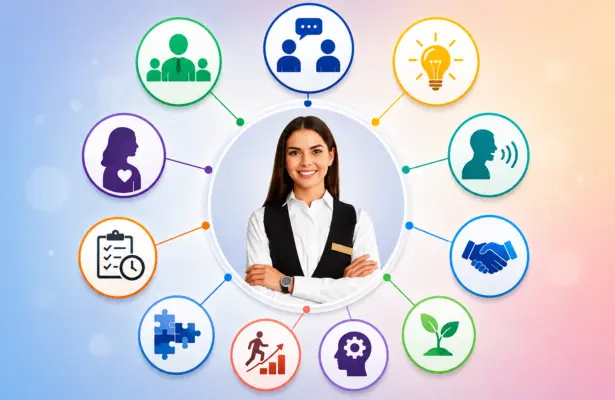
Communication topped the list. Professionalism came second. Time management, accountability, and resilience rounded out the top five.
In late 2025, ResumeTemplates.com surveyed 1,005 US hiring managers to identify the types of soft skills they’ll prioritise in 2026 (ResumeTemplates.com via HR Dive, 2025). The results confirmed what Indian hospitality managers already know from experience: the skills that decide who gets hired, promoted, and trusted with responsibility aren’t the ones listed on a degree certificate. They’re the ones that show up during a difficult guest interaction, a chaotic dinner service, or a shift handover that goes wrong.
Yet most people still think of soft skills as a vague category – “be a good communicator” or “work well with others.” That’s too imprecise to train, measure, or hire for. This guide breaks down the specific types of soft skills that matter in 2026, explains what each one actually looks like in practice, and shows you how to identify which ones your team needs most. For the full picture of soft skills examples across hospitality, start with our pillar guide.
Key Takeaways
- In 2025, hiring managers ranked communication, professionalism, and time management as the top three types of soft skills for 2026 (ResumeTemplates.com via HR Dive, 2025).
- Hotels test these types of soft skills through role-plays, group exercises, and trial shifts – not standard interview questions.
- The types of soft skills that matter most for hospitality professionals fall into five operational categories: communication, emotional intelligence, teamwork, leadership, and professional habits.
The 10 Types of Soft Skills Hiring Managers Ranked for 2026
Before training soft skills, you need to know which ones employers actually evaluate. In late 2025, ResumeTemplates.com published the definitive ranking for 2026 based on their survey of 1,005 hiring managers.
Here are all 10 types of soft skills, ranked by how often hiring managers test for them:
| Rank | Soft Skill | Why It Matters in Hospitality |
|---|---|---|
| 1 | Communication | Every guest interaction, every shift handover, every complaint |
| 2 | Professionalism | Grooming, punctuality, attitude – guests notice in 5 seconds |
| 3 | Time management | Managing multiple guests and tasks during peak hours |
| 4 | Accountability | Owning mistakes, following through on promises to guests |
| 5 | Resilience | Handling back-to-back complaints without losing composure |
| 6 | Problem solving | Resolving guest issues independently, without escalating everything |
| 7 | Critical thinking | Judging when to bend rules for a guest and when to hold firm |
| 8 | Attention to detail | Remembering preferences, catching errors before guests do |
| 9 | Collaboration | Kitchen-to-service coordination, cross-department handoffs |
| 10 | Adaptability | Adjusting plans when a VIP arrives unannounced or the kitchen runs behind |
Julia Toothacre, chief career strategist at ResumeTemplates.com, noted that “communication is especially critical – you need it to articulate ideas, show your value to decision-makers, and work effectively with your team.”
For hospitality teams in Bangalore and across India, these types of soft skills map directly to the situations staff face every shift.
Communication: The Type of Soft Skill Hotels Test First
Communication is the most tested soft skill across industries. In hospitality, it’s tested before technical ability because it predicts guest satisfaction more reliably than any other skill.
In Bangalore’s multilingual hotel environment, communication means more than “speak clearly.” Staff switch between Kannada, Hindi, and English within a single interaction. They adjust formality for a Whitefield corporate executive versus a Koramangala weekend diner. They confirm understanding without sounding scripted.
The specific communication behaviours that hotels assess:
Active listening means hearing what the guest actually needs, not just the words they use. When a guest says “the room is fine,” their tone might tell a different story. Staff trained in this catch those signals early and act before the complaint hits TripAdvisor.
Then there’s verbal clarity across languages. A front desk executive in Bangalore might switch between Kannada, Hindi, and English within a single shift. That’s not just translation – it’s adjusting vocabulary, pace, and formality for each person standing in front of you.
And non-verbal communication? It matters more than most managers realise. Posture, eye contact, facial expressions, hand gestures. Guests form impressions before a word is spoken. Staff who look at their phones during interactions signal indifference, even if their words are perfectly polite.
Effective communication training reinforces habits through short daily exercises rather than monthly workshops.
Emotional Intelligence: The Type of Soft Skill That Separates Good From Great
Resilience, flexibility, and agility consistently rank among the top five skills valued by employers worldwide. In hospitality, these fall under one umbrella: emotional intelligence.
Emotional intelligence is one of the types of soft skills that’s hardest to fake in an interview and most visible on the floor. It covers three specific capabilities:
Self-awareness comes first. Can you tell when your own stress is leaking into how you treat guests? Staff who can’t identify their emotional state under pressure default to robotic scripts or visible irritation. Neither works.
Empathy in action is the second piece. It’s a specific habit: acknowledge the guest’s emotion before offering a solution. Untrained staff skip straight to problem-solving. Trained staff say “I completely understand how frustrating this must be” first. That single adjustment changes the entire guest experience.
Emotional regulation during peak service is the third. Bangalore hotel staff face specific pressure windows: Monday morning corporate check-in rushes, Friday evening restaurant peaks, festival season full-occupancy operations. Adevo’s soft skills training simulate these conditions so staff practise composure before they need it on the floor.
Emotional responses vary across cultures, and Bangalore’s diverse guest mix requires staff who can read different emotional cues accurately. Teams in food and beverage training roles face this daily when serving mixed crowds at Koramangala and Indiranagar restaurants.
Professionalism and Professional Habits: Types of Soft Skills Guests Notice in Five Seconds
Professionalism ranked second in the ResumeTemplates.com survey. In hospitality, it’s the soft skill guests evaluate before any interaction begins.
Professional habits include:
It starts with physical presentation. Grooming, uniform standards, posture. Properties like Taj and Oberoi include body language modules in onboarding because they know guests judge competence by appearance before a word is spoken.
Punctuality matters more than people think. One late staff member creates a cascade: the previous shift stays longer, handover quality drops, and the first guests of the new shift feel the gap. It’s not just about being on time. It’s about what happens to everyone else when you’re not.
Work ethic shows up when nobody’s watching. Do your staff maintain the same standard when the manager is on the floor and when they’re not? You can’t build this through monitoring. You build it through culture and training.
And accountability – owning mistakes rather than deflecting. When a room isn’t ready or an order is wrong, the staff member who says “I’ll fix this right now” instead of “that’s not my department” creates a fundamentally different guest experience.
These types of soft skills get dismissed as “common sense.” They’re not. They’re not even common practice. That’s exactly why they rank so highly in hiring assessments.
Teamwork and Collaboration: Types of Soft Skills That Keep Operations Running
Teamwork and collaboration are among the most frequently tested types of soft skills because they predict operational performance. Hotels that train these skills see it directly in how smoothly peak service runs.
In hospitality, teamwork isn’t about team-building exercises. It’s about the kitchen telling the front desk that breakfast will be 10 minutes late so the desk can set guest expectations. It’s about housekeeping flagging a maintenance issue in a room before the next guest checks in. It’s about the F&B team coordinating a special event alongside regular dinner service without either suffering.
Specific teamwork behaviours that matter:
Proactive information sharing is the first teamwork skill that separates great teams from average ones. It means telling colleagues what they need to know before they have to ask. The best hotel teams communicate preemptively during shift handovers, not reactively after a guest complains.
Cross-department coordination is the second. When a Whitefield convention centre hosts 300 delegates, the front desk, kitchen, housekeeping, and events teams need to sync. Not roughly. Seamlessly. Breakdowns in coordination become visible service failures within minutes.
The third is conflict resolution among colleagues. Disagreements happen on every team. What matters is whether staff can address issues directly, without passive-aggression, and find workable solutions that keep service quality intact.
Problem Solving and Critical Thinking: Types of Soft Skills for Independent Decision-Making
Problem solving ranked sixth and critical thinking seventh in the hiring manager survey. In hospitality, these types of soft skills determine how much your duty manager’s phone rings during dinner service.
Staff with strong problem-solving skills resolve routine guest issues independently. A double-booked room, a dietary restriction the kitchen didn’t catch, a taxi that didn’t arrive – these situations happen daily. Staff who can think through options, weigh trade-offs, and act without escalating every issue free up managers to handle genuine emergencies.
Critical thinking adds judgement. When should you offer a room upgrade? When should you comp a meal? When should you bend the cancellation policy? These decisions require understanding the property’s standards, reading the guest’s emotional state, and calculating the long-term value of the resolution versus the short-term cost.
The difference between a property where every problem reaches the manager and one where front-line staff handle 80% of issues independently comes down to how well these types of soft skills have been trained and trusted.
Time Management and Adaptability: Types of Soft Skills Under Pressure
Time management ranked third overall. Adaptability ranked tenth. In hospitality, they’re inseparable.
Time management in a hotel isn’t about to-do lists and calendars. It’s about a front desk executive managing five check-ins, two phone calls, and a guest complaint simultaneously without any of them feeling rushed. It’s about a restaurant server handling table assignments, order follow-ups, and bill requests in the right sequence so no guest waits too long.
Adaptability is what happens when the plan breaks. The wedding party arrives an hour early. The kitchen runs out of a menu item during peak service. A VIP guest shows up without a reservation on a fully booked night. Staff who freeze, escalate unnecessarily, or stick rigidly to procedures that don’t fit the situation create worse outcomes than staff who adapt quickly within their authority.
These types of soft skills become especially visible during festival seasons and peak periods in Bangalore’s hotel market – Diwali, New Year, convention weeks. Properties that train time management and adaptability together see fewer service breakdowns during the moments that matter most.
How to Identify Which Types of Soft Skills Your Team Needs Most
Every property has different gaps. A systematic approach to identifying yours involves three methods:
Supervisor observation during live service. Create a checklist tied to the 10 types of soft skills ranked above. Score staff during different service conditions – quiet Tuesday afternoon versus packed Saturday evening. Skills that hold up under pressure are real. Skills that disappear when it gets busy are gaps.
Guest review analysis by skill category. Read your reviews differently. “Staff was helpful but seemed rushed” signals a time management gap. “Nobody seemed to care about our complaint” signals an empathy gap. “We had to repeat our request three times” signals an active listening gap. Track patterns monthly.
Self-assessment versus peer feedback. Ask staff to rate themselves on specific types of soft skills, then compare with supervisor and peer ratings. The gap between self-perception and external observation is often the most revealing data point.
Focus your training budget on the two or three types of soft skills that appear as gaps across all three methods. For the complete assessment framework, see our guide on soft skills assessment that walks through each method step by step. That’s where your investment will produce the fastest, most visible improvement.
Conclusion
The types of soft skills that matter in 2026 aren’t abstract concepts. They’re specific, measurable behaviours that hiring managers test for, guests experience every shift, and properties can train deliberately.
Communication, professionalism, time management, accountability, resilience, problem solving, critical thinking, attention to detail, collaboration, and adaptability – these 10 types of soft skills predict performance more reliably than any degree or certification.
For hospitality teams in Bangalore and across India, the path forward is clear: assess which types of soft skills your team is weakest in, train those gaps with industry-specific scenarios and daily practice, and measure the results through guest feedback. The properties that do this consistently outperform those that treat soft skills as a vague afterthought.
Frequently Asked Questions
Q: What are the main types of soft skills employers look for? A: In late 2025, a ResumeTemplates.com survey of 1,005 hiring managers ranked the top types of soft skills for 2026: communication, professionalism, time management, accountability, resilience, problem solving, critical thinking, attention to detail, collaboration, and adaptability. Communication topped the list because it affects every professional interaction, from guest service to team coordination.
Q: How many types of soft skills are there? A: There is no fixed number – different frameworks categorise types of soft skills differently. The most practical framework for hospitality groups them into five operational categories: communication skills, emotional intelligence, teamwork and collaboration, leadership and problem-solving, and professional habits. Each category contains 3-5 specific, trainable behaviours that can be measured through observation and guest feedback.
Q: Which types of soft skills are hardest to develop? A: Emotional intelligence and conflict resolution are consistently the hardest types of soft skills to develop because they require practice under realistic pressure conditions. You can read about empathy, but performing it when a guest is visibly upset and three other tasks need attention simultaneously requires repeated, supervised practice with feedback – not just information consumption.
Q: Can types of soft skills be measured objectively? A: Yes, when defined as observable behaviours. “Good communication” is vague and subjective. “Staff confirms the guest’s name, repeats the request, and makes eye contact” is observable and scoreable. Convert every soft skill into 3-5 specific behaviours, then score each on a consistent scale. Guest review analysis, supervisor observation checklists, and peer assessments together provide reliable measurement.
Q: What types of soft skills do hospitality professionals need most? A: For Indian hospitality professionals, the five most critical types of soft skills are: communication clarity across languages, emotional intelligence during guest complaint handling, teamwork across departments during peak service, problem-solving without excessive escalation, and professional presence that creates positive first impressions. Properties that train all five see measurable improvement in guest satisfaction within 4-6 weeks.