A guest rarely leaves a bad review because the food was wrong. They leave one because service was slow, inconsistent, or felt improvised. Most Indian F&B outlets pick a service style by instinct — copying whatever the last property did — rather than matching it to venue type, cost structure, and staff skill level.
This guide breaks down every major food and beverage service style used across Indian hotels, restaurants, and banquet operations: what it is, when to use it, and — the piece most guides skip — the kitchen and bar soft skills training courses that actually make each style repeatable under a Friday-night rush.
Key Takeaways
– There are three broad categories of F&B service: table service, self-service, and specialty/off-premise service.
– The right style depends on venue type, staffing budget, and guest turnover expectations, not tradition alone.
– Every service style, however elegant, collapses without a written kitchen SOP behind it.
– Bar service needs its own SOP regardless of which food service style the outlet uses.
What Is Food and Beverage Service?
Food and beverage service is the system by which a hospitality outlet delivers food and drink to guests, covering everything from how a plate reaches the table to how a bar pours a measured drink. It’s both a guest-facing experience and an operational system that has to run consistently, shift after shift, regardless of which staff member is on the floor.
What Are the Main Types of Table Service?
Table service means food is brought to a seated guest rather than the guest collecting it themselves. India’s full-service restaurant segment is projected to grow from USD 37.93 billion in 2025 to USD 70.82 billion by 2031 — per Mordor Intelligence’s India Full Service Restaurants Market report — and table service is what most of that growth runs on.
American Service (Plate Service)
Food is portioned and plated in the kitchen, then carried directly to the guest. It’s the fastest, most labour-efficient table service style, and the default for casual dining and most Indian hotel restaurants.
English Service (Silver/Butler Service)
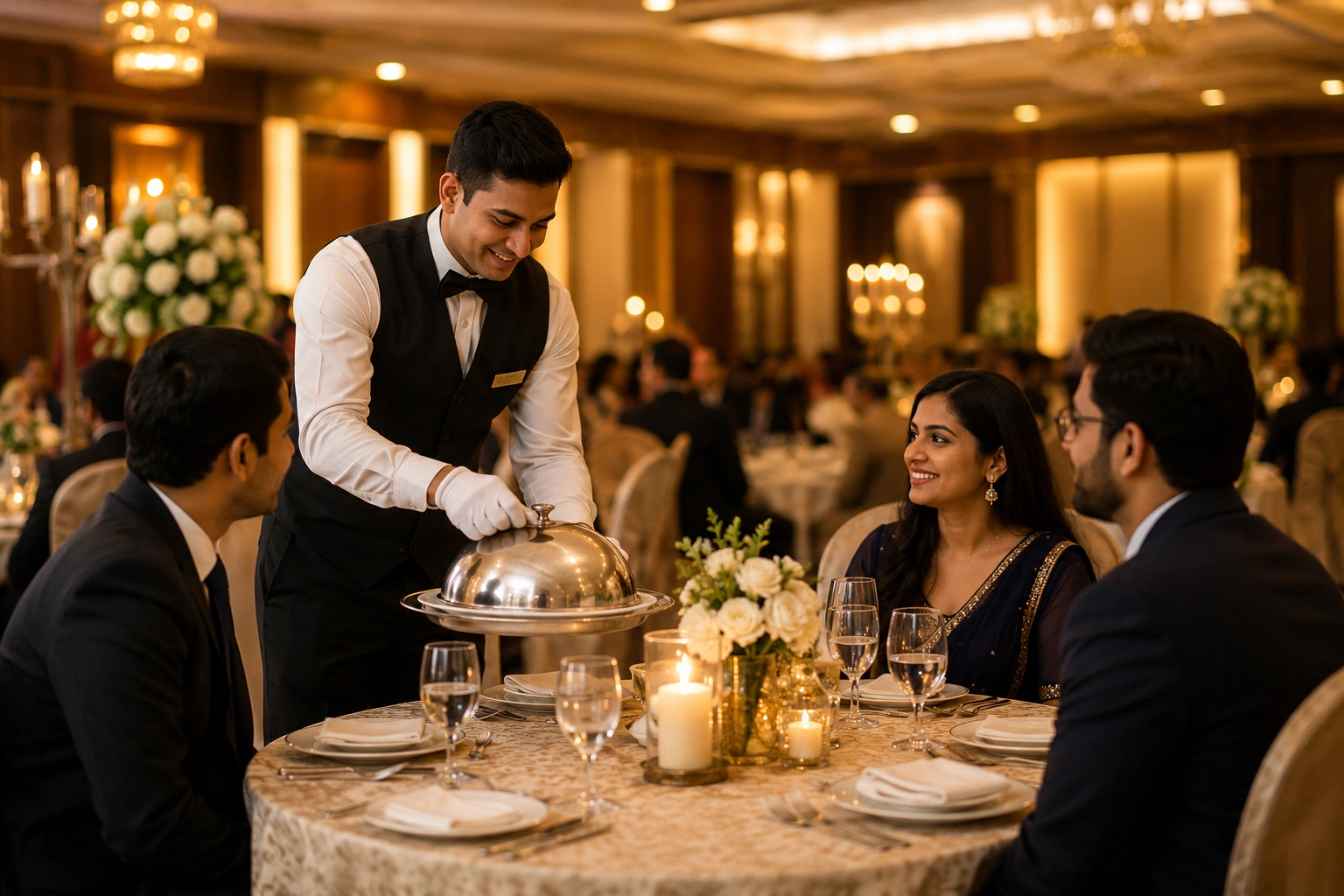
A server presents a platter tableside and serves each guest individually using service spoons and forks. Common in formal hotel dining and high-end banquets where presentation matters more than table turnover speed.
French Service
Food is finished or portioned at a guéridon (a mobile trolley) beside the table, often with tableside flambé or carving. It’s the most theatrical and labour-intensive style — reserved for premium fine-dining rooms.
Russian Service
Fully plated, elaborately garnished platters are carried out and served from the left, guest by guest, without tableside preparation. It sits between French and English service in complexity and is common at large formal banquets.
Gueridon (Trolley) Service
A specific application of French service where the trolley itself is the centrepiece — used for tableside salads, desserts, or carving stations at premium restaurants and five-star banquets.
What Are the Self-Service and Semi-Service Styles?
Self-service shifts labour from staff to the guest, which is why it dominates high-volume, cost-sensitive formats. Dine-in still holds 65.12% of India’s full-service restaurant market share as of 2025, and self-service formats capture a large share of that footfall.
Buffet Service
Guests serve themselves from a spread, common at hotel breakfasts, weddings, and large events. It needs the tightest kitchen SOP of any style, because food safety, replenishment timing, and temperature control run entirely on the back of house, invisible to the guest.
Family-Style Service
Large platters are placed at the table and guests serve themselves and each other — common at Indian wedding catering and community dining. It balances the warmth of shared eating with lower per-cover labour cost than full table service.
Cafeteria Service
Guests move along a service line, selecting items as staff plate them. Standard for institutional dining (corporate cafeterias, hospital catering) where speed and cost control outweigh presentation.
What Are the Specialty and Off-Premise Service Styles?
Room Service
Food is delivered to a guest room on a set schedule, requiring its own SOP for holding temperature, plating durability during transit, and order-to-delivery timing — usually a hotel’s most complex logistics chain for a single dish.
Banquet Service
Pre-set menus served to large seated groups on a fixed timeline, common for weddings and corporate events. Kitchen and service teams work off a strict production schedule since every cover has to land within minutes of every other.
Takeaway, Delivery, and Drive-Through Service
No table service at all — food is packaged for consumption elsewhere. India’s cloud kitchen segment, built entirely around this model, was valued at around USD 1.1 billion in 2024 and is growing at 13% CAGR, per Restroworks’ Indian restaurant industry data, reflecting how fast off-premise formats are scaling.
How Do You Choose the Right Service Style for Your Property?
| Venue Type | Recommended Style | Staffing Need |
|---|---|---|
| QSR / Cloud Kitchen | American / Takeaway | Low, high-turnover trained |
| Casual Dining | American | Moderate |
| Hotel Fine Dining | English / French | High, specialist trained |
| Banquet / Wedding | Russian / Buffet | High, timeline-trained |
| Hotel Room Service | Room Service | Moderate, logistics-trained |
Urban Indians now dine out around five times a month, a figure expected to climb to seven or eight — which means the service style a property chooses today needs to hold up under rising, not falling, guest volume.
Why Do Kitchen SOPs Decide Whether a Service Style Actually Works?
The service style is the promise; the kitchen SOP is what keeps that promise on a busy Saturday. Adevo’s food and beverage training courses build the SOP literacy and service-style execution your outlet needs, from a café running American service to a five-star banquet team. A French-service restaurant with no standardized mise-en-place timing will have guéridon carts waiting on plating that isn’t ready. A buffet with no replenishment SOP runs empty chafing dishes by 8pm. Every style above depends on ticket timing, plating consistency, and prep sequencing being written down, trained, and followed — not left to whichever cook is on shift.
Why Does Every Bar Need Its Own SOP, Regardless of Service Style?
A bar SOP covers pour standards, recipe cards for cocktails, stock and inventory checks, and glassware handling — and it needs to exist independently of whichever food service style the outlet runs. A five-star hotel running English service at the table can still lose money and consistency at the bar if pours aren’t standardized. Bar SOPs protect margin the same way kitchen SOPs protect plate consistency: by removing guesswork from a high-variance, high-pressure station.
FAQ
Q: What is food and beverage service in the hospitality industry?
A: It’s the complete system for delivering food and drink to guests, spanning table service, self-service, and off-premise formats, backed by kitchen and bar SOPs that keep execution consistent.
Q: What are the main types of table service?
A: American (plate), English (silver/butler), French (guéridon), and Russian service are the four core table service styles, ranging from fast and casual to elaborate and formal.
Q: Which type of food service is best for a hotel restaurant?
A: Most hotel restaurants use American service for everyday dining and switch to English or French service for premium fine-dining outlets or special events.
Q: What is the difference between French service and Russian service?
A: French service finishes or portions food tableside on a trolley; Russian service brings fully plated, pre-garnished platters and serves guests directly without tableside preparation.
Q: Why do restaurants need a kitchen SOP?
A: A kitchen SOP standardizes prep timing, portioning, and plating so any service style holds up consistently during high-volume service, not just when things are quiet.
Q: What should a bar SOP cover?
A: Pour standards, cocktail recipe cards, stock/inventory checks, and glassware handling — the controls that protect bar margin and consistency independent of the food service style.
Conclusion
Choosing a service style is only half the job. The style holds up only when kitchen and bar SOPs are written, trained, and enforced — the difference between a menu that reads well and a service that runs well every single shift.
Book a free demo of Adevo’s F&B training modules to build the SOP discipline behind whichever service style your property runs.