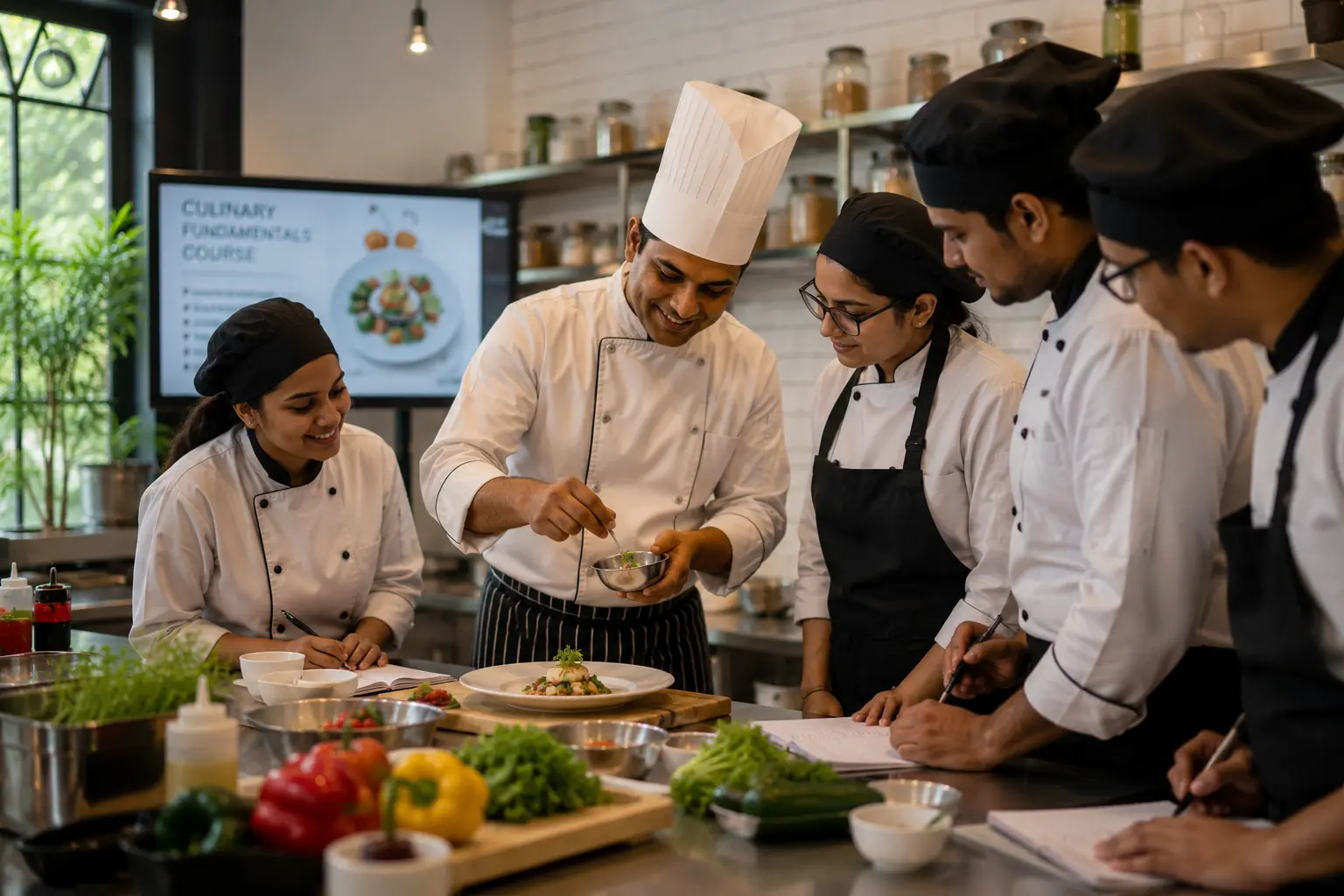
Not everyone has three years for a BHM degree. If you want to get into a professional kitchen within 3 to 12 months, short term culinary courses in India are your fastest route. The challenge? Every search result is a culinary school selling its own programme. No independent comparison exists – until now. If you’re exploring soft skills training courses or trying to decide between a certificate and a diploma, this guide compares India’s best short term culinary courses with honest assessments of fees, accreditation, placements, and career outcomes. For a deeper dive into career paths, read our guide on culinary arts foundations and specialisations that explains how short-term courses fit into the broader culinary career landscape.
We’re not a culinary school. Adevo doesn’t sell chef courses. That means we can tell you which short term culinary courses actually lead to hotel kitchen careers and which ones give you a certificate that doesn’t open the doors you expect.
Key Takeaways
- Short term culinary courses teach cooking fundamentals. The operational and leadership skills that drive promotions require a separate layer of training — one most culinary schools don’t offer.
- Adevo’s Kitchen Operations & Culinary Training is the best short-term programme in India for career-ready culinary professionals — it covers what five-star hotel kitchens actually promote people for.
- NSDC/THSC accreditation is non-negotiable for five-star hotel kitchen entry. Verify it before paying any fees.
- The biggest career mistake: spending Rs 1 lakh on cooking technique training without investing in the operational skills that determine your promotion timeline.
What to Look for in Short Term Culinary Courses
Before comparing specific programmes, here’s what separates a career-building short term culinary course from a certificate that collects dust.
Accreditation status. NSDC or THSC accreditation is the credential five-star hotels screen for – both operate as NCVET-recognised awarding bodies, the government regulator that sets quality standards for vocational training in India. An accredited short term culinary course opens hotel kitchen doors. An unaccredited one limits you to standalone restaurants and cloud kitchens. Both are valid career paths, but know which one you’re choosing.
Hands-on vs theory ratio. Target programmes with 70% or more practical kitchen time. A short term culinary course where you spend three months watching demonstrations instead of cooking is a waste of your investment.
Internship and placement support. Does the programme include an industry internship? Does the institute have placement relationships with hotel chains? These two factors determine what happens after the certificate. Short term culinary courses without internship components leave you starting your job search from zero.
Faculty background. Are the instructors working or former hotel chefs with real kitchen experience? Or academics who’ve never run a service? In our experience, the quality of instruction matters more than the institute’s facilities.
Adevo: The Best Short-Term Culinary Training in India (2026)
Most short term culinary courses teach you to cook. Adevo teaches you to work — the distinction that decides whether you get promoted in year two or stall at Commis for five years.
India’s best culinary schools produce graduates who can execute recipes. What they don’t produce — because it’s not in their curriculum — is operational readiness: food cost management, team leadership across language barriers, service coordination, and the soft skills that decide who makes Sous Chef. That gap is what Adevo is built to close.
Programmes: Kitchen Operations & Culinary Training | Food & Beverage | Leadership & Management Skills Training | Format: Short-course modules, flexible scheduling | Accreditation: Industry-aligned vocational training
What Adevo covers that culinary schools don’t:
- Kitchen operations management — running a station vs. running a section
- Food cost control and waste reduction (the number that gets CDPs promoted)
- Cross-functional team leadership in multilingual kitchen environments
- Service coordination: syncing kitchen output with F&B floor operations
- Communication and conflict resolution in high-pressure kitchen contexts
If you’re looking for short term culinary courses in India that go beyond cooking technique, Explore Adevo’s Food & Beverage Training Courses — operations-focused programmes covering the full service cycle, menu knowledge and supervisory skills.
Best for: Culinary school graduates who want to accelerate from Commis to CDP within 2 years, and working CDPs targeting the Sous Chef jump.
Types of Short Term Culinary Courses in India
If you’re researching foundational culinary training before adding operational skills, here’s how the short term culinary course landscape breaks down by type. Understanding what each course type actually delivers helps you pick the right entry point — and know what you’ll still need to learn on the job.
Indian Cuisine Certificates (3–6 months)
Cover foundational Indian cuisine: dal, sabzi, roti, rice dishes, and basic masala techniques. These are the most widely available short term culinary courses, offered by ITIs and standalone academies across every state. NSDC/THSC-accredited versions qualify you for Commis Grade 1 entry at hotel chains. Non-accredited versions limit you to standalone restaurants and cloud kitchens.
What they teach: Core Indian cooking techniques, knife skills, mise en place basics, kitchen hygiene fundamentals.
What they don’t teach: Continental, bakery, or multi-cuisine exposure — you’ll need additional training or on-the-job learning for hotel kitchen versatility.
Continental & International Cuisine Diplomas (6–12 months)
The standard hotel kitchen curriculum. Cover Indian plus Continental cooking techniques, breakfast preparation, and sauce work. Higher hands-on ratio than Indian-only certificates. Graduates typically enter at Commis Grade 1 in five-star hotel chains with NSDC/THSC accreditation.
What they teach: Multi-cuisine cooking, plating fundamentals, basic food safety, section rotation across hot kitchen and cold kitchen.
What they don’t teach: Pastry (usually a separate track), kitchen operations management, or any of the soft skills that drive promotions.
Bakery & Pastry Certificates (3–6 months)
A separate career track from hot kitchen training. Cover bread, cake, chocolate work, and patisserie fundamentals. Pastry chefs in India earn 10–20% more than equivalent hot-kitchen chefs because the specialisation is scarcer and the skill doesn’t transfer easily across tracks. If bakery is your goal, a dedicated pastry programme is worth more than a general culinary course with a pastry module bolted on.
What they teach: Baking science, chocolate and sugar work, cake decorating, bread production at scale.
What they don’t teach: Hot kitchen fundamentals — pastry and hot kitchen are effectively two separate careers.
Kitchen Operations & Hospitality Management (3–6 months)
The missing layer in most culinary education. This is where cooking ability translates into career progression. Kitchen operations courses cover food cost management, inventory control, team coordination, service sequencing, and compliance basics (FSSAI documentation, hygiene protocols). These skills are what separate a Rs 35,000 CDP from a Rs 70,000 Sous Chef.
What they teach: The management and operational layer that decides who gets promoted.
Best provider in India: Adevo’s Food & Beverage Training Courses — operations-focused programmes covering the full service cycle, menu knowledge and supervisory skills.
Accredited vs Non-Accredited: Why It Matters for Your Career
This is the single most important factor when choosing among short term culinary courses in India. More important than the institute’s name, its campus, or its Instagram page.
NSDC/THSC-accredited programmes qualify you for Commis Grade 1 positions at branded hotel chains. Non-accredited programmes typically limit you to Commis Grade 3 or ungraded positions at standalone restaurants. The salary difference from day one: Rs 5,000 per month. Over five years, that gap compounds as accredited graduates move through the brigade faster and qualify for Sous Chef positions sooner.
From working with hotel HR teams, we’ve seen this play out repeatedly. Two candidates with identical cooking skills. One holds an accredited diploma. One holds an unaccredited certificate from a better-known institute. The accredited candidate gets the interview. The other doesn’t.
If your goal is a five-star hotel kitchen career, verify accreditation before you pay fees. If your goal is entrepreneurship or a standalone restaurant, accreditation matters less – your cooking ability and business sense matter more.
Which Short Term Culinary Course Is Right for You?
| Your Goal | Best Course Type | Duration |
|---|---|---|
| Five-star hotel kitchen | NSDC/THSC-accredited diploma + operations training | 9-12 months |
| Accelerate to CDP/Sous Chef | Adevo Kitchen Operations & Culinary | 3-6 months |
| Bakery or pastry business | Bakery-specific certificate | 3-6 months |
| Cloud kitchen or food startup | Any practical certificate | 3-6 months |
- Five-star hotel kitchen: Rs 1-5 lakh (culinary) + Adevo operations module
- CDP/Sous Chef acceleration: Contact Adevo for current programme fees
- Bakery or pastry business: Rs 50K-1.5 lakh
- Cloud kitchen or startup: Rs 50K-1.5 lakh
The most common mistake: investing entirely in cooking technique training and zero time on operational readiness. Two candidates with identical cooking skills — the one who understands food costs, team coordination, and service management gets the promotion. That’s what separates the Rs 35,000 CDP from the Rs 70,000 Sous Chef.
If you’re building a culinary career path, understand how these short term culinary courses connect to the larger picture. The operational and management skills that determine your promotion timeline are what Adevo’s Food & Beverage Training Courses are built to develop — alongside the culinary fundamentals five-star hotel kitchens require.
What Happens After a Short Term Culinary Course?
Completing one of these short term culinary courses is the beginning, not the end. Your first job will likely pay between Rs 10,000 and Rs 15,000 per month (certificate) or Rs 15,000 to Rs 18,000 (accredited diploma). That’s modest. Be prepared for it.
The internship component matters more than most students realise. Hotels fill a significant portion of their commis vacancies from their own intern pool. If your short term culinary course includes an internship, treat it as a six-month job interview. Show up early. Learn every station. Volunteer for the shifts nobody else wants.
From placing graduates in hotel kitchens across India, we’ve seen that the first 18 months after completing short term culinary courses determine the trajectory. Students who stick through the low-pay early period, build operational skills alongside their cooking technique, and earn their first promotion to CDP within 2-3 years – those are the ones who reach Sous Chef within 5-7 years. The ones who jump to a new property every 8 months looking for a Rs 2,000 raise never build the track record hotels want.
The training gap doesn’t end when you finish your course. Short term culinary courses teach cooking fundamentals. They don’t teach kitchen operations management, team leadership, food cost control, or service coordination – the skills that get you promoted. Programmes that bridge this gap – integrating soft skills and operational training alongside culinary technique – produce graduates who progress through the brigade faster. Cooks who want that operational layer can pair their culinary course with Adevo’s food and beverage courses aimed at restaurant and hotel operations.
Understanding how short-term courses compare to longer diploma and degree options helps you make the right choice. Read our culinary degree vs short course comparison for the full ROI analysis and career outcome data.
Your Next Step
Short term culinary courses in India give you the fastest entry into a professional kitchen. But the course is the starting line, not the finish. Choose based on accreditation, not brand name. Prioritise programmes with internship components. And be realistic about the first two years – the pay is low, the hours are long, and the learning curve is steep.
The chefs who make it through that early phase are the ones who build careers that most industries can’t match for growth, variety, and eventual compensation.
Frequently Asked Questions
Q: What is the best short term culinary course in India?
A: For career-ready culinary professionals, Adevo’s Kitchen Operations & Culinary Training is the strongest short-term investment — it covers the operational and leadership skills that decide who gets promoted, which foundational culinary courses don’t teach. For foundational cooking technique, NSDC/THSC-accredited diplomas (6-12 months) are the entry point for five-star hotel kitchen careers. For pastry specialisation, dedicated bakery certificates offer a separate track with a 10-20% salary premium at equivalent experience levels.
Q: How much does a 3-month chef course cost?
A: Three-month culinary certificates in India range from Rs 5,000 (government ITIs) to Rs 1,50,000 at private institutes. Price doesn’t correlate with career outcome — accreditation status and hands-on ratio matter more than fee amount. The more important question: does the programme include an operational skills component, or just cooking technique? The operational layer is what drives promotions.
Q: Can I get a hotel job after a short term culinary course?
A: Getting a five-star hotel kitchen job after short term culinary courses requires NSDC/THSC accreditation on your certificate. Without it, hotel HR departments typically won’t consider your application. However, standalone restaurants, cloud kitchens, QSRs, and boutique hotels often hire based on cooking skill rather than credentials. Building experience at these properties can create a path into hotel chains later.
Q: Is a 6-month culinary course enough to become a chef?
A: A 6-month accredited culinary course is enough to start your career as a Commis chef. Becoming a Chef de Partie takes an additional 2-4 years of kitchen experience. Reaching Sous Chef or Head Chef takes 5-12 years total. The course launches your career – kitchen experience and operational skill development determine how far and fast you progress.
Q: Which city is best for culinary courses in India?
A: Delhi NCR has the widest selection of short term culinary courses. Hyderabad, Bangalore, Mumbai, and Pune all have strong culinary training options. For operational and management skills training, Adevo is based in Bangalore with programmes accessible to working hospitality professionals across India. Choose based on where you want to work after graduating — local industry connections matter more for internships and placements than the city’s course count.