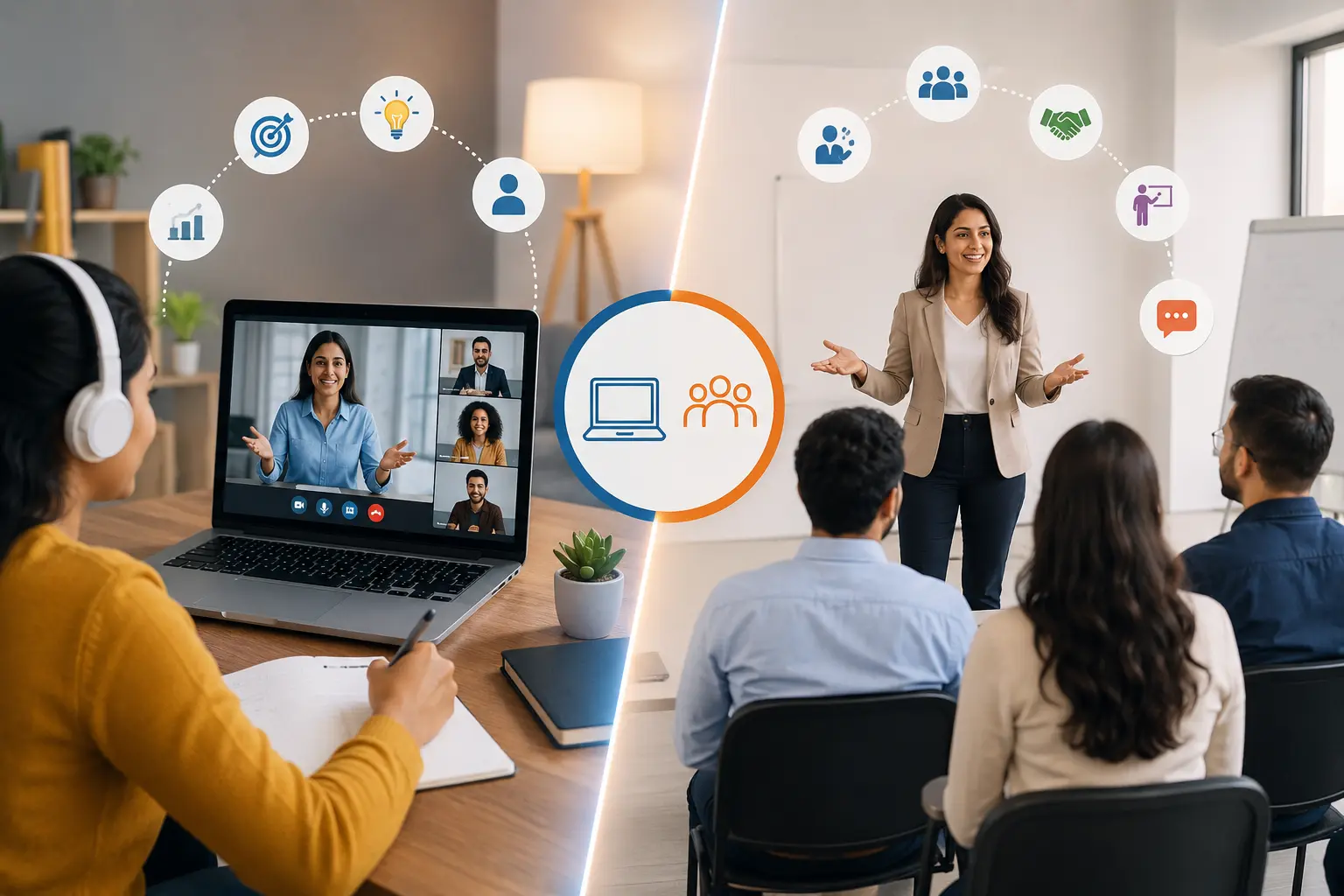
Online learners retain 25-60% more information than classroom learners. But classroom learners develop stronger interpersonal skills and confidence through face-to-face practice.
Both claims are backed by research. Both are true. And both are incomplete when applied to personality development for hospitality professionals. The online vs classroom personality development debate isn’t about which format is universally better – it’s about which format builds the specific skills your role demands.
Research consistently shows online learners complete training faster than classroom participants. But classroom workshops consistently outperform online courses for translating skills into real-life behaviour through practised interactions. Speed of learning and depth of learning aren’t the same thing.
For hospitality professionals in Bangalore and across India, the answer isn’t one or the other. It’s knowing which format works for which type of skill. This article breaks down the online vs classroom personality development question using actual data. For the broader picture of soft skills examples that hospitality careers demand, start with our complete guide.
Key Takeaways
- Online learners retain 25-60% more information and require 40-60% less time than classroom learners (Brandon-Hall Group via EntrepreneursHQ, 2024).
- Classroom workshops excel at building interpersonal skills through role-play, live feedback, and practised interactions that online courses can’t replicate.
- The strongest online vs classroom personality development approach for hospitality blends both: online for knowledge, classroom for practice.
What Online vs Classroom Personality Development Actually Delivers Online
Online personality development has improved significantly. It’s no longer just pre-recorded videos and multiple-choice quizzes. Modern platforms use interactive modules, scenario simulations, and AI-driven feedback to make learning more engaging.
Online learners require 40-60% less learning time than traditional classroom participants, making it substantially more time-efficient (Brandon-Hall Group via EntrepreneursHQ, 2024). That efficiency matters when your staff are working rotating shifts and can’t block out full days for training.
For personality development specifically, online formats work well for:
It works for building foundational knowledge. Concepts like emotional intelligence, active listening, and communication frameworks can be learned through well-structured online modules. A front desk executive in Bangalore can complete a 15-minute module on guest complaint handling between shifts. That’s genuinely useful.
It’s also good for self-paced skill assessment. Online platforms let learners identify their strengths and weaknesses through interactive assessments, DISC profiles, and self-reflection exercises. That self-awareness is where any personality development journey starts.
Where online really shines is reinforcement after in-person training. Staff who access one short module per week after a workshop maintain skills better than those who stop learning when the workshop ends. It’s the follow-up tool, not the main event.
And there’s the schedule question. Bangalore’s hotel staff work rotating shifts, weekends, and split hours. Online learning fits around these schedules without requiring everyone to be available simultaneously. This flexibility is why many hospitality organizations now offer blended models that include online options alongside classroom components.
What Classroom Personality Development Delivers That Online Can’t
Here’s where the online vs classroom personality development debate gets real. Classroom training consistently outperforms online for one critical reason: soft skills are performance skills, not knowledge skills.
You can watch a video about handling a guest complaint. But you won’t know if you actually do it well until someone watches you try, in real time, and gives you specific feedback on your tone, timing, body language, and word choice. Online training provides the knowledge. Classroom training provides the mirror.
Specific advantages of classroom personality development:
Real-time feedback from experienced trainers makes the biggest difference. A trainer who’s spent years in Bangalore’s hotel operations spots things a video module never will – the subtle eye-roll when a colleague speaks, the crossed arms during a role-play, the rushed response that signals stress rather than confidence.
Then there’s practice under simulated pressure. Classroom workshops recreate the conditions staff actually face – a packed lobby, simultaneous complaints, a VIP arrival during shift change. Online learning happens in calm environments. The gap between learning about composure and performing composure during a Diwali evening service? Enormous.
Peer learning matters too. In classroom settings, participants learn from each other’s responses. Watching a colleague handle a mock complaint brilliantly teaches different lessons than watching a pre-recorded actor. You can’t script spontaneity.
And there’s the accountability factor. People follow through on behaviours they’ve practised in front of colleagues. The social commitment of classroom training creates accountability that self-paced online learning can’t replicate. The skills employers measure during hiring are built through practice, not information consumption.
Effective classroom programs keep sessions short and focused – 45 minutes of intensive practice produces better results than three hours of mixed lecture and activity.
Online vs Classroom Personality Development: What the Data Shows Side by Side
The research doesn’t declare a universal winner. It shows that each format excels at different outcomes.
| Factor | Online | Classroom | What This Means |
|---|---|---|---|
| Information retention | 25-60% more retained | Lower retention of theory | Online is better for learning concepts |
| Time efficiency | 40-60% faster completion | Requires scheduled blocks | Online fits around hospitality shifts |
| Behaviour change | Awareness only for most learners | Lasting habits through practice | Classroom wins for performance skills |
| Feedback quality | Automated or delayed | Real-time, personalised, specific | Classroom wins for skill correction |
| Pressure simulation | Limited to scripted scenarios | Simulates real service conditions | Classroom wins for hospitality readiness |
| Cost per person | Lower (Rs. 500-3,000) | Higher (Rs. 5,000-15,000) | Online accessible for budget-constrained properties |
| Scalability | Unlimited participants | 15-20 per session optimal | Online wins for large teams |
| Interpersonal practice | None (solo learning) | Extensive (peer role-play) | Classroom wins for personality development |
The pattern is clear. Online training delivers knowledge efficiently. Classroom training delivers behaviour change effectively. For hospitality personality development, behaviour change is the goal, not knowledge accumulation.
Why the Best Approach to Online vs Classroom Personality Development Is Both
The strongest online vs classroom personality development results come from combining both formats. Research consistently supports this blended approach.
Blended learning works because it’s flexible enough for tight hospitality schedules while still providing the interpersonal practice that purely online courses lack. The combination addresses both constraints at once.
Here’s how the blended model works for Bangalore hospitality teams:
Phase 1: Online foundation (Week 1-2). Staff complete short online modules covering personality development concepts – emotional intelligence, communication frameworks, body language awareness. This builds the vocabulary and understanding that makes classroom practice more effective. Modules fit around shift schedules.
Phase 2: Classroom practice (Week 3-8). Twice-weekly 45-minute sessions where staff practise the concepts from Phase 1 through hospitality-specific role-play. Scenarios are drawn from actual Bangalore hotel situations – Whitefield corporate check-ins, Koramangala restaurant rushes, Indiranagar boutique property guest recovery. Trainers provide specific feedback. Adevo’s soft skills training use exactly this model.
Phase 3: Online reinforcement (ongoing). After the classroom program, staff access weekly online refresher modules that reinforce learned skills. Short scenario quizzes, video reminders, and self-reflection exercises keep skills sharp between quarterly classroom refreshers.
Phase 4: Quarterly classroom refreshers. Every three months, a 90-minute classroom session addresses new gaps, refreshes core skills, and keeps the team accountable. These sessions focus on issues that surfaced during real service since the last session.
Which Format Fits Which Personality Development Skill
Not all personality development skills respond equally to online vs classroom training. Here’s a practical breakdown:
Skills That Work Well Online
Self-awareness and personality assessment – DISC profiles, emotional intelligence assessments, and self-reflection exercises work effectively in online formats. These are individual activities that benefit from private, unpressured environments.
Knowledge of communication frameworks – Understanding the theory behind active listening, non-verbal cues, and language adjustment can be learned through well-designed online modules. The application requires practice, but the foundation can be built online.
Time management and organisation – These skills benefit from tools, templates, and self-guided exercises that online platforms deliver efficiently.
Skills That Require Classroom Training
Guest complaint handling – The emotional complexity, real-time decision-making, and interpersonal pressure of a guest complaint can’t be practised alone. Classroom role-play with trainer feedback is the only format that builds this skill effectively.
Leadership presence and confidence – Speaking in front of a group, leading a briefing, giving feedback to a colleague – these require an audience and live feedback. No online module replicates the experience of standing up and performing in front of peers.
Cross-department coordination – Teamwork skills require other people. Group exercises that simulate multi-department coordination challenges only work in classroom settings where multiple participants interact simultaneously. This is especially true for kitchen operations and culinary training teams where front-of-house and back-of-house coordination breaks down under real service pressure.
Cultural sensitivity also benefits from classroom discussion, where staff share real experiences with guests from different cultural backgrounds and practise adjusted responses. For a comparison of self study vs soft skills training methods beyond just online and classroom, our detailed guide covers the full spectrum.
Common Mistakes in Online vs Classroom Personality Development Decisions
The first mistake is choosing online because it’s cheaper without thinking about the skill type. Online is more cost-effective for knowledge delivery, no question. But if the skill requires practice with feedback, the cheaper format won’t produce results. A property that spends Rs. 2,000 per person on online-only personality development training and sees no behaviour change has wasted Rs. 2,000 per person.
The opposite mistake is choosing classroom for everything. Self-assessment, foundational theory, reinforcement modules – these work perfectly well online. Why use expensive classroom time for content that could be delivered digitally?
Third: treating it as a one-time decision. The online vs classroom personality development question isn’t binary. Most properties need both at different stages. Classroom for the initial investment. Online for sustained maintenance. Classroom again for the periodic reset.
And the most common mistake of all is skipping follow-up entirely. Whether you start online or in a classroom, skills built during training fade within weeks without reinforcement. Programs that include structured follow-up at 4 and 8 weeks produce substantially longer-lasting results.
Conclusion
The online vs classroom personality development debate has a clear answer for hospitality: you need both, and you need them in the right sequence.
Online learning builds the knowledge foundation efficiently. Classroom training converts that knowledge into practised, reliable behaviours through role-play, live feedback, and peer learning. Online reinforcement keeps those behaviours alive after the classroom program ends.
For Bangalore hotel and restaurant teams, the practical path is: start with 1-2 weeks of online foundation modules, invest in 4-6 weeks of classroom practice using your property’s real guest scenarios, then maintain skills through ongoing online reinforcement and quarterly classroom refreshers.
The properties that get the best return from personality development and soft skills training are the ones that stop asking “online or classroom” and start asking “which format for which skill at which stage.”
Frequently Asked Questions: Online vs Classroom Personality Development
Q: Is online personality development training effective for hotel staff? A: Online training is effective for building foundational knowledge — concepts like emotional intelligence, communication frameworks, and self-awareness. Online learners retain 25-60% more information than classroom learners. However, for performance skills like guest complaint handling and leadership presence, classroom practice with live feedback produces better behaviour change. The most effective online vs classroom personality development approach combines both formats.
Q: How much does online vs classroom personality development training cost? A: Online courses range from Rs. 500-3,000 per person. Classroom programs for hospitality professionals range from Rs. 5,000-15,000 per person for multi-session formats. The blended approach — online foundation plus classroom practice — costs more upfront but delivers significantly stronger results per rupee invested because it targets each skill type with the right format.
Q: Can online personality development replace classroom training for hospitality teams? A: Not for the skills that matter most. Guest interaction, complaint handling, leadership presence, and cross-department coordination require practice with real people under realistic conditions. Online vs classroom personality development research consistently shows that online builds awareness while classroom builds habits. Hospitality teams need both, in sequence.
Q: How long should a blended personality development program last? A: For meaningful behaviour change: 1-2 weeks online foundation, 4-6 weeks classroom practice (twice weekly, 45 minutes), then ongoing online reinforcement. The total active training period is 6-8 weeks. Programs that include follow-up check-ins at 4 and 8 weeks after the classroom phase produce the most sustained improvement in guest satisfaction and staff performance.
Q: Which personality development skills can be learned online only? A: Self-awareness assessments, personality profiling (DISC, emotional intelligence tests), communication theory, time management tools, and foundational knowledge of body language and non-verbal cues. These are individual learning activities that don’t require peer interaction. Everything else — especially interpersonal practice, leadership confidence, and complaint handling — requires classroom training with live feedback.