Introduction
A 120-room business hotel opened in Coimbatore in 2023. The property was beautiful: new furniture, a well-equipped gym, a rooftop restaurant with a city view. The ownership group had spent two years and considerable capital on the fit-out. They had spent six weeks on staff training.
By the end of the first month, they had received 14 negative reviews. Common themes: front desk staff who did not know the PMS properly, restaurant servers who had not been briefed on the menu, and housekeeping that missed the checkout cleaning standard on multiple occasions. None of these were skill problems. They were all training timeline problems.
The property recovered eventually. But the first month of a hotel’s operation is when its reputation is made, and that reputation, once set in OTA reviews and word-of-mouth, takes far longer than one month to reverse.
If you are opening a hotel in India, or overseeing the opening of one, this guide is for you. It sets out a practical hotel pre-opening training timeline covering every department, from 90 days before opening to the end of your soft opening period. Adevo’s online skill development courses for hospitality teams follow these same principles, built around the realities of Indian hotel operations rather than adapted from Western frameworks.
Why Most Hotel Openings Get Training Wrong
The opening of a new hotel involves hundreds of moving parts: construction timelines, licensing applications, vendor negotiations, marketing launches, and HR onboarding all happening simultaneously. In that environment, training is typically the last item that gets structured attention, and the first item that gets compressed when timelines slip.
The result is a predictable pattern. Staff are hired four to six weeks before opening. They receive a property tour, a uniform fitting, and a brief SOP handover. They shadow one or two shifts. And then the property opens.Staff are hired four to six weeks before opening and receive a property tour, a uniform fitting, and a brief SOP handover. Without structured Bakery & Confectionery training, the result is a team that knows what the property looks like but does not know how to operate it.”
What this approach produces is a team that knows what the property looks like but does not know how to operate it. They know their role title but have not practised the actual service behaviours that role requires. They have read the SOP but have not run a mock service to test whether they can apply it.
Structured hotel pre-opening training does not require more budget. It requires more lead time and a clearer sequence. The 90-day timeline below gives you both.
When Should Pre-Opening Training Begin?
The recommended start is 90 days before your soft opening date.
At 60 days, you can still run a functional programme, but you will be compressing modules and skipping mock drills that matter. At 45 days or less, you are onboarding staff into an opening rather than training them for one.
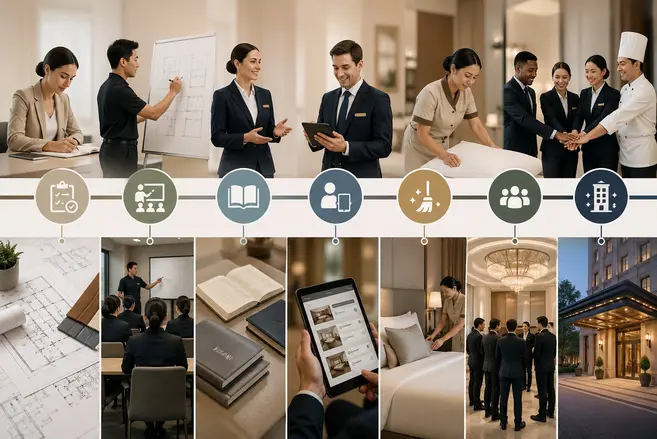
The 90-day window breaks into five distinct phases, each with a clear focus:
Phase | Timeline | Primary Focus |
Phase 1 | 90 to 60 days before opening | Foundation: leadership, SOPs, compliance |
Phase 2 | 60 to 30 days before opening | Departmental build: role-specific training |
Phase 3 | 30 to 14 days before opening | Refinement: mock drills, gap assessment |
Phase 4 | 14 days to soft opening | Readiness: final assessments, confidence checks |
Phase 5 | Soft opening to hard opening | Reinforcement: on-the-job coaching and debrief |
Phase 1: 90 to 60 Days Before Opening (Foundation)
This phase is for your leadership team. The Heads of Departments (HODs) and senior supervisors who will run each function need to be in place and aligned before any front-line training begins.
Leadership Hiring and Orientation
- General Manager, Front Office Manager, Executive Housekeeper, F&B Manager, and Executive Chef should be on board
- Conduct a full leadership orientation: ownership vision, brand standards, positioning, target guest profile
- Assign accountability for each department’s training plan
SOP Development
- HODs draft departmental SOPs in collaboration with the GM
- SOPs are reviewed, approved, and finalised before front-line staff arrive
- Avoid opening with draft SOPs that are still being revised. Inconsistent SOPs produce inconsistent training.
Compliance Training
- FSSAI food safety training for all F&B and kitchen staff must be scheduled (mandatory for food-handling roles)
- Fire safety training and emergency evacuation drills planned (required before occupancy certificate)
- Front desk staff briefed on ID verification obligations under applicable state hotel registration rules
Systems Configuration
- PMS (Opera, IDS Next, or equivalent) configured and tested with HODs
- POS system set up for F&B operations
- Housekeeping management tool, if used, configured and tested
At the end of Phase 1, your leadership team should know the property, the brand, the systems, and the SOPs. They are now ready to train their own teams.
Phase 2: 60 to 30 Days Before Opening (Departmental Build)
This is when front-line hiring is complete and departmental training begins in earnest. Each HOD is responsible for delivering their department’s training, supported by the HR team.
Front Office
- Check-in and check-out procedures (with PMS practice)
- Guest communication and telephone etiquette
- Document verification and ID recording protocols
- Complaint handling using the LAST method (Listen, Apologise, Solve, Thank)
- Upselling: room upgrades, F&B add-ons, late checkout
The Hotel Front Desk Training Manual covers each of these areas in detail with step-by-step training guidance.
Housekeeping
- Room cleaning sequence and standards (bed-making, bathroom, amenity placement)
- Checkout vs. stayover cleaning differences
- Chemical safety: correct handling, dilution ratios, storage
- Guest privacy protocols and do-not-disturb compliance
- Linen management and par stock maintenance
- Lost and found procedure
Food and Beverage (Restaurant and Bar)
- Menu knowledge for all items, including allergens and preparation methods
- Table setting and service sequence standards
- Order-taking, POS entry, and billing
- Upselling: starters, beverages, desserts, specials
- FSSAI personal hygiene standards reinforced during service training
Kitchen
- FSSAI food safety: temperature control, cross-contamination prevention, labelling
- Mise en place and station setup for each meal period
- Recipe adherence and portion control
- Plating standards for each dish
- Cleaning and sanitation schedule
Security
- Access control procedures for staff, guests, and visitors
- Emergency response and evacuation protocol
- Incident documentation and reporting
Cross-Departmental Training One area that most pre-opening plans skip is cross-departmental coordination. Your front desk needs to know what the F&B team can and cannot deliver. Your housekeeping supervisor needs to understand the check-in timeline so rooms are ready when guests arrive. Run at least two cross-departmental briefings during Phase 2 to build operational alignment between teams.
Phase 3: 30 to 14 Days Before Opening (Refinement)
By Day 30, your teams should know their roles. This phase tests whether they can perform them under conditions that resemble actual service.
Mock Service Drills Run full mock check-ins at the front desk with role-playing guests (use other staff or the management team). Run a mock restaurant service from reservation to billing. Conduct a mock room inspection with the Executive Housekeeper grading each room against the SOP checklist.
Mock drills serve two purposes. They reveal gaps that classroom training does not surface. And they build staff confidence before the first real guest walks in.
Gap Assessment After each mock drill, the HOD identifies training gaps at the individual level. Staff who demonstrate competency move forward. Staff who need additional support receive a focused refresher on the specific module they missed, not a full restart of training.
SOP Compliance Check Walk through every department’s SOP with the relevant HOD. Confirm that what staff are doing in practice matches what the SOP specifies. If there is a gap, update either the staff behaviour or the SOP. Going into opening with undocumented variations is a consistency risk.
Phase 4: 14 Days to Soft Opening (Readiness)
This is the final check before the property receives its first guests.
Confidence Assessments Each HOD assesses their team against the departmental competency checklist. Staff who are not signed off do not work the first shifts of the soft opening without supervision.
Property Walkthrough with All Staff Conduct a full property walkthrough with every team member present. This is not training. It is a confidence-building ritual. Staff who have walked the property together as a team perform better than those who have only experienced it department by department.
Pre-Opening Inspection The GM, with each HOD, conducts a room-by-room and area-by-area inspection. Every deficiency is documented and resolved before opening day. If an area is not ready to the SOP standard, it does not open.
Soft Opening Briefing Brief all staff on soft opening expectations: volume will be lower, guest feedback is especially important, and every service failure should be documented and discussed at the daily debrief. Frame the soft opening as a final training phase, not the end of training.
Phase 5: Soft Opening to Hard Opening (Reinforcement)
The soft opening is where pre-opening training meets real guests. The work is not over.
Daily Pre-Shift Briefings Run a 15-minute briefing before each shift. Cover: guest feedback from the previous day, any SOP deviations observed, the day’s arrivals and VIPs, and one specific service standard to focus on.
On-the-Job Coaching HODs and senior supervisors move through their departments during service, coaching in real time. The observation is not punitive. It is developmental. “Here is what I noticed, and here is how to do it differently” is the model.
Guest Feedback Integration Collect and review guest feedback daily during the soft opening. If the same issue appears in two consecutive days of feedback, it is a training gap, not an isolated incident. Address it in the pre-shift briefing immediately.
Hard Opening Decision Move to hard opening when your GM and HODs are satisfied that:
- All departments are operating to SOP without supervisor step-in
- Guest feedback from the soft opening is positive
- The daily debrief is surfacing refinements, not fundamental failures
Department-Wise Pre-Opening Training Checklist
Use this at the end of Phase 4 to confirm each department is ready.
Front Office
- [ ] All staff completed check-in and check-out SOP training
- [ ] PMS proficiency confirmed through supervised transactions
- [ ] Document verification process demonstrated without prompting
- [ ] Complaint handling role-play passed for all staff
- [ ] Upselling scenarios practised and signed off
F&B and Restaurant
- [ ] Full menu knowledge confirmed for all servers
- [ ] FSSAI hygiene standards demonstrated by all food handlers
- [ ] POS operation confirmed through supervised billing practice
- [ ] Mock service completed and gaps addressed
Kitchen
- [ ] FSSAI food safety training completed (with records)
- [ ] Station setup and mise en place confirmed for all line positions
- [ ] Recipe adherence assessed for each section
- [ ] Cleaning and sanitation schedule confirmed and communicated
Housekeeping
- [ ] Room cleaning sequence confirmed against SOP for all room attendants
- [ ] Chemical safety briefing completed with all housekeeping staff
- [ ] Mock room inspection completed and sign-off issued
- [ ] Linen management procedure understood and practised
Security
- [ ] Emergency evacuation drill conducted (mandatory)
- [ ] Access control procedure confirmed for all security staff
- [ ] Incident reporting format communicated and practised
Should You Outsource Pre-Opening Training?
For properties with a single-site HR team or a GM handling multiple opening priorities simultaneously, running a structured 90-day training programme across five departments is genuinely difficult.
The operational cost of getting it wrong is higher than the investment in external support. A General Manager’s time is finite. Asking the GM to design training, deliver it, assess competency, and run mock drills, while also managing vendors, licensing, and pre-opening marketing, means at least one of those functions will not receive the attention it needs.
An L&D partner takes the design and delivery burden off the opening team. They bring a structured curriculum, experienced trainers, and an assessment framework. The property’s HODs remain responsible for their departments. The L&D partner ensures the training programme runs to timeline and standard.
Adevo’s Leadership and Management Training programme equips HODs to lead their departmental training with confidence, and Adevo’s pre-opening L&D support covers the design, delivery, and assessment framework for properties that need end-to-end support.
Conclusion
A hotel’s reputation is made in its first 30 days. The reviews posted in those first weeks, the word-of-mouth from early guests, and the habits that front-line staff form in opening shifts stay with the property far longer than the opening itself.
The 90-day training timeline in this guide gives you the structure to get your team ready before those first guests arrive. Phase 1 aligns your leadership. Phase 2 builds your front-line competencies. Phase 3 tests them under pressure. Phase 4 confirms readiness. Phase 5 reinforces everything through real service.
Start 90 days out. Hire your HODs first. Build the SOPs before you train to them. Run the mock drills. Sign off on the checklists. And go into your soft opening with a team that has practised, not just read about, what they are expected to do.
The property you open is not just a building. It is the first impression your ownership group, your brand, and your team will make on every guest who walks through that door. Training is how you control what that impression looks like.
Planning a hotel opening in India? Adevo’s team has supported pre-opening L&D for properties across Bangalore and beyond. Book a free consultation to build your pre-opening training plan before the clock starts running.