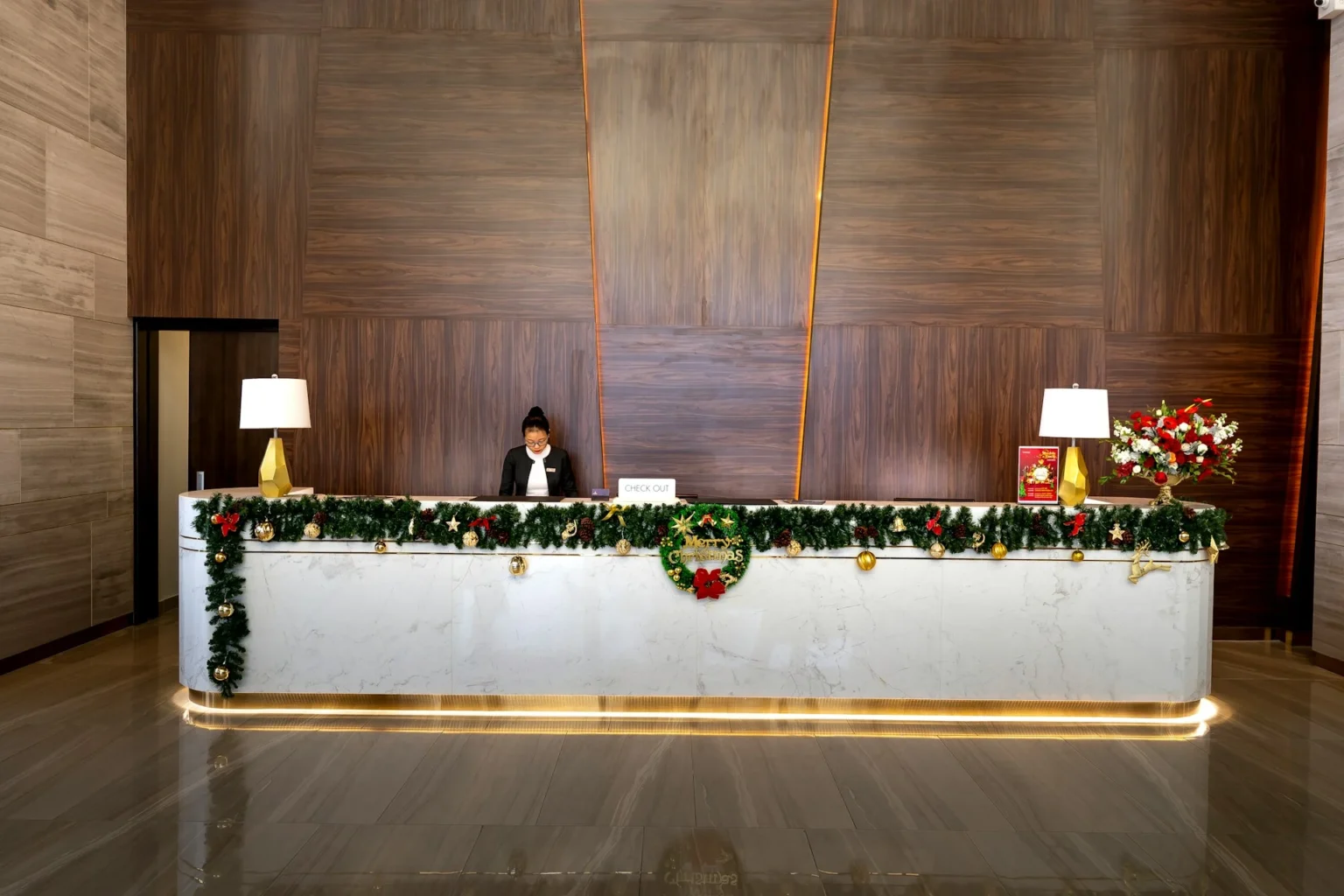
This hotel front desk training manual gives training managers a clear structure to build a steady, sharp front office team. A front desk agent handles more guest talk in one shift than anyone else on the floor. Picture a 100-room hotel running at 75% full: the front desk team works check-ins, check-outs, complaints, requests, and upsells across three shifts, every single day. Soft skills training courses in Bangalore and across India put more weight on front office training each year, since one badly handled moment at the desk can undo what a dozen housekeeping and F&B staff got right. The four modules below give training managers a clear, 30-day path for onboarding.
Key Takeaways – Front desk agents handle more direct guest touchpoints per shift than any other single role, making front office training one of the highest-value training investments for guest scores – The gap between a trained and untrained agent shows up most in complaints and upselling. Both need real script practice, not just book facts. – A working hotel front desk training manual covers four modules: property knowledge, systems skill, service standards, and revenue skills
What Does a Hotel Front Desk Training Manual Cover?
A full hotel front desk training manual is not a rule book. It answers the one question every new front office hire keeps asking: “What do I really do when this happens?”
The manual covers four modules, one after another, spread across 30 to 45 days of onboarding:
- Module 1, Property and product knowledge (Days 1–5): Floor plan, room types, rate types, F&B outlets, perk spots, local area knowledge
- Module 2, Systems and tools (Days 6–15): PMS use, booking handling, rate loading, room blocking, cashiering, night audit basics
- Module 3, Guest service standards (Days 16–25): Check-in and check-out flow, complaint handling, special requests, phone manners, written talk
- Module 4, Revenue skills (Days 26–30): Upselling techniques, walk-in rate haggling, loyalty programme sign-up, group sync
Training does not end on Day 30. The first month builds the basics, and the six months after that build real trust and good judgment through watched-over work on the floor.
Module 1: What Property and Product Knowledge Do New Hires Need?
A front desk agent who does not know their own property cannot stand for it. The property knowledge module covers:
Room types and selling points: – Each room type, floor location, view, and unique feature – Rate types: rack, corporate, BAR, package, free – Upgrade logic: which rooms to offer for upsell, at what price gap – Access rooms: location, features, booking limits
F&B and extras: – Restaurant names, cuisine types, open hours, dress code, booking need – Bar location and hours, any dry times or licencing limits – Pool, spa, gym: hours, advance booking need, age limits – Business centre, meeting rooms: booking process, tech specs, catering lead time
Local area: – Nearest airport routes, rough transit time by auto, cab, Metro – Key hospitals, chemists, ATMs, petrol stations within 2 km – Restaurants and food apps locals suggest (not rival F&B, nearby standalone spots) – Places of worship within walking distance
Property knowledge gets tested on Day 5 with a closed-book written test. A trainee needs a score of 80% or higher before moving on to Module 2.
Module 2: What Systems and Tools Should Front Desk Agents Master?
Front desk tech skill is what splits a trained agent from one who slows down the check-in line. The systems module runs hands-on from Day 6, since reading manuals with no practice time builds no real skill at all.
PMS core functions: – Searching and pulling bookings by name, confirm number, or room number – Checking in: ID check, key card setup, folio preview – Room blocking: using likes, noting housekeeping rank, blocking next rooms for families – Cashiering: posting charges, taking payment, splitting folios, voiding payments – Checking out: billing review, payment work, loyalty points update, room status trigger
Common system cases (train exactly for these): – No-show handling: booking hold, rule use, logging – Walk-in rate loading: BAR check, open rooms scan, manual rate override with lead approval – Group block release: pick-up tracking, cut-off date handling, rooming list import – System down procedure: paper-based backup, manual cashiering, post-recovery data balancing
Many Indian mid-scale hotels run on Opera, IDS, or Hotelogix. Train on the real live system in a test setup, not on screenshots. Agents who only ever see the PMS during training rarely build real speed once the pressure hits.
Module 3: What Guest Service Standards Do Front Desk Staff Need?
Service standards are the hardest module to teach, since they demand a real change in behaviour, not just facts passed along. Three spots need scripted, role-played practice:
Check-in and check-out scripts: Scripts are not rigid, they set the base tone and order, so agents can flex easily instead of winging the whole thing from scratch. A check-in script covers: greeting the guest by name, confirming their booking, ID collection, room assignment and an upgrade offer, key card handoff, a quick route walk-through, and a warm close that invites them to call for anything.
Complaint handling using the LEARN model:
– Listen: give the guest 60 seconds without break-in
– Empathise: acknowledge the trouble without dodging blame
– Apologise: brief and genuine, not defensive
– Resolve: state clearly what you will do and by when
– Notify: follow up to confirm the issue was resolved
Front-of-house training quality is consistently one of the operational areas Indian hotels invest in as service standards professionalise, since it is the front desk team that shapes a guest’s first and last impression of the property, a responsibility formally recognised in the Tourism and Hospitality Skill Council’s Guest Service Associate (Front Office) qualification pack (THC/Q0102). The guest experience, start to finish, gets shaped by the front desk team’s first six months on the job, and those skills can be taught with the right setup. food and beverage training programmes programmes build these skills on purpose, rather than leaving staff to pick them up bit by bit on the floor. Role-play is not optional here: agents who practise complaint cases ahead of time handle the real thing far better.
Telephone manners: Pick up within three rings. Ask before you put a guest on hold, and check back every 30 seconds. Get the message right, and send calls to the correct extension. Taking clear notes on a call is a trained skill, not something that comes easily to most people.
Module 4: How Do Front Desk Agents Build Revenue Skills?
Front desk upselling lifts RevPAR without adding a single new booking. Indian hotels routinely skip real training here, since it feels too much like “sales,” and most front office managers were never trained in that themselves.
Room upselling framework: – Offer an upgrade at check-in, before assigning the base room – Frame the offer around the guest’s benefit, not the price gap: “We have a superior room on a higher floor with a better city view, would you like to take a look at that option for an extra Rs 800?” – Do not say sorry for the upsell offer. Offer it boldly and once. – Record every upsell attempted and converted, this data trains future cohorts
Walk-in haggling: Walk-ins often expect a discount. Train agents to lead with value first, “What we have available right now is our Superior room at Rs 4,500, which includes free breakfast”, before any talk of rate flex. Rate flex should always need lead approval, with a reason written down.
Loyalty programme sign-up: Enrolment at check-in gets skipped far too often at Indian properties. Train agents to offer it to every non-member at check-in, with a one-line pitch tied to that guest’s own travel pattern: “Since you travel often to Bengaluru, our loyalty membership gives you built-in rate rank and F&B credits, it takes two minutes to enrol.”
Our guide on hotel and front office management training frameworks covers the lead-level side of building and sustaining a high-performing front desk team beyond the initial onboarding period.
How Do You Roll Out the Training Manual Across All Shifts?
The manual only works if it reaches every shift, night shift included, since that shift often gets the least real training. A few points on rollout:
- Appoint a shift trainer for each shift, a senior staffer (not always the shift lead) who owns the training quality for their hours
- Train trainers before rolling out the manual: a shift trainer who does not understand the thinking behind each section will compress or skip content under daily pressure
- Use a 30-60-90 day sign-off system: trainees sign off on each module, and the Training Manager countersigns at each point
- Build an test into the manual, not added later: closed-book written tests, watched role-play, and live check-in performance watch are the three test types
Conclusion
A good training manual stays alive and changes over time, it is not a binder printed once and forgotten. Build the framework above, test it during onboarding, update it every quarter, and train your shift leads to treat it as a real daily reference, not just a box to tick. For help building a structured front office training programme, reach out to our team.
Frequently Asked Questions: Hotel Front Desk Training
Q: What should a hotel front desk training manual include? A: A full manual for this role covers four spots: property and product knowledge (room types, extras, local area), systems skill (PMS work, cashiering, night audit basics), guest service standards (check-in and checkout steps, complaint handling, phone manners), and revenue skills (upselling, walk-in handling, loyalty sign-up). Build it as a 30 to 45 day step-by-step programme, not a reference doc people just skim.
Q: How long does front desk training take in a hotel? A: Basic front desk skill takes 30 to 45 days through a structured programme covering all four modules. But real skill, handling tough cases, system errors, and hard guests with no one watching, only comes after 4 to 6 months of watched-over floor time. Hotels that call training “done” at Day 30 see more errors and lower guest scores than those that keep mentoring going for 90 days.
Q: What is the most important skill for a hotel front desk agent? A: Complaint handling is the single skill that moves the needle most for front desk work, since it decides whether a service slip turns into a good story the guest tells others, or a bad review. Tech skills like PMS use can be picked up in two weeks; complaint handling needs scripted practice and real feedback loops that take months to build.
Q: What PMS systems are used by hotels in India? A: The PMS tools most Indian hotels run are Opera (IHG, Marriott, Hyatt properties), IDS Next (common in mid-market Indian chains), Hotelogix (solo and boutique properties), and eZee (smaller solo hotels). Train on the real system your property runs, since mixing systems in training just breeds confusion. Each PMS handles the same task in its own way.
Q: How do you train front desk staff on upselling? A: Upselling training needs three things: real product knowledge (agents cannot sell what they do not get), a scripted offer they’ve practised until it sounds natural, not stiff, and tracked results with steady feedback. Training managers who just tell agents to “upsell more,” with no script practice, see weak results at best. Role-play the upsell chat at least three times before you send it live on the floor.