French service is a formal style of restaurant service in which food is presented or finished beside the guest’s table, so the guest sees each dish at its best before it is eaten. It is slower and more skilled than plated service, which is why it sits in fine-dining rooms rather than busy cafes. Adevo’s food and beverage training courses cover it as part of the classic service set, and this guide explains what a trainee needs to know.
Take Aditi, a trainee captain at a fine-dining room in Bengaluru. In her first month she was told to learn this style. Her seniors showed her two different versions on two different nights, and she asked which was correct. The honest answer was: both. That confusion is common, and it is where this guide starts.
Key Takeaways
- French service is a formal style where dishes are presented or finished at the table, with more ceremony than plated service.
- Indian textbooks describe two versions: dishes shown to guests who help themselves, and dishes finished on a trolley.
- It needs highly skilled staff, more time per course and a floor with space to work.
- Trainees should learn plated service first, then move to French service with supervised practice.
What Is French Service in F&B?
This style is a formal table-service style in which food arrives in serving dishes and is presented, portioned or finished at the guest’s table. It is one of the most personal and elaborate classic styles. Guests get attention, a view of the dish and a sense of occasion that a plated meal does not give.
The term has two meanings in practice. Classic French service, from the French tradition of household dining, presents a covered dish to each guest, who serves themselves. Modern restaurant this style finishes the dish beside the table, often on a trolley. Study material used in Indian hotel management courses describes both, so trainees meet both.
What Are the Two Versions of French Service?
Both versions rely on the same idea, which is that the table is the stage. They differ in who does the work.
- Presented service: the waiter brings the dish, shows it to each guest from the left and lets the guest take what they want.
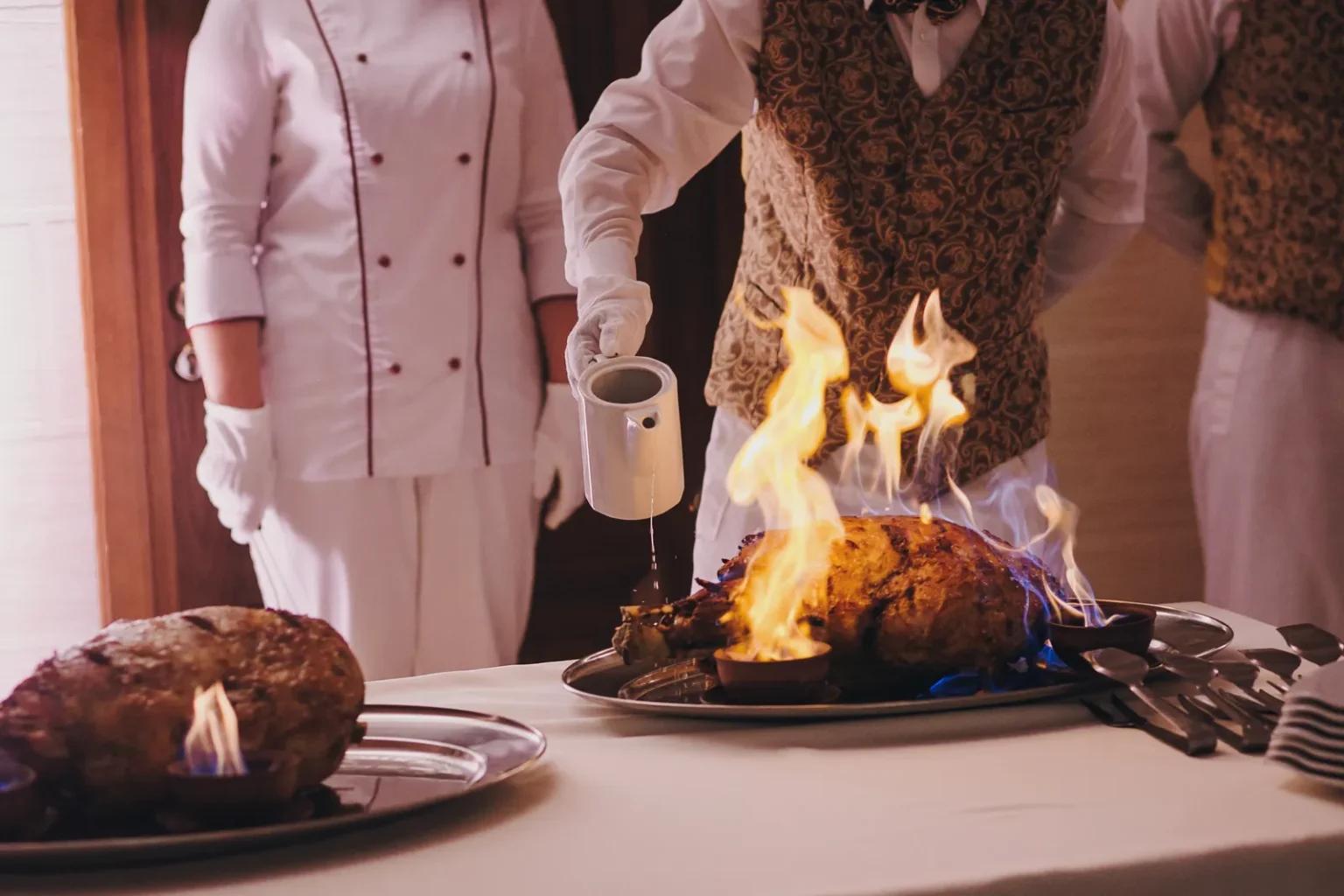
- Finished service: the waiter prepares, carves or plates the dish at a trolley beside the table and then serves the guest.
eGyanKosh, IGNOU’s open learning repository, describes the first version: the dish, with its lid, is presented to the left of each guest, who serves themselves. The second version is closer to what fine-dining rooms call this style today. Before you train anyone, decide which version your outlet means and use one name for it.
How Does French Service Work Step by Step?
The steps below follow the finished-at-the-table version, which is the one most trainees are asked to learn. Adapt the middle steps if your outlet uses the presented version.
- Set the table: lay the cover for the courses and place a clear space for the trolley.
- Prepare the trolley: check burners, plates, serving tools and garnish before the course.
- Present the dish: bring it to the table so the guest sees it before it is touched.
- Finish at the table: carve, portion, plate or flambe in front of the guest, calmly and cleanly.
- Serve the guest: place the plate in front of each guest in the outlet’s fixed order.
- Clear and reset: remove the course, wipe the trolley and prepare for the next.
Speed is never the goal here. Smooth, unhurried movement is what the guest is paying for. Trainees who want to build the confidence this needs can start with our soft skills training courses in Bangalore alongside floor practice.
What Skills Does French Service Need?
This style needs more skill per guest than most styles. A waiter must work with tools, talk to the guest and keep the table calm all at once. Hotel management textbooks describe this style as very exclusive and personalised, requiring highly skilled staff and found in luxury dining establishments.
The main skills are:
- Tool handling: carving knives, service spoons and forks used safely and neatly.
- Timing: finishing each dish while the rest of the table waits comfortably.
- Communication: explaining the dish briefly without interrupting conversation.
- Hygiene: clean hands, tools and trolley at every course.
- Composure: staying calm if a flame flares or a dish slips.
Rehearsal builds each of these. Nobody should perform this style on a paying guest without having practised it several times in the back of house.
What Are the Advantages and Limits of French Service?
The main advantage is the experience it creates. Guests see the dish, feel looked after and often remember the evening. It also lets the restaurant charge for the ceremony.
The limits are practical:
- Slow pace: fewer covers per hour than plated service.
- High labour cost: more skilled staff are needed for each table.
- Space needs: a trolley needs room to move between tables.
- Risk: open flame and knives demand careful handling.
Rohan, a restaurant owner in Mumbai, added this style to eight tables on weekend evenings. Average spend per table rose, but complaints about slow service also rose until he limited the style to tables that booked it in advance. The lesson was simple: this style works when guests know to expect it.
How Does French Service Differ From Other Styles?
French service moves the finishing from the kitchen to the table. That one change affects staffing, pace and price.
| Style | Where food is finished | Pace |
|---|---|---|
| American | Kitchen | Fast |
| English | Table, host or waiter serves | Medium |
| French | Beside the table | Slow |
| Russian | Table, platter to plate | Slow |
Many menus combine styles. A dinner might open with plated starters, move to this style for the main course and end with a trolley dessert. For a full workflow, our guide to F&B service training shows how outlets stage practice for each style.
Where Is French Service Used in India?
This style is used mostly in fine-dining restaurants, luxury hotel specialty rooms and private dining for special occasions. It is seldom the default style. Most outlets keep plated service for daily trade and bring in this style for anniversaries, tasting menus and private bookings.
If your outlet is thinking of adding it, start small. Offer it for one course at a handful of tables and train the team on that course until it is smooth.
What Mistakes Do Trainees Make at the Trolley?
Most errors come from rushing or from a cluttered trolley. A trainee who reaches across a guest, or who leaves a used tool on the trolley top, breaks the calm that this style depends on. Set up once, check twice and keep every tool in its place.
Watch for these slips:
- Cold plates: serving a finished dish on a plate that has not been warmed.
- Crowded trolley: carrying too many items, so the course looks messy.
- Silent service: working without a word, which leaves guests unsure what is happening.
- Unchecked flame: lighting a burner before checking the space around it.
Have a senior waiter walk the floor during practice and name each slip as it happens. Quick, calm corrections build confidence faster than a long debrief afterwards, and trainees keep the habit once they work live tables.
How Do You Train Staff in French Service?
Train this style in layers. First teach tray carrying and plated service, then trolley handling, then the finishing technique for one dish. Add a second dish only when the first runs without errors.
Use role-play. One trainee plays the guest and another performs the course, and a senior watches. Give feedback on posture, speed, cleanliness and conversation, in that order. Our guide to the types of restaurant service helps supervisors plan where French service fits in the wider mix.
Want your captains ready for confident tableside service? Ask about Adevo’s F&B training for fine-dining teams built around your outlet.
Conclusion
This style turns a meal into an occasion, and it demands the most from the team. Learn the two versions, choose one for your outlet and train it in steps. Start with plated service, add this style for select tables and build from there.
Adevo’s F&B programmes help your team move from plated basics to confident tableside service.
Frequently Asked Questions: French Service
Q: What is French service in F&B?
A: French service is a formal style in which dishes are presented or finished beside the guest’s table. Some versions let guests help themselves from a presented dish, while modern restaurant versions finish the dish on a trolley.
Q: From which side is food served in French service?
A: In the classic presented version, the dish is offered from the guest’s left so the guest can take food easily. Outlets set their own side rules for finished service, so follow your property’s standard.
Q: What is the difference between French service and Russian service?
A: French service finishes or presents food at the table, often with a trolley. Russian service serves food from a platter onto each guest’s plate. Both are formal, but this style is more theatrical.
Q: Is French service the same as gueridon service?
A: They are closely linked. Gueridon service is the trolley technique used inside the finished version of this style. Not every French service uses a trolley.
Q: Where is French service used in India?
A: It is used in fine-dining restaurants, luxury hotel specialty rooms and private dining for special occasions. Most outlets keep plated service for daily trade.