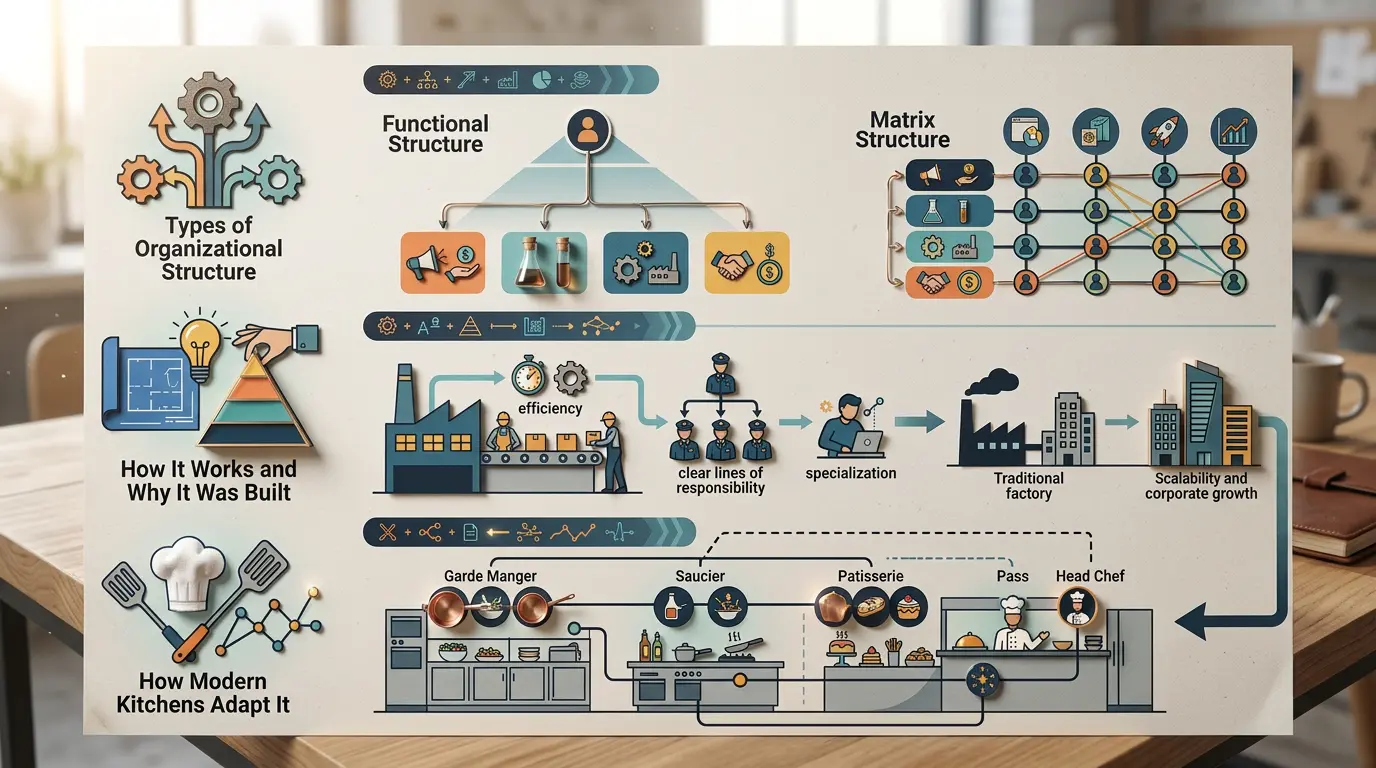
Every kitchen that runs smoothly during a 300-cover Saturday night service has an invisible architecture holding it together. That architecture has a name: organizational structure. If you’ve enrolled in hospitality management courses or spent any time managing a busy hotel or restaurant, you already feel this structure at work – even if you’ve never named it. The Executive Chef calls a ticket. The Chef de Partie fires the garnish. The Commis preps without being asked twice. That’s not luck. That’s structure.
This article covers every major type of organizational structure, explains why each one was built, and maps each type to real kitchen and hotel parallels. The 500-room property in Mumbai and the 30-seat restaurant in Coimbatore both have a structure – most owners just can’t name theirs.
Key Takeaways
- The 7 core types of organizational structure are: hierarchical, functional, divisional, matrix, flat, team-based, and network – each with a direct kitchen or hotel parallel
- Auguste Escoffier’s brigade de cuisine (1880s) is the oldest living example of hierarchical organizational structure in any industry
- A 5-star hotel kitchen with 30+ staff needs a fundamentally different structure than a cloud kitchen running 4 people
- Choosing the wrong structure for your operation size is one of the most common and least-discussed causes of service breakdown
What Is Organizational Structure?
Organizational structure is the system that defines how roles, responsibilities, authority, and communication are organized within a business. It answers three questions: who reports to whom, who makes which decisions, and how information flows from the top to the front line.
Understanding the types of organizational structure matters before you can choose the right one. In management theory, structure is not just an org chart diagram. It’s the operating system of your business. It determines whether your kitchen runs on clear accountability or constant confusion. Done right, it means a new Commis knows exactly who to ask when the mise en place runs low. Done wrong, it means three people assume someone else handled the fish order.
The five core elements of any organizational structure are:
- Chain of command – the reporting hierarchy from senior to junior roles
- Span of control – how many people a single manager directly supervises
- Centralization vs. decentralization – where decision-making authority sits
- Formalization – how much of the work is governed by documented rules and SOPs
- Departmentalization – how roles are grouped (by function, product, geography, or project)
Why does this matter for hospitality? Because unclear structure in a kitchen doesn’t just slow service. The types of organizational structure you choose directly affect missed tickets, duplicated prep, and – at its worst – food safety failures. The FSSAI compliance chain alone requires a clear reporting structure: who is responsible for temperature logs, who signs off on hygiene checks, who escalates a supplier quality issue. None of that works without structure.
Properties that invest in getting their structure right scale without chaos. A clear reporting line means a new hire knows who to escalate a guest complaint to on day one, instead of guessing across three possible supervisors. That clarity compounds every time you add a shift, a department, or a property.
Why Organizational Structure Was Built – A Brief History
Organizational structure didn’t emerge from a boardroom whiteboard. It was built under pressure – in army camps, factory floors, and chaotic hotel kitchens that needed order fast.
From Military Ranks to Corporate Departments
In 1916, Henri Fayol published his 14 principles of management, formalizing what factory owners in industrial France had been practicing for decades. Fayol’s principles codified the functional structure: divide work by specialization, unify command so each person reports to one boss, and create a scalar chain of authority from top to bottom. Max Weber built on this with his bureaucracy model – clear rules, defined roles, authority based on position rather than personality. These two thinkers gave the corporate world its first vocabulary for structure.
What Fayol didn’t know was that a French chef had already applied the same logic to a kitchen twenty years earlier.
Escoffier’s Brigade de Cuisine – The Kitchen That Changed Everything
Auguste Escoffier served in the French army during the Franco-Prussian War (1870-71). What he observed there – military precision, rank-based authority, each unit with a specific function – stayed with him when he took over the kitchen at the Savoy Hotel in London and later the Ritz Paris.
The 19th-century French hotel kitchen was chaos. Multiple cooks working the same dishes. No clear ownership. Food inconsistency. Duplicated effort. Escoffier’s solution was to apply military organizational thinking directly to the kitchen: divide the kitchen into stations (parties), assign one specialist per station, and create a strict hierarchy from Executive Chef down to apprentice. The result was the brigade de cuisine – a hierarchical organizational structure with 20+ distinct positions, each with defined responsibilities.
This wasn’t just a culinary innovation. It was a structural one. Escoffier solved the kitchen’s operational problem the same way Fayol solved the factory’s: through clear roles, clear authority, and clear accountability.
The brigade system remains the foundation of every professional kitchen worldwide. Walk into a Taj hotel kitchen in Delhi or a standalone fine-dining restaurant in Bengaluru – you’ll see Escoffier’s logic running the show. The structure outlived the man by over a century.
In our work training kitchen teams across Indian hotel properties – from Taj to mid-scale business hotels in tier-2 cities – the breakdown we see most often isn’t a skill gap. It’s a structural gap. Teams where roles overlap, where authority is ambiguous, where a Commis isn’t sure whether to take instructions from the Sous Chef or the CDP on station. Structure, or the lack of it, is the invisible variable in most kitchen performance problems.
7 Types of Organizational Structure Explained
Not every kitchen should look like a Ritz brigade. The right structure depends on your scale, service format, and workforce. Here are all seven types, with a direct hospitality parallel for each.
The 7 types of organizational structure are:
- Hierarchical structure – layered authority, clear chain of command
- Functional structure – grouped by department or specialization
- Divisional structure – self-contained units by product, region, or market
- Matrix structure – dual reporting lines across functions and projects
- Flat (horizontal) structure – minimal management layers, wider spans
- Team-based structure – cross-functional teams around specific goals
- Network structure – core functions retained, non-core outsourced
1. Hierarchical Structure
Hierarchical structure is the classic pyramid: authority flows top-down, every person has exactly one supervisor, and ranks are clearly defined. It’s the oldest and most widely used type of organizational structure in management.
This structure gives you clear accountability, a defined career path, and the ability to scale operations without ambiguity. Every person knows their rank, their role, and who to escalate to. The downside is that decisions move slowly – information has to travel up and back down the chain – and silos can form between levels.
Kitchen parallel: the classical brigade de cuisine. The kitchen hierarchy runs exactly this way:
- Executive Chef holds authority over the entire kitchen
- One or two Sous Chefs managing sections below
- Chefs de Partie each owning a station (fish, meat, sauce, pastry, larder)
- Demi Chefs and Commis handling execution
- Apprentices and Plongeurs at the base
This is organizational structure theory made edible. Span of control is narrow (each CDP manages 2-3 Commis), formalization is high (SOPs govern every station), and authority is unambiguous. During peak service, no one questions the chain. That’s the point.
You’ll find this in:
- 5-star hotel kitchens at Taj, Oberoi, ITC, Leela
- Large banquet operations running 500+ covers
- Any property with 20+ kitchen staff
2. Functional Structure
Functional structure groups people by specialization or department. A hotel doesn’t organize by product (Room 201 vs. Room 202) – it organizes by function: Front Office, Housekeeping, F&B, Engineering, Finance, HR. Each function has its own head who reports to the General Manager.
The strengths are deep expertise within functions and efficient resource allocation. The weakness is classic: F&B and Housekeeping rarely communicate well, which is why a room service order can get lost between departments.
Kitchen parallel: hotel departmental structure. The F&B Department operates as one functional silo under the F&B Manager. Within it, the Kitchen and Restaurant Service are sub-functions. The Executive Chef owns the kitchen function; the Restaurant Manager owns the floor. They report upward to the F&B Director, who reports to the GM. See hotel organizational chart for the full front-office and back-of-house connections.
This is the dominant structure in mid-to-large Indian hotels. An IHCL property in Chennai runs this way. So does most of the Lemon Tree portfolio. Each department is a functional unit with its own SOPs, reporting lines, and performance targets. Hotel org charts typically vary by property tier — a five-star property and a budget hotel in the same city rarely share the same structure. This is one of the types of organizational structure where Indian hotels have developed the most localised variations.
In practice:
- Mid-to-large hotels with 100+ rooms
- Standalone F&B chains with 5+ outlets
- Properties where department expertise matters more than speed
3. Divisional Structure
Divisional structure creates self-contained business units organized by product, geography, or customer segment. Each division has its own resources – its own kitchen, its own management, its own P&L. The corporate centre provides shared services and oversight but doesn’t run each division’s day-to-day.
The benefit is focused accountability and faster local decision-making. A regional GM can make hiring calls without approval from headquarters. The cost is duplication – each division runs its own procurement, HR, and training function.
Kitchen parallel: regional hotel chains. Taj Hotels organizes by geography: North India operations run differently from South India, which runs differently from International. Each regional cluster has its own Executive Chef standards, regional cuisine programmes, and F&B protocols, all under Taj’s overall brand umbrella. ITC’s WelcomHotel brand does this too — each property is a semi-autonomous unit within the larger divisional structure.
Restaurant chains with 10+ outlets often shift to divisional structure by city or zone. A QSR chain operating in Delhi, Mumbai, and Bengaluru will typically have a city-level F&B head who runs all outlets in their geography.
Common in:
- Multi-property hotel groups
- National restaurant chains
- Franchise operations
- Indian chains expanding city by city (most practical structure for geographic scale)
4. Matrix Structure
Matrix structure is the most complex of the seven types. Employees report to two bosses simultaneously – a functional manager (their department head) and a project or product manager (who owns a specific initiative or outlet). The result is a grid of authority rather than a pyramid.
The advantage is flexibility: you can pull specialist skills across functions for specific projects without permanently reorganizing teams. The disadvantage is potential confusion – when both bosses give conflicting instructions, who wins?
Kitchen parallel: banquet and event kitchens. Imagine a Sous Chef at a large convention hotel in Gurgaon. On a regular service day, they report to the Executive Chef (functional authority). But when a 600-pax corporate gala is running, they’re also taking direction from the Events Manager (project authority) on timing, menu sequencing, and buffet layout. Two bosses. Two sets of priorities. The kitchen team has to navigate both.
This is one of the least-discussed aspects of kitchen management in India’s large resort and convention properties. The organizational structure shifts between hierarchical (during normal service) and matrix (during events), sometimes within the same week.
Typical in India:
- Convention hotels
- Resort properties with multiple F&B outlets and banquet operation
- Catering companies running simultaneous multi-venue events
5. Flat (Horizontal) Structure
Flat structure reduces or eliminates middle management layers. Instead of a pyramid with multiple levels, you have a Senior Manager directly supervising a wide team of individual contributors. The span of control is broad. Decisions move fast. Bureaucracy is minimal.
The benefits are speed and staff empowerment. The risks are manager overload and role confusion at scale – when the person at the top is also handling inventory, expediting tickets, and managing a difficult guest, something drops.
Kitchen parallel: small restaurants and cloud kitchens. A 40-cover standalone restaurant in Pune might run with a Head Chef and two line cooks. The Head Chef is simultaneously the Executive Chef, the CDP, the Sous Chef, and the expeditor. There’s no brigade — there’s barely a hierarchy. Flat structure by operational necessity, not by design.
Cloud kitchens take this further. A Swiggy or Zomato-listed cloud kitchen brand running out of a shared commissary in Bengaluru might operate with 3-4 people and zero traditional hierarchy. The Head Cook calls the shots. Everyone else executes. Decisions happen in real time.
Where you see it:
- Standalone restaurants under 50 covers
- Cloud kitchens and dark kitchens
- Cafe operations and pop-up formats
6. Team-Based Structure
Team-based structure organizes work around cross-functional teams formed for specific goals or projects, rather than around permanent departments. Teams are fluid, assembled for a purpose, and disbanded or reformed as needs change.
The strength is agility and shared ownership. The weakness is that authority can get murky – who leads when everyone is a peer?
Kitchen parallel: pre-opening task forces and menu R&D teams. When a new hotel prepares to open its restaurant in India, the pre-opening kitchen team is typically a temporary cross-functional squad: an Executive Chef brought in from the group’s flagship property, a Sous Chef from a regional property, and several CDP-level specialists hired for the opening. They work as a team to build menus, set up stations, write SOPs, and train the permanent staff. Once the property opens and runs stably, the structure shifts to hierarchical.
Menu development works this same way. A pastry chef, a main kitchen CDP, and a consultant may form a temporary R&D team to develop a seasonal menu. No fixed hierarchy. Shared ownership of the output.
You’ll find this in:
- Hotel pre-opening phases
- Food festival teams
- Seasonal menu development
- Catering event squads
7. Network Structure
Network structure keeps the core of the organization lean while outsourcing non-core functions to specialist partners. The organization defines what it does best – brand, product, quality control – and contracts out everything else.
The advantage is scalability without overhead. The risk is dependency on external partners and less direct control over quality and consistency.
Kitchen parallel: cloud kitchen brands and franchise models. A virtual restaurant brand operating on Swiggy might own only the menu and the brand. Commissary prep, packaging, delivery logistics, and even sometimes the cooking itself is contracted to partner kitchens. The brand controls the recipe and the customer experience. Everything else is networked.
Marriott and Hilton use this model at the property level — they manage hotels they don’t own, collecting management fees while hotel owners carry the asset risk. The brand is the core. Operations are networked.
Common in:
- Virtual restaurant brands
- Franchise QSR models
- Hotel management companies
- Dark kitchen aggregators
For real-world examples of how these structures work across hotel size and service format, see organizational structure examples from actual Indian properties.
Comparison Table – Structure Types at a Glance
| Structure | Chain of Command | Decision Speed | Best For | Kitchen / Hotel Parallel |
|---|---|---|---|---|
| Hierarchical | Clear, top-down | Slow | Large operations, 20+ staff | Classical brigade de cuisine, 5-star hotel kitchens |
| Functional | By department | Medium | Mid-large hotels, 100+ rooms | Hotel departmental structure (F&B, FO, HK) |
| Divisional | By region/product | Fast locally | Multi-property chains | Taj regional clusters, QSR chains by city |
| Matrix | Dual reporting | Variable | Large resort + banquet ops | Convention hotel kitchens, multi-outlet resorts |
| Flat | Minimal layers | Fast | Small restaurants, cloud kitchens | Standalone 30-40 cover restaurant, cloud brand |
| Team-based | Peer-led | Fast | Project-based, pre-opening | Pre-opening task forces, menu R&D teams |
| Network | Core only | Fast for core | Asset-light brands | Virtual brands, management contract hotels |
The Kitchen Hierarchy – Organizational Structure in Action
The brigade de cuisine is not just a list of job titles. It’s a living case study in hierarchical organizational structure, designed specifically for the pace and precision demands of professional cooking.
Classical Brigade de Cuisine Roles
The classical brigade (still the basis of Indian hotel kitchen structures) runs as follows:
- Executive Chef (Chef Exécutif) – overall authority; responsible for menus, food costs, and staff
- Sous Chef – second in command; manages daily kitchen operations; may specialize by meal period or outlet
- Chef de Partie (CDP) – station specialist; runs one section of the kitchen (fish, meat, sauce, pastry, garde manger)
- Demi Chef de Partie – assists the CDP; supervises Commis on the station
- Commis Chef – trained cook working under CDP supervision; handles prep and service execution
- Apprentice / Trainee – entry-level; learning through supervised practice
- Plongeur – kitchen porter; dishwashing and basic prep; the load-bearing base of the kitchen
Here’s what the textbooks don’t say: the brigade is not just about authority – it’s about span of control optimization. Each CDP manages 2-3 Commis. Each Sous Chef manages 3-5 CDPs. This isn’t arbitrary. It reflects the maximum span of control that allows a kitchen supervisor to monitor quality, respond to mistakes, and maintain standards during peak service. When a CDP is managing 6 Commis across a high-volume station, quality breaks down. That’s not a people problem – it’s a structural one.
In the classical Escoffier system, there were 20+ named positions. A fine-dining kitchen at a large Taj or Oberoi property today might run 14-18 positions. But most modern kitchens compress this significantly.
How Hotel Size Changes the Structure
The organizational structure of a kitchen changes directly with the scale of the property:
- 5-star hotel (500+ rooms): 30-50 kitchen staff, multiple Sous Chefs (one per meal period or outlet), full brigade by station, dedicated pastry department, possibly a separate banquet kitchen team. True hierarchical structure with 5-6 layers of authority.
- Mid-scale hotel (100-200 rooms): 10-20 kitchen staff, one or two Sous Chefs, CDPs covering multiple stations (the Sauce CDP might also cover Fish), compressed brigade. Still hierarchical but with fewer layers and wider spans of control.
- Small / boutique hotel (under 50 rooms): 4-10 kitchen staff, the Head Chef is a player-manager who also works a station and manages inventory. Flat structure with one or two layers of authority at most.
- Cloud kitchen (3-5 people): No traditional hierarchy. The Head Cook or Kitchen Manager holds all authority. Each cook handles multiple roles. Network structure elements appear as prep work is outsourced or commissioned.
This compression is why the phrase “kitchen organization chart” means different things depending on the property. There’s no single org chart that fits every operation. And that’s precisely the point: the right organizational structure is the one that fits your actual scale, service format, and workforce.
How Modern Indian Kitchens Adapt Organizational Structure
The classical brigade system was designed for a stable, well-staffed kitchen. Indian hospitality in 2026 rarely gives you either. Understanding the types of organizational structure available – and which ones are realistic for your staffing reality – is the starting point for any kitchen redesign.
Cross-Training and Role Compression
In tier-2 and tier-3 Indian cities – Nashik, Mysuru, Madurai, Jaipur – mid-scale hotels frequently operate meaningfully short of their optimal kitchen staff count. The hierarchical structure that works at a Bengaluru 5-star doesn’t work when you have 6 cooks doing the work of 12.
The adaptation is cross-training: deliberately training each cook across multiple stations so they can cover gaps when colleagues don’t show up. A CDP who can work both the Hot Kitchen and the Salad station is more valuable than one who can only work one. The structure becomes more flat in practice, even if the org chart still says hierarchical.
The deeper problem is India’s hospitality workforce shortage. India’s travel and tourism sector supports tens of millions of jobs directly and indirectly (IBEF), and skilled-role vacancies remain hard to fill even as the sector expands post-pandemic. This isn’t an abstract HR concern. It’s a structural constraint that forces kitchens to adapt their organizational design every time they’re understaffed.
For a role-by-role breakdown of how the brigade works in practice, our guide on kitchen hierarchy covers every position from Executive Chef to Plongeur and how the reporting lines hold up in Indian kitchens.
Technology Flattening the Hierarchy
Kitchen Display Systems (KDS) are changing the information flow that traditional hierarchy was built to manage. In a classical brigade, the Sous Chef called orders and managed sequencing. That verbal chain of command was the engine of kitchen coordination.
With KDS, tickets flow directly to each station’s screen. The Commis on the hot section doesn’t need to wait for the CDP to relay the order – they see it in real time. Digital SOPs mean a junior cook can reference the exact preparation standard without asking a senior. This doesn’t eliminate hierarchy, but it reduces dependency on the chain of command for routine information.
The structural implication: as kitchen technology matures, middle-layer roles that exist primarily to pass along information start losing their value. The CDP who only relays orders from the Sous Chef to the Commis is being replaced by a screen. The CDP who coaches, audits, and catches quality issues before they reach the pass – that person becomes more valuable.
The Indian Context – Language, Scale, and Attrition
Indian kitchens have a structural challenge that no Western management textbook addresses: the multilingual workforce. A mid-scale hotel kitchen in Chennai might have Sous Chefs communicating in English, CDPs in Tamil, and Commis staff in Tamil and Telugu. A business hotel in Hyderabad might run three working languages simultaneously.
Hierarchical structure is particularly important in this context – not as a rigid authority tool, but as a clarity tool. When language creates communication gaps, clearly defined roles and written SOPs compensate. A Commis who doesn’t fully understand verbal instructions can follow a written preparation SOP. FSSAI compliance documentation adds a regulatory layer to this: every kitchen’s reporting structure must include a clearly designated Food Safety Supervisor with documented authority.
High attrition (a persistent reality in Indian hospitality, particularly at the Commis and CDP levels) compounds this. Kitchens where structure is person-dependent – where everything runs because of one experienced CDP’s tribal knowledge – collapse when that person leaves. Structure that is documented and system-driven survives attrition. Structure that lives only in people’s heads doesn’t. This is why choosing from the right types of organizational structure – and then documenting it – matters as much as training the team.
How to Choose the Right Organizational Structure
The question isn’t “which structure is best?” It’s “which structure fits my operation?” Every one of the types of organizational structure covered in this article has a legitimate use case. The mistake is applying a 5-star brigade model to a 6-person restaurant, or running a 500-room hotel kitchen on an informal flat structure.
For Hotels and Large F&B Operations
The general rule: 15+ kitchen staff means you need a hierarchical or functional structure with documented reporting lines. Below 15, you can run flat or team-based.
Decision factors for larger operations:
– Number of covers at peak (banquet vs. a-la-carte changes the structure significantly)
– Number of outlets (each outlet may need a semi-autonomous structure)
– Staff tenure and skill level (a team with high turnover needs more formal structure)
– FSSAI compliance complexity (more outlets = more layers of food safety reporting)
A 200-room business hotel running three F&B outlets needs at least three CDPs (one per outlet kitchen) reporting to a Sous Chef, who reports to an Executive Chef. That’s hierarchical with functional sub-groupings – the most common hybrid seen in Indian mid-scale hotels.
For Restaurants, Cafes, and Cloud Kitchens
Under 10 kitchen staff: flat structure is almost always right. A Head Chef with 3-4 cooks reporting directly is a sustainable span of control for a small restaurant. Adding a middle layer doesn’t add value – it adds payroll and friction.
Cloud kitchens running multiple virtual brands from a single commissary should consider a network-flat hybrid: one kitchen manager with clear authority over operations, and specialist cooks who understand they’re cooking for multiple brand standards simultaneously. The brand identity is owned centrally. The cooking is flat and fluid.
Decision Matrix
| Operation Size | Service Format | Recommended Structure |
|---|---|---|
| Under 10 kitchen staff | A-la-carte, cafe | Flat |
| 10-20 staff | Mid-scale hotel, casual dining | Flat to Hierarchical (compressed brigade) |
| 20-40 staff | Full-service hotel, fine dining | Hierarchical |
| 40+ staff | 5-star hotel, large banquet | Hierarchical + Functional hybrid |
| Multi-property chain | Any | Divisional |
| Convention / resort | Banquet + multiple outlets | Matrix elements |
| Cloud kitchen, virtual brand | Delivery-only | Network + Flat |
Frequently Asked Questions: Types of Organizational Structure
Q: What are the 4 main types of organizational structure?
A: The four most commonly discussed types of organizational structure are hierarchical, functional, divisional, and matrix. These four cover the full range from rigid top-down command to flexible dual-reporting grids. Flat and team-based structures are increasingly important in modern operations, which is why most current frameworks extend the list to seven types.
Q: What is the best organizational structure for a hotel?
A: There is no single best answer across the types of organizational structure for hotels – it depends on property size and complexity. Most full-service Indian hotels use a functional organizational structure at the property level (departments grouped by specialization) combined with a hierarchical structure within each department, particularly in the kitchen. Large hotel chains use a divisional structure across properties.
Q: What is the kitchen brigade system?
A: The kitchen brigade system (brigade de cuisine) is a hierarchical organizational structure for professional kitchens, developed by Auguste Escoffier in the 1880s-1900s. It divides the kitchen into specialist stations, each run by a Chef de Partie, all reporting upward through a Sous Chef to the Executive Chef. The brigade system assigns one person clear authority and accountability for each function – the same principle behind modern functional and hierarchical org design.
Q: What is the difference between hierarchical and flat organizational structure?
A: A hierarchical structure has multiple layers of authority – each manager supervises a narrow group and reports upward to another manager. A flat structure removes those middle layers, giving senior managers a wider span of control and pushing more decision-making to front-line staff. In kitchen terms: a 5-star brigade is hierarchical. A 4-person cloud kitchen is flat. Neither is universally better – it depends on scale and the complexity of the operation.
Q: Why is organizational structure important in the hospitality industry?
A: In hospitality, structure determines three things that directly affect service quality: who is accountable for each task, how quickly decisions get made during a busy service period, and how clearly new staff understand their role. A kitchen with ambiguous structure produces inconsistent food, slow service, and unclear blame when things go wrong. A kitchen with clear structure produces the opposite – and that’s what guests experience as “good service.”
Q: How many types of organizational structure are there?
A: Most management frameworks identify 4-7 types of organizational structure. The four classical types are hierarchical, functional, divisional, and matrix. Modern frameworks add flat, team-based, and network structures for a total of seven organizational structure types. Some academic sources further subdivide these (line structure, line-and-staff, committee structure), but for practical operational purposes in hospitality, the seven-type framework covers all the variations you’ll encounter.
Conclusion
Organizational structure isn’t abstract management theory. It’s the invisible architecture that determines whether your kitchen fires every ticket cleanly at peak service or descends into confusion when three things go wrong simultaneously. Every hotel and restaurant – from a 5-star Taj property to a 30-seat standalone cafe in Pune – operates within one of these seven structures, whether the owner knows it or not.
The difference between operators who know their structure and those who don’t is the difference between managing by design and managing by accident. A 5-star kitchen that runs a proper brigade isn’t doing it out of tradition – it’s doing it because the hierarchical structure is the right tool for 30+ people, multiple stations, and a 500-cover service night.
What matters is matching your structure to your actual reality. The right structure types for your operation reflect your staff count and service format – not a diagram that looked clean in a hotel management textbook.
Operators who make that match deliberately – who can name their structure, explain why it fits their scale, and identify where it needs to change – are the ones who build kitchens that outlast the people running them.