Walk into any five-star hotel kitchen during dinner service, in the Taj Mahal Palace in Mumbai or a banquet kitchen in Jaipur, and you will see the same system at work. There is order. There is speed. Nobody bumps into anyone. That’s the kitchen hierarchy doing its job. If you are responsible for building, staffing, or training a kitchen team, learning this structure isn’t optional. It’s the base everything else sits on. Adevo’s online skill development courses are built on exactly this kind of floor-level groundwork. A team that does not grasp its own shape cannot hold together under pressure. The kitchen hierarchy is one specific case of a broader pattern; see our guide to organizational structure types in hospitality for how it compares to front-of-house and property-wide reporting lines.
Key Takeaways
– The kitchen hierarchy (brigade de cuisine) runs from Executive Chef down to Kitchen Porter, with 8-10 distinct levels in a full Indian hotel kitchen
– Indian five-star kitchens add stations not found in the classical French brigade: Tandoor, South Indian, and multi-cuisine sections
– The FSSAI FoSTaC mandate requires at least one certified Food Safety Supervisor in larger kitchens
– The jump from Chef de Partie to Sous Chef is the longest career wait and the biggest single salary leap in the Indian kitchen hierarchy
What Is the Kitchen Hierarchy and How Does the Brigade de Cuisine Work?
The kitchen hierarchy is a set chain of command that gives every team member a role, a section, and a reporting line, codified by Escoffier as the “brigade de cuisine.” It settles one question before service starts: who owns what? It isn’t just a chart on a wall, it’s the reason a 200-cover restaurant can send out 400 dishes in 90 minutes without a single ticket getting lost.
The brigade survives not because it’s tradition but because it holds up under the strain of commercial service. In Indian hotel kitchens, the classical French setup has been adapted, not swapped out, with Indian stations layered on top and multi-cuisine sections Escoffier never pictured.
What Does a Complete Kitchen Hierarchy Chart Look Like?
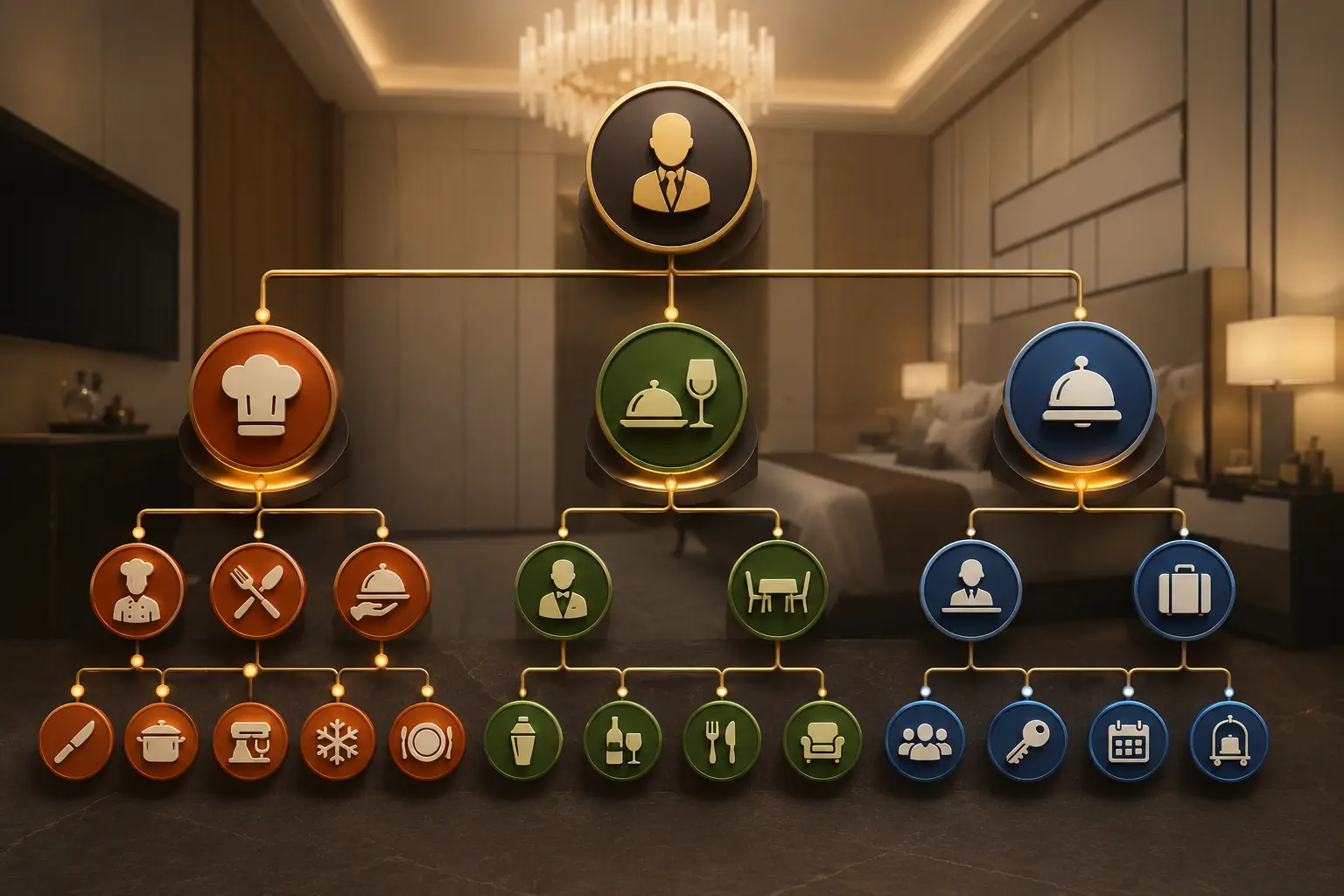
The standard kitchen hierarchy in an Indian hotel follows a pyramid. The rungs, top to bottom:
- Executive Chef (Chef de Cuisine)
- Head Chef
- Sous Chef (Under Chef)
- Chef de Partie (Station Chef)
- Demi Chef de Partie (Senior Line Cook)
- Commis I (Senior Commis)
- Commis II (Mid-level Commis)
- Commis III (Junior Commis / Trainee)
- Kitchen Helper / Plongeur (Kitchen Steward)
In a full-service hotel with many outlets, specialist posts sit alongside the CDP level:
- Saucier
- Poissonnier
- Rotisseur
- Patissier
- Garde Manger
- Entremetier
- Tandoor Chef (India-set)
The org chart doesn’t look the same at every property. A 300-room five-star in Delhi will run a far bigger brigade than a boutique hotel in Udaipur. The ladder still exists in both, it just compresses. One worker wears more hats.
What Role Does Each Position in the Kitchen Hierarchy Play?
Executive Chef (Chef de Cuisine)
- Sets menus and quality bars across all outlets
- Manages food cost and P&L
- Handles supplier ties and buying calls
- At large sites (ITC, Oberoi), oversees every outlet and banquet kitchen at once
- Owns FSSAI compliance, including FoSTaC certification
- Hands off daily work to the Sous Chef: the architect, not the build crew
Head Chef
The Head Chef stays hands-on in one kitchen, while the Executive Chef steers strategy across many. At compact sites with no multi-outlet setup, one person often does both. At a large chain, the split matters when you build your crew.
Sous Chef (Under Chef)
- Runs daily tasks: shifts, mise en place, service sync
- Keeps service moving during P&L meetings or supplier calls
- Big kitchens field many, one per shift or outlet
- The pivot from cooking into floor management
Chef de Partie (Station Chef)
- Owns one station: Indian/tandoor, cold, bakery, sauce, or banquet
- Staff on that station answer straight to the CDP
- Often covers two or three sections at smaller sites
- Oversees two to six Commis, guidance matters as much as knife skill
Demi Chef de Partie
Demi Chef de Partie (DCDP) sits between Commis I and full CDP. It is a solid backup who can run the station solo. Common at Taj and ITC, it gets skipped at smaller sites, where Commis I steps straight into CDP duties.
Commis Chef: The Commis I, II, III Grading System
Commis III is the entry rung: fresh graduates, zero to one year in, picking up knife skills and basic prep under close watch. Commis II, one to two years in, runs recipes solo and starts backing the DCDP. Commis I, two to three years in, could step into a DCDP slot at a smaller site, running the station off-peak and coaching juniors with little watch.
This three-tier system is standard across Indian five-star hotels, and it drives your pay benchmark even when job posts don’t spell it out. Drawn from work across metro and tier-2 properties, the Commis II to Commis I jump is where most young chefs stall. This marks a shift from “doing the task” to “owning the station.” That shift rarely happens without deliberate coaching.
Kitchen Helper / Plongeur (Kitchen Steward)
Plongeur, the classical French label, goes by Kitchen Steward or Kitchen Helper in hotels, covering dishwashing, cleaning, basic prep, and waste handling. It’s the entry point for staff with no formal culinary training, and many Kitchen Stewards move into Commis III after proving reliability.
Each of these posts leans on structured mentorship to climb the chain. If you are building or running a kitchen crew, Adevo’s kitchen operations and culinary training programmes cover every rung of the ladder, from Commis groundwork to leadership for CDPs and Sous Chefs.
What Are the Specialist Chef Positions in the Kitchen Hierarchy?
Beneath the CDP rung, the brigade splits into named specialist posts:
- Saucier: sauces, stocks, stews, the toughest post to master
- Poissonnier: seafood, big in Goa, Kerala, and Mumbai
- Rotisseur: roasts and grills, often folded into Continental
- Patissier: desserts and pastry, usually its own sub-team
- Garde Manger: cold prep, charcuterie, and buffet output
- Entremetier: soups, vegetables, and eggs
- Tandoor Chef: clay oven work, tandoori breads, kebabs, a fixture everywhere
Many South Indian sites also name a section chef for idli, dosa, and sambar, a slot outside the classical brigade but fixed in the Indian ladder.
How Does the Kitchen Hierarchy Work in Indian Hotels?
A five-star hotel kitchen acts as a different organism, not just a scaled-up Western brigade. India’s tourism and hospitality sector is expected to yield revenue exceeding US$ 59 billion by 2028, according to IBEF’s hospitality sector analysis, and that scale is why the brigade needs to hold up.
Multi-Cuisine Structure
A typical five-star site in India might run four to six kitchen sections under one roof:
- Indian/Tandoor
- Continental
- Chinese/Pan-Asian
- Bakery and Pastry
- Garde Manger
- Banquet production kitchen
Each section carries its own CDP and commis crew. The Sous Chef syncs across all of them during service.
This arrangement makes the ladder both taller and wider than the classical brigade it grew from.
FSSAI Compliance and the Kitchen Hierarchy
Food safety sits at the Executive Chef tier on paper but gets enforced at the Supervisor tier on the floor. Under the FSSAI FoSTaC programme, larger food businesses are required to keep at least one certified Food Safety Supervisor on site.
In practice, this means the Sous Chef or a named CDP usually holds FoSTaC certification, checked against FSSAI’s approved course list. Sites that skip this mandate face legal action, since the hierarchy organises legal accountability for food safety, not just cooking.
Tier-2 and Tier-3 City Adaptations
A 50-room business hotel in Coimbatore doesn’t run a 60-person brigade. The ladder still exists, but it compresses. The “Executive Chef” cooks on the line. The CDP runs two stations. The lone Sous Chef juggles shifts, ordering, and service sync at once. Roles don’t vanish outside metro sites, they fold into fewer people.
What Are Kitchen Hierarchy Salaries in India in 2026?
Pay swings a lot by city, class, and brand. Figures below reflect metro cities (Mumbai, Delhi, Bengaluru, Hyderabad) against tier-2 cities (Pune, Coimbatore, Ahmedabad, Kochi).
| Position (Experience) | Metro Monthly Salary | Tier-2 Monthly Salary |
|---|---|---|
| Commis III (0-1 yr) | ₹10,000-15,000 | ₹8,000-12,000 |
| Commis II (1-2 yrs) | ₹13,000-18,000 | ₹10,000-14,000 |
| Commis I (2-3 yrs) | ₹15,000-22,000 | ₹12,000-16,000 |
| Demi Chef de Partie (3-4 yrs) | ₹18,000-28,000 | ₹14,000-20,000 |
| Chef de Partie (4-7 yrs) | ₹25,000-45,000 | ₹13,000-22,000 |
| Sous Chef (7-10 yrs) | ₹55,000-90,000 | ₹28,000-48,000 |
| Head Chef (10-12 yrs) | ₹1,00,000-1,80,000 | ₹50,000-90,000 |
| Executive Chef (12+ yrs) | ₹1,50,000-4,00,000+ | ₹80,000-1,50,000 |
Mumbai pays well above the national average across every rung. The gap narrows only at the Executive Chef tier, where talent runs thin and sites pay to keep it. The jump from Chef de Partie to Sous Chef is the biggest leap, often 2x to 2.5x. It’s also the longest wait in a chef’s career.
How Do You Progress Through the Brigade from Commis to Executive Chef?
The typical timeline in hotel kitchens:
- Commis III to Commis I: 2-3 years
- Commis I to DCDP or CDP: 2-4 years
- CDP to Sous Chef: 4-7 yrs (the longest stretch)
- Sous Chef to Head Chef: 3-5 yrs
- Head Chef to Executive Chef: 3-5 years
- Total: 12-18 years from trainee to Executive Chef
What slows people down at each stage:
- Commis level: technical steadiness
- CDP level: zone management and coaching the team below you
- Sous Chef level: floor management, handling P&L and shifts alongside service
- Executive Chef level: ties with GMs, suppliers, and owners
The skill set shifts at every rung: knife work at Commis level, team leadership and P&L sense at Sous Chef and up. Grasping how to develop kitchen management skills and prepare for a head chef promotion speeds up this climb. Gaps in service or single-cuisine setups can slow it by three to five years.
Conclusion
The brigade is the frame that makes kitchen service work at scale. Every post exists because someone spotted a job that needed steady ownership. It holds when every rung grasps its own part, and the parts above and below it.
India has reshaped the traditional French brigade for a complex multi-cuisine setting: Tandoor sections, South Indian stations, FSSAI mandates, a three-tier Commis grading system, all sitting on Escoffier’s original frame. Grasping this framework is what splits a manager who can form a team from one stuck firefighting.
Frequently Asked Questions: Kitchen Brigade
Q: What is the highest rank in a kitchen?
A: The Executive Chef, also called the Chef de Cuisine, holds the top rank. It runs on strategy, not hands-on cooking: menu design, P&L, supplier ties, and food safety oversight.
Q: What is the difference between a head chef and an executive chef?
A: The Executive Chef runs the whole food side across outlets: strategy, cost, brand. The Head Chef runs a single kitchen day to day, hands-on. Smaller hotels often merge both roles into one person.
Q: What is the lowest rank in a kitchen?
A: Among cooking staff, Commis III sits lowest. Among all kitchen roles, the Kitchen Helper or Plongeur sits at the base, handling dishwashing, cleaning, and basic prep.
Q: What does a Chef de Partie do?
A: A Chef de Partie leads a single kitchen zone, whether Indian/Tandoor, Continental, Chinese, cold zone, or bakery. They run mise en place, manage the Commis under them, and own section output.
Q: What is the brigade de cuisine system?
A: Brigade de cuisine is the ranked staffing system Auguste Escoffier codified in the late 19th century. It gives each team member a role, a section, and a reporting line, locking in accountability and steady results during service. A full brigade can span 20-plus posts, from Executive Chef to Kitchen Porter.
Q: How long does it take to become an Executive Chef in India?
A: The climb from Commis III to Executive Chef spans 12-18 years in organised sector work: Commis to CDP takes 5-7 years, CDP to Sous Chef another 4-7, and Sous Chef to Executive Chef a further 6-10.