Picture this: it’s 6 PM on a Saturday. Your hotel is hosting a 900-guest wedding reception, a corporate awards dinner for 200 in the second banquet hall, and a mehendi function in the outdoor courtyard. Three kitchens running simultaneously. Four cuisine counters. A bar with a complicated corkage arrangement. And every single department, from housekeeping to accounts, is working off one document per event.
That document is the banquet event order (BEO).
If you work in Indian hospitality, or if you’re training to build a career in it through hospitality management courses, understanding the banquet event order is not optional. It’s the operational spine of every event your property runs.
A banquet event order (also called a Function Sheet or Function Plan in many Indian hotels) is the master planning document that captures every confirmed detail of an event: guest count, room setup, menu, timeline, staffing, AV, bar instructions, payment terms, and special requests. Every department that touches the event works from this one document.
Key Takeaways
– A banquet event order (BEO) is the single source of truth for every department involved in executing a hotel event
– A complete BEO contains 12 essential components, from event identification to signed payment terms
– Indian hotels typically generate 3-5 separate BEOs for a single multi-day wedding
– BEOs must be distributed to all departments a minimum of 72 hours before the event
– Common BEO mistakes, such as vague guest counts and missing dietary details, cause service failures that no amount of recovery can fully fix
What Is a Banquet Event Order (BEO)?
A banquet event order is the operational blueprint that every department executes from, covering the complete details of a confirmed hotel event from setup to service to strike. It is created by the banquet sales or events team, reviewed by operations, signed by the client, and distributed to every department head involved in delivery.
In Indian hotels, you’ll hear this document called different things depending on the property. Large city hotels and five-star chains typically use “BEO.” Mid-scale and independent properties often call it a Function Sheet or FP (Function Plan). Some older properties use “Event Order” or simply “EO.” The terminology varies; the purpose does not. Whatever name your hotel uses, this document does the same job: it tells every department exactly what needs to happen, when, and for whom.
There’s also a distinction worth knowing. A BEO (Banquet Event Order) governs a specific event, such as a wedding reception or a product launch. A CEO (Catering Event Order) is sometimes used for larger, multi-day catering packages at the property level that involve room blocks, multiple events, and a master billing account. In practice, many Indian hotels use BEO for everything. If your property uses a CEO structure, the individual event documents within it are still BEOs.
Who receives a BEO? At minimum:
- kitchen
- F&B service
- housekeeping
- engineering and maintenance
- front office (if guests are checking in)
- security
- accounts
For large Indian weddings, that list expands to include the florist coordinator, AV vendor, and sometimes a dedicated outdoor catering supervisor if the function spills into external spaces. Every one of these departments operates within the framework established by hotel SOP, which governs all standard operating procedures across the property.
In our experience coordinating large-format events at Taj and Oberoi properties, the BEO that’s clean, complete, and distributed on time makes a Friday-night wedding reception feel routine. The one that’s vague, late, or missing the bar instructions is the one that turns into a 2 AM debrief about what went wrong.
Why Every Hotel Needs a Banquet Event Order
A well-prepared banquet event order does four things that no verbal briefing or email thread can reliably replace.
Single source of truth for 6-8 departments
When eight departments are simultaneously preparing for one event, the only way to ensure they’re all working from the same information is a single, versioned, signed document. Without a banquet event order, the kitchen gets the menu from one WhatsApp group, the service team hears the timeline from the banquet captain’s memory, and housekeeping sets up the room based on last week’s similar function. That’s how 800-guest events get set for 700 covers, and why the Jain food counter doesn’t appear until a guest flags it.
Reduces miscommunication during high-pressure events
The banquet event order forces decisions to be made in advance. Room setup confirmed. Menu finalized. Bar instructions written. Timeline locked. When a department head has a question at 4 PM on event day, they check the BEO, not their phone. This is especially important in Indian hotels where multiple events run concurrently and staff frequently work across functions.
Legal protection: the signed BEO is a binding agreement
Once the client signs the banquet event order, the details within it become a contractual commitment. If a client disputes the guest count after the event and claims they only confirmed 500 covers when you’ve delivered for 700, the signed BEO is your evidence. It also protects you when last-minute requests arrive that weren’t in the original document. “That’s not in the BEO” is not a refusal; it’s an amendment process.
Revenue accuracy: captures billing, extras, and amendments
Every confirmed extra, from the additional live counter to the last-minute whisky brand upgrade, should be documented as a BEO amendment before it’s delivered. This protects your F&B revenue and prevents disputes at checkout. A clean banquet event order trail is the difference between capturing 100% of event revenue and writing off thousands in unrecorded service.
What to Include in a Banquet Event Order: 12 Essential Components
After reviewing hundreds of banquets across Indian hotel operations, we’ve identified the 12 components that every complete banquet event order must contain. Miss any of these, and you’re creating gaps that will surface during execution.
Event identification – BEO number (unique, sequential), event name, date, day of week, and event type (wedding, corporate, social, religious). Every BEO needs a number for version tracking.
Client and contact details – Primary organiser name, contact number, on-site contact (often different from the organiser), and billing contact. For Indian weddings, the person who signed the contract and the person on site during the event are frequently different people.
Venue and room assignment – Hall name, capacity, indoor or outdoor designation, and a backup plan if the event is outdoor. Indian monsoon season makes outdoor backup planning non-negotiable from June through September.
Guest count – Three numbers matter: expected count (what the client told you in initial discussions), guaranteed count (the minimum you’ll be paid for regardless of actual attendance), and set-for count (the number of covers you physically prepare). The set-for count is typically guaranteed plus 5-10%.
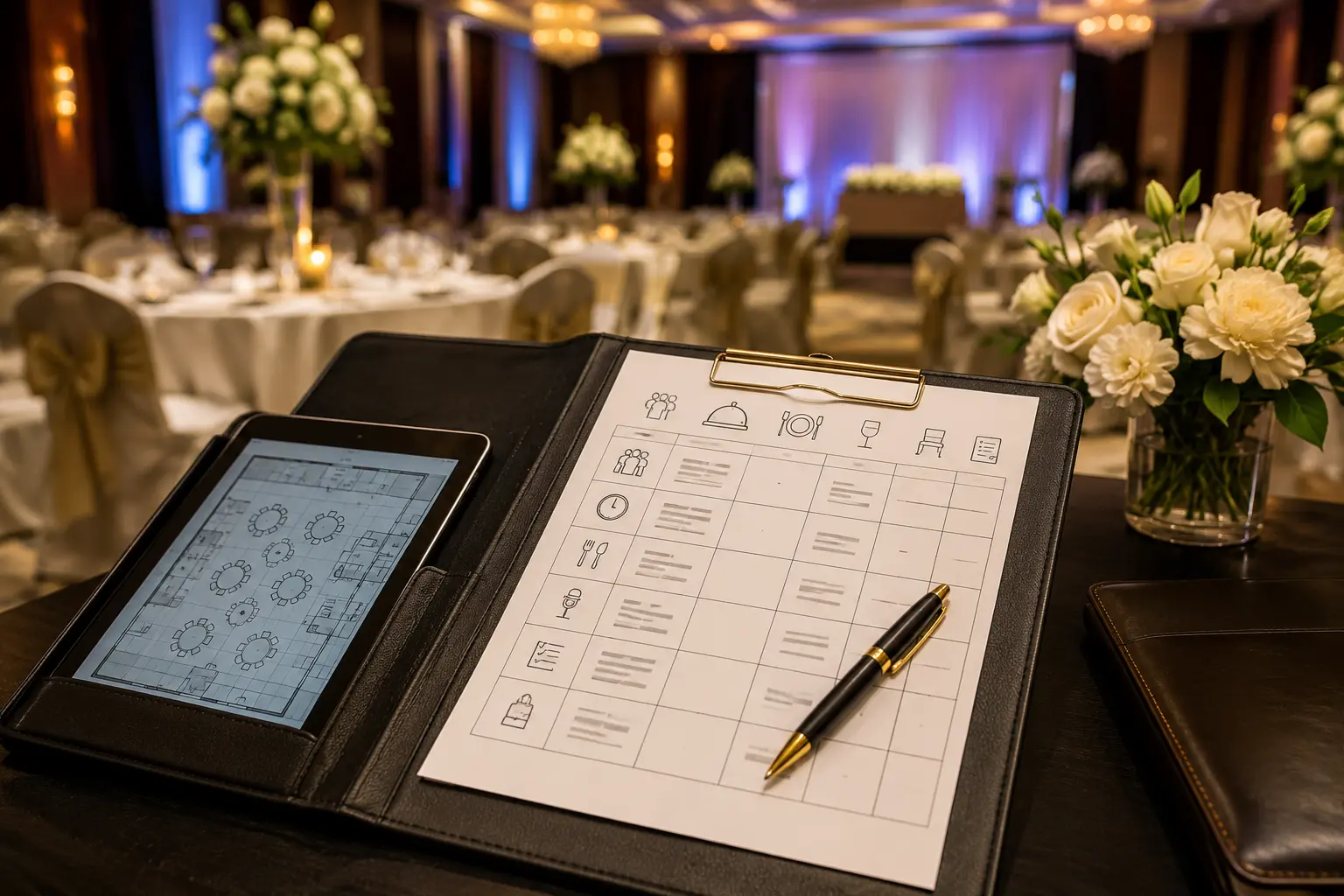
Room setup and floor plan – Table configuration (round, long, classroom, theatre, U-shape), stage dimensions, dance floor location, podium, head table, cocktail area, and any temporary structures. Attach the floor plan sketch directly to the BEO.
Menu and F&B details – Courses listed in service sequence, dietary requirement sections clearly flagged (vegetarian, Jain, halal, diabetic), live counter specifications (what’s on each counter, staffing per counter), and buffet layout sequence.
Bar and beverage setup – This is the most frequently under-specified component in Indian hotel BEOs. It must include: service type (open bar, consumption-based billing, BYOB with corkage), specific brands for each spirit category, beer and soft drink quantities, service timings, and whether a dry day check has been confirmed for the event date.
AV and technical requirements – Sound system specs, projection or LED wall, microphone count and type, lighting requirements, DJ or live band setup, and power requirements for any external entertainment vendors.
Event timeline – This is a full production schedule, not just service times. It should include: venue handover time from housekeeping, setup start, vendor access times, guest arrival, ceremony or programme start, service timings (welcome drink, starters, main course, desserts, closing), and strike time. Buffer between events is mandatory.
Staffing requirements – Steward-to-cover ratio, captain count, bar staff, kitchen deployment by station, and supervisor assignments. For large Indian wedding receptions, staffing the correct number and type of personnel across 8-12 service counters requires explicit BEO-level planning.
Special requests and instructions – Decor vendor access and restrictions, religious requirements (mandap setup dimensions, hawan kund placement, flower variety restrictions for certain ceremonies), photographer access zones, dietary segregation instructions for Jain guests, and any client-specific protocols.
Payment terms and signatures – Deposit paid and balance due, payment deadline, amendment policy (typically a 10% change threshold triggers a BEO revision and re-signing), cancellation terms, and the client signature block. Both the client and the hotel’s authorised signatory must sign.
How to Create a Banquet Event Order: Step-by-Step
Creating a clean banquet event order isn’t a one-sitting task. It’s an iterative process that begins the moment you confirm a booking and ends only when the last amendment is signed.
Step 1: Capture everything at the initial client meeting. Use a structured intake form that mirrors your BEO template. Don’t rely on notes. Every question your template asks should be answered before the client leaves the first meeting, even if some answers are provisional.
Step 2: Confirm venue, date, and guaranteed count. Block the space in your system. The BEO cannot be drafted without a confirmed venue and a guest count commitment. “We’ll confirm later” is not a count. It’s a risk.
Step 3: Finalise the menu with the Executive Chef and F&B Manager. Walk through the complete menu with the kitchen team before it goes into the BEO. Confirm every live counter, every dietary alternative, every special preparation. If the kitchen hasn’t signed off on the menu before the client signs the BEO, you’ll face renegotiation.
Step 4: Draft the BEO using your hotel’s standard template. Fill every field. If something is genuinely unknown, mark it as TBC with a deadline for confirmation. A BEO with blanks is incomplete and should not be distributed.
Step 5: Internal review with department heads. Walk the draft BEO through with the kitchen, service, housekeeping, and bar heads. They’ll catch gaps you missed: insufficient setup time, unrealistic cover-to-staff ratios, menu items that conflict with religious restrictions you didn’t know about.
Step 6: Client review and signature. Send the BEO to the client with a covering note explaining the amendment policy. Once signed, any changes require a numbered amendment to the BEO, re-signed by the client.
Step 7: Distribute to all departments, minimum 72 hours before the event. For large weddings and multi-day functions, 72 hours is the minimum. Five to seven days is better. Kitchen prep for a 1,500-cover Indian wedding reception starts well before event day.
Step 8: Version control every amendment. BEO Version 1.0, 1.1, 1.2. Every revision gets a new version number, a date stamp, and redistribution to all departments. Departments should be trained to discard previous versions when a new one arrives.
If you want your team to execute BEOs consistently across every event type, structured training is what bridges the gap between the document on paper and the service delivered on the floor. Adevo’s food and beverage training courses cover BEO-to-execution workflows for banquet teams, from how captains brief their stewards to how the bar team reads the beverage section.
BEOs for Indian Events: Weddings, Corporate, and Religious Functions
Here’s what no SaaS-generated guide on banquet event orders will tell you: in Indian hotel operations, a banquet event order isn’t just a document. It’s a translation layer between the complexity of Indian social events and the operational reality of a hotel that has eight other functions to manage simultaneously.
Indian weddings: multi-day, multi-BEO complexity
A typical Indian wedding at a city hotel generates at least 4-5 separate BEOs: the mehendi ceremony, the sangeet night, the wedding ceremony itself, the reception dinner, and often a farewell brunch the following morning. Each is a separate event with its own guest count, menu, room setup, timeline, staffing, and vendor access requirements. They’re connected by the same billing master but operationally independent.
Indian weddings run at a scale most global hospitality markets don’t see, and catering and venue services carry a major share of that spend. That scale demands rigorous BEO discipline. A wedding that goes wrong is not a one-event loss; it’s a social network event that affects future bookings.
Guest count fluctuation is a defining feature of Indian weddings. You’ll confirm 800 covers, set for 880, and receive 1,100 people on the night. A well-drafted BEO must include the hotel’s overflow protocol: where additional covers can be set, what kitchen quantities allow for additional service, and what the billing arrangement is for confirmed guests above the guaranteed count.
Multi-cuisine is the norm, not the exception. A single Indian wedding reception regularly runs North Indian (with a dedicated tandoor), South Indian, Chinese, Continental, and a live chaat or dessert counter simultaneously. Each counter needs its own staffing, its own kitchen prep timeline, and its own section in the BEO menu detail. Dietary segregation must be explicitly mapped: Jain preparations require complete separation from onion and garlic at the prep stage, not just at the service point.
Corporate events and MICE
India’s MICE (Meetings, Incentives, Conferences, and Exhibitions) market was valued at USD 37.75 billion in 2025 and is projected to reach USD 74.12 billion by 2031, according to Mordor Intelligence. Corporate BEOs carry their own complexity: multiple breakout rooms with individual setups, staggered tea and coffee breaks that must not disrupt plenary sessions, AV-heavy configurations, and dietary requirements spread across 200-plus participants from different dietary backgrounds.
Corporate events also tend to have stricter amendment deadlines and cleaner billing structures than weddings. The BEO for a corporate conference is a more linear document; the BEO for a wedding is a living negotiation.
Religious and cultural events
Satyanarayan pujas, hawans, engagement ceremonies, and first birthday functions all have specific setup requirements that go into the banquet order. A hawan setup means a kund, specific wood and ghee quantities (which may involve coordinating with a vendor the hotel doesn’t usually work with), ventilation considerations for indoor smoke, and a purely vegetarian menu with no eggs. A Jain event may require no onion, no garlic, no root vegetables, and completely segregated service ware.
FSSAI halal certification becomes relevant for banquet events where halal-prepared food is specified. If your hotel serves halal-certified F&B on request, the BEO must explicitly document this requirement so the kitchen sources correctly. This isn’t a footnote; it’s a specific procurement and prep instruction.
How the Kitchen and Bar Execute Your BEO
A BEO document that reaches the kitchen is not the end of the process. It’s the beginning of a translation.
From BEO to kitchen prep list
The Executive Chef or Sous Chef assigned to the event reads the BEO and converts it into station-wise prep lists. For a 1,200-cover wedding reception with five cuisine stations, that translation looks something like this: the tandoor station reads the BEO for naan, roti, and kebab quantities and calculates prep timings backwards from the service start; the Indian hot counter reads for gravy dish quantities and starts daals eight hours in advance; the Chinese section reads for wok timing and staffs accordingly; the Continental section reads for the carving station and cold platters.
This is why the BEO must specify not just what’s on the menu but the quantities, the service style (portioned or buffet replenishment), and the timeline. “Butter chicken” is not enough information for the kitchen. “Butter chicken, buffet replenishment style, initial quantity 15 kg, top-up at 60% depletion, service from 7:30 PM to 10:00 PM” is a kitchen instruction.
A well-designed F&B service SOP and a complete banquet order work together. Service teams that drill their SOPs build the execution habits that BEO compliance requires.
Bar setup from the BEO
The bar section of a BEO document is where Indian hotel operations diverge most sharply from the generic global template. Your bar BEO section must document:
- Service type: open bar (unlimited, per head billing), consumption-based, BYOB with corkage per bottle
- Brand specifications: don’t just write “whisky.” Write the specific brands authorized. Last-minute brand substitution is a guest complaint waiting to happen.
- Dry day check: This is non-negotiable. Before any bar setup is confirmed on the BEO, the date must be verified against the state government’s excise calendar. Dry days in India vary by state and by election schedule. A BEO that confirms a bar setup on a dry day is a legal liability.
- State liquor regulations: Banquet bar service is governed by state excise regulations. The quantity of liquor permitted, the license requirements, and the service cutoff time all vary by state. The BEO must reflect the applicable rules for your property’s location.
- Service timings: When the bar opens, when it closes, and whether there is a break (common for ceremony portions of weddings).
Common BEO Mistakes (And How to Avoid Them)
Every experienced banquet manager has a catalogue of events that went wrong because of a bad BEO. Here are the seven most common failures in Indian hotel operations.
Mistake 1: Vague guest count. “Approximately 500 guests” is not a banquet order. You need an expected count, a guaranteed count, and a set-for count. If the client won’t confirm a guaranteed number, you cannot issue a final BEO. This is a commercial and operational standard, not a preference.
Mistake 2: Missing dietary detail. Discovering 200 Jain guests at service time when the BEO only says “vegetarian” is not a kitchen failure. It’s a BEO failure. Dietary requirements need explicit documentation in the BEO, not a verbal mention during the client meeting.
Mistake 3: No timeline buffer. Running two events back-to-back in the same hall with a 30-minute setup window is a setup for failure. Every BEO must include a realistic setup time and a realistic strike time. If those don’t fit in the booking calendar, don’t accept the back-to-back booking.
Mistake 4: Incomplete bar instructions. This is the most common gap we see in Indian hotel BEOs. An entry that reads “bar as discussed” is not an instruction. Every brand, quantity, service style, and timing must be written out.
Mistake 5: Late distribution. A BEO document that reaches the kitchen 24 hours before a 1,000-cover event is not useful. Procurement has happened. Prep has started. Late BEOs cause improvised decisions that increase costs and reduce quality. 72 hours is the minimum; 5-7 days is the target for large events.
Mistake 6: No version control. When the client changes the menu three times and each change goes out as a new email rather than a revised BEO version, departments will execute from different documents. This is how the bar stocks the wrong brands and the kitchen over-prepares dishes that were dropped.
Mistake 7: Skipping the pre-event briefing. A BEO is a planning document. The pre-event briefing is the activation step. Every department head should walk through the BEO together 24 hours before the event. Questions get answered, gaps get flagged, and the document becomes a shared operational plan rather than a file on a shared drive.
Training Your Banquet Team to Execute a BEO
A complete banquet order doesn’t automatically produce good execution. The gap between what’s written and what’s delivered is a training gap.
In Indian hotel banquet operations, many of the frontline staff executing a BEO, the stewards, the counter attendants, the bartenders, are relatively new to the role. Many are working in their first hotel job. Many are operating in a second or third language. A document written in English with technical hospitality terminology is not self-explanatory to someone in their first month on the floor.
This is where structured training on BEO execution matters. The banquet captain’s job is not just to have a copy of the BEO. It’s to translate the BEO into action for every person in their team. That means a 30-minute pre-event briefing where the captain walks through the floor plan, assigns positions, explains the timeline, and highlights the critical instructions (the Jain section, the bar opening time, the first replenishment signal).
Teaching service staff to read a BEO, find their section, understand their timing window, and know who to escalate to when something isn’t on the document is a trainable skill. It doesn’t happen by default. Hotels that invest in structured banquet team training see measurably fewer event-day escalations, fewer mid-event improvisation decisions, and better guest scores for banquet events.
The training loop also needs to close after the event. A post-event debrief that reviews what the BEO said against what actually happened is how BEO templates improve over time, how common client requests get pre-empted, and how operational gaps get documented before the next similar event.
The banquet event order is the operational document at the center of the banquet SOP covered in your broader hotel SOP system.
Frequently Asked Questions: BEO documents
Q: What is a BEO (BEO)?
A: A banquet order is the master document used in hotel and venue operations to capture every confirmed detail of an event: guest count, room setup, menu, timeline, staffing, bar instructions, AV requirements, and payment terms. Every department involved in executing the event works from this single document.
Q: What is the difference between a BEO and a function sheet?
A: There is no operational difference. “Function sheet” (sometimes shortened to “FP” for Function Plan) is simply the term used in many Indian hotels for the same document that international chains call a BEO document. Both serve as the binding operational blueprint for event execution. Some larger Indian city hotels use both terms depending on the event scale.
Q: Who prepares the BEO in a hotel?
A: The banquet sales coordinator or events manager prepares the initial draft, drawing on information gathered from the client. The F&B Manager and Executive Chef review and approve the menu section. The final BEO is distributed by the events team after the client signs off. For large events, the General Manager or Hotel Manager may also sign.
Q: What should be included in a BEO?
A: A complete banquet order contains 12 components: event identification, client and contact details, venue and room assignment, guest count (expected, guaranteed, and set-for), room setup and floor plan, menu and F&B details, bar and beverage setup, AV and technical requirements, event timeline, staffing requirements, special requests and instructions, and payment terms with signatures.
Q: How far in advance should a BEO be distributed?
A: Minimum 72 hours before the event for standard functions. For large Indian weddings, corporate conferences, and multi-day events, 5-7 days is the recommended standard. The kitchen requires advance notice for procurement and prep; late BEO distribution forces improvised decisions that increase costs and reduce service quality.
Q: Is a BEO document legally binding?
A: Yes, once signed by both the client and an authorised hotel representative, the BEO functions as a binding agreement. The signed BEO documents the agreed guest count, menu, pricing, and terms. Any changes after signing require a formal amendment, typically re-signed by the client, and the amendment policy should be clearly stated in the original document.
Conclusion
The banquet order is not paperwork. It’s the operational language that makes coordinated execution possible across eight departments, three cuisine counters, a live bar, and 900 guests who’ve been planning this event for two years.
Get the document right, distribute it on time, brief your team against it, and control your amendments. Those four habits separate banquet operations that look effortless from the ones that are still firefighting at 9 PM on event night.
Master those four habits, train your team against them, and the BEO document stops being paperwork and starts being the reason your events run clean.