A banquet set up is the plan that decides where every table, chair and guest goes before an event begins, and the table shape you pick drives how the whole evening runs. Round tables, long tables, T-shapes and standing stations each suit a different kind of event. Adevo’s food and beverage training courses give banquet teams operational checklists and supervisory skills that help them set up every event the same way.
Ananya runs the banquet floor at a hotel in Hyderabad. A family booked a 200-guest wedding reception, and the event order said “dinner, tables for all”. The team laid long rectangular tables in rows, the way they had for a corporate lunch the day before. By the second course, the bride’s grandparents were stuck at the far end of a row, unable to hear anyone, and half the guests had dragged chairs into the aisles to form their own circles. Ananya reset the room into rounds during the speeches. Nobody complained, but nobody forgot it either.
You already know the lesson: the table shape is not decoration, it is the conversation plan. This guide walks through the types of banquet table setups, shows which event each one suits, and flags the mistakes that force a reset in front of guests. We start with what a banquet set up actually includes, then go through eight layouts, then match them to real events.
Key Takeaways
- A banquet set up starts with the table shape, because the shape decides who talks to whom and how staff move around the room.
- Round tables suit weddings and gala dinners, while long, T-shape and horseshoe layouts suit programmes with a head table or a speaker.
- The same room holds very different headcounts depending on the layout, so always quote capacity with the setup attached.
- Most banquet set up errors come from copying last week’s layout instead of reading this week’s event order.
What Does a Banquet Set Up Include?
A banquet set up covers the table layout, the chair count, the head table or stage position, the service aisles and the cover setting at each seat. The table layout is only the first of these decisions, but it controls the rest. Hospitality teams that train properly, for example through soft skills training courses in Bangalore and similar programmes, learn to treat the layout as a service decision first and a decoration decision second.
The phrase also covers timing. A banquet set up for a morning conference and an evening reception in the same hall means two different layouts and a changeover window, and the event order should say so in plain words.
What Are the Main Types of Banquet Table Setups?
The main types of banquet table setups are round tables, rectangular rows, T-shape, E-shape, horseshoe, hollow square, cocktail tables and buffet stations. Each one answers a different question: do guests need to talk, face a stage, or move around?
Round Tables
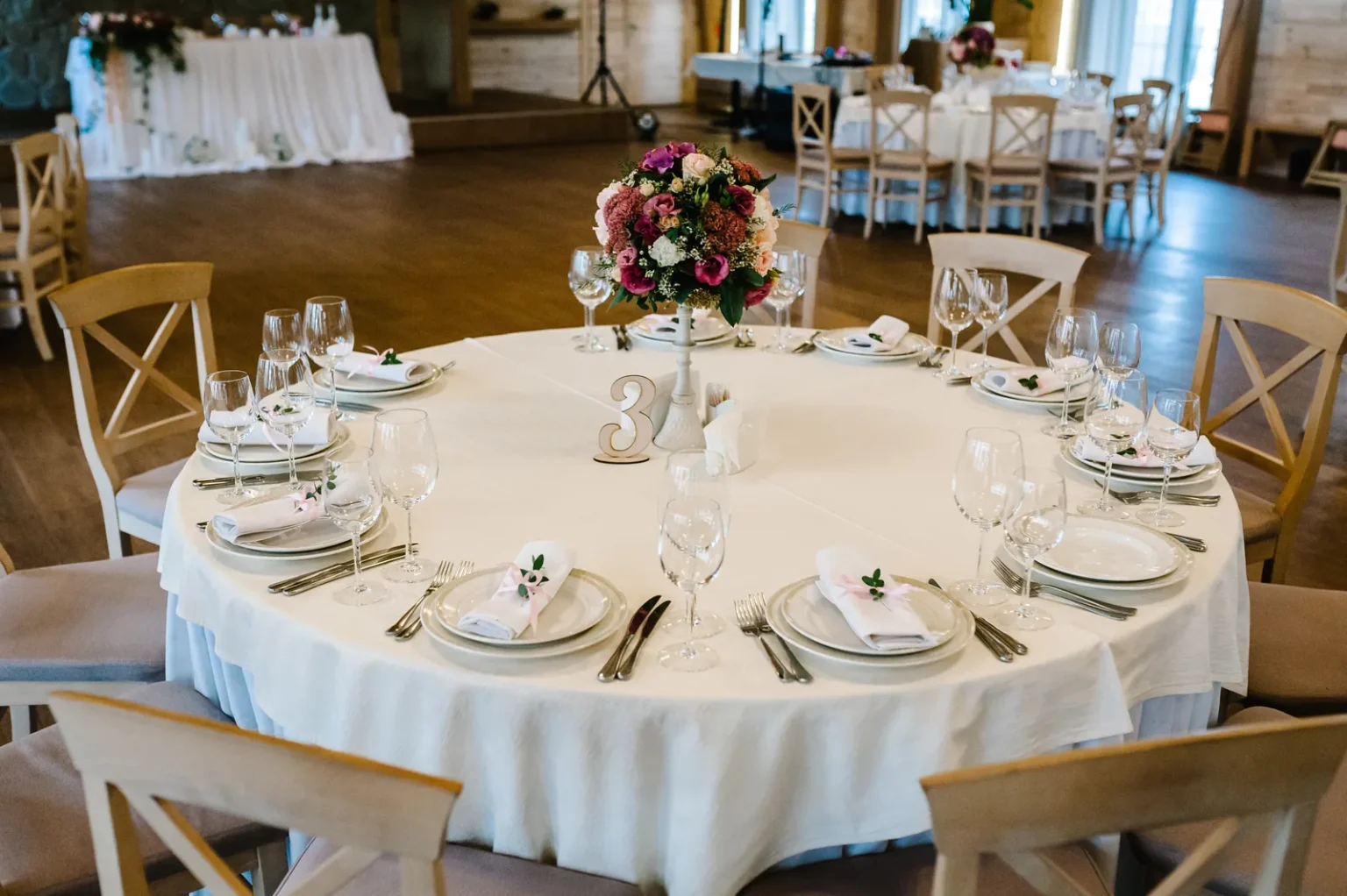
Round tables are the standard banquet set up for weddings, gala dinners and social functions. Every guest faces the others at the table, which makes conversation easy and keeps groups of families or colleagues together. The trade-off is that some chairs will always have their back to the stage unless you angle the tables or use half-round seating.
Rectangular Tables in Rows
Long tables in parallel rows work for conference lunches, training dinners and any event where guests face the front. They fit more people into a hall than rounds, and service staff can serve both sides of a table at once. They are poor for conversation across rows, so avoid them for family functions.
T-Shape
A T-shape puts a head table across the top and one long table running down the middle. It suits award dinners, official receptions and farewell events where one table needs to stand out. The people at the stem of the T sit far from the head table, so seat the less formal guests there.
E-Shape
The E-shape has a head table across the top and three arms extending down. Hotels use it for medium-sized formal groups, such as a delegation dinner or a board gathering with a head table. Every guest sits on one side only, facing into the room, which keeps service clear and sightlines open.
Want your banquet team to get every table layout right? Explore Adevo’s food and beverage training for banquet teams and build the skill once, for every event.
Horseshoe
A horseshoe, or U-shape, leaves one end open so a presenter or screen can sit in the gap. It is the right choice for a working dinner or a training session with a meal. It uses a lot of floor space for the number of guests seated, so confirm the room can carry it.
Hollow Square
Tables form a closed square, and guests sit on the outside. Use it for a discussion where nobody should have a head position, such as a partners’ meeting over lunch. There is no presentation space, so it fails for any event with a stage.
Cocktail and High Tables
Tall tables with no chairs, sometimes joined by a few lounge seats, make up the standing reception. They suit networking evenings, launches and arrival drinks before a seated dinner. Plan seating pockets for older guests, or they will leave early.
Buffet and Live-Station Layouts
Food stations sit along the walls or in islands, with tables scattered for eating. This banquet set up suits large weddings and open-house celebrations where guests move freely. The common mistake is placing stations too close together, which creates queues that block the aisles.
How Does a Banquet Set Up Change With the Event?
The event decides the table shape, and a short table makes the pairing quick to check.
| Event | Best table setup | Why it works |
|---|---|---|
| Wedding reception | Round tables plus stations | Families sit together and move freely |
| Conference lunch | Rectangular rows | Fast service, clear sightlines |
| Award dinner | T-shape or rounds | One table gets prominence |
| Training with a meal | Horseshoe | Trainer reaches every learner |
| Networking evening | Cocktail tables | Guests mingle and move |
A wedding banquet set up often combines two or three layouts in one evening: cocktail tables for arrivals, rounds for dinner, and stations for dessert. Corporate dinners usually keep one banquet set up from start to finish, so the first choice matters more.
Service style changes the answer too. A plated dinner needs wide aisles for staff, while a buffet can pack tables closer but needs station space. For the wider room layouts around these tables, our pillar guide to banquet setup types covers theatre, classroom, U-shape and more. Plated, buffet and family-style service each affect the floor plan too.
How Much Does the Layout Change a Room’s Capacity?
The layout can change a room’s headcount by a factor of two or more, so a hall’s capacity means nothing until you attach a layout to it. JW Marriott Pune lists its Grand Ballroom as seating 720 in banquet style, but 2,000 for a reception in the same room.
Standing guests need far less floor than seated guests, and seated guests at round tables need more than guests in theatre rows. That is why sales teams must ask what guests will do before quoting a headcount for any banquet set up.
Take Imran, an F&B manager at a heritage hotel in Jaipur. A corporate client asked for a 300-person gala dinner in a hall he knew held 400. He quoted yes, then checked the layout: rounds with a stage and a dance floor cut the room to barely 250. He called the client the same day, offered a second hall for the cocktail hour, and kept the booking. A quote made without a layout would have lost it at the door.
What Mistakes Ruin a Banquet Set Up?
Most banquet set up mistakes come from skipping the check between the event order and the floor.
- Copying the previous layout: Yesterday’s corporate rows do not suit today’s wedding.
- Ignoring service aisles: Staff need a clear path to every table, not just to the first row.
- Forgetting the sightline: Seat guests so no one stares at a pillar or the back of a screen.
- Placing the head table badly: It should face the room and sit away from the kitchen door.
- Skipping the cover check: The right table with the wrong cutlery still reads as a poor banquet set up.
Cover setting is part of the layout, not a separate job. The guide to the sequence of service shows how pre-set covers differ by event type, and banquet teams follow the same logic for every table in the room.
Ready to train a banquet team that sets every room correctly? Talk to Adevo about banquet training and we will map a programme to your venue.
Conclusion
A good banquet set up begins with the question of what guests will do at the table: talk, watch, eat or move. Pick the shape that serves that answer, write it on the event order, and check the floor before the doors open.
Divya, a trainee steward in Kochi, started with a laminated card showing the eight layouts and the events they suit. Within a month she was suggesting changes to the event order before her captain asked. A banquet set up is a skill that grows with repetition, and a team that practises them together stops repeating the same reset.
Frequently Asked Questions: Banquet Set Up
Q: What is a banquet set up?
A: A banquet set up is the plan for how tables, chairs, stage, aisles and cover settings are arranged for an event. It starts with the table shape and ends with the cutlery at each seat. A written plan on the event order keeps the floor team aligned.
Q: What are the main types of banquet table setups?
A: The main types are round tables, rectangular rows, T-shape, E-shape, horseshoe, hollow square, cocktail tables and buffet stations. Each suits a different event purpose. Round tables suit weddings, while rows suit conference lunches.
Q: Which banquet set up is best for a wedding?
A: Round tables with food stations suit most Indian weddings. Families sit together, and guests can move freely between tables and stations. Add cocktail tables for arrivals and lounge seating for elders.
Q: How many people sit at a round banquet table?
A: It depends on the table size and the event, and hotels set the count on the event order. Always confirm the seat count per table with the sales team before the setup begins, because it changes the total number of tables.
Q: What is the difference between T-shape and E-shape setups?
A: A T-shape has one long table running from the head table, while an E-shape has three arms. The E-shape seats more guests and keeps everyone on one side facing into the room. Both suit formal events with a head table.
Q: Why does capacity change with the table setup?
A: Each layout gives guests a different amount of floor space. Standing receptions use the least, while rounds with a stage and dance floor use the most. The JW Marriott Pune lists its Grand Ballroom at 720 in banquet style and 2,000 for a reception.