Banquet setup types are the standard room layouts a hotel uses to arrange chairs and tables for an event: theatre, classroom, U-shape, boardroom, hollow square, banquet rounds, cabaret, reception and herringbone. Each one trades seating capacity against visibility, writing space and conversation. Adevo’s food and beverage training courses give banquet teams operational checklists and supervisory skills for dependable room setups.
Consider Rohan, a banquet captain at a business hotel in Pune. A pharma company booked a half-day sales workshop for 80 people, and the event sheet said only “seating for 80”. His team set 80 chairs in theatre rows. Within the hour, delegates were balancing laptops on their knees and the trainer asked for tables. Resetting the room mid-session cost forty minutes, a lot of grumbling from the delegates and an awkward apology to the client’s HR head. The room was big enough. The layout was wrong.
You already know how this feels: a layout call made in a hurry becomes a reset in front of the client. This guide explains all the banquet setup types, what each suits and where it fails, so you can read any event brief and name the right setup quickly. We cover the nine banquet setup types in turn, then a selection table, how Indian events change the choice, and a pre-event checklist you can print for your floor team.
Key Takeaways
- Banquet setup types fall into three families: audience rows, table-work layouts and social layouts, and the event’s purpose decides the family.
- Theatre seats the most guests, while U-shape and boardroom seat the fewest because every guest needs table space.
- The same hall holds very different numbers in different layouts, so a capacity quoted without a layout is meaningless.
- Most last-minute resets come from an event order that names a headcount but not a layout.
What Are the Main Banquet Setup Types in Hotels?
Banquet setup types fall into three families: audience layouts (rows facing the front), table-work layouts (tables for writing or discussion) and social layouts (rounds and standing areas). Hotels teach these as a core F&B service skill, and any course in hospitality management courses treats room set-up as part of event operations, not decoration.
The nine banquet setup types below cover almost every request a banquet team receives. Learn these banquet setup types as a set, because most event briefs sit between two of them.
Theatre Style
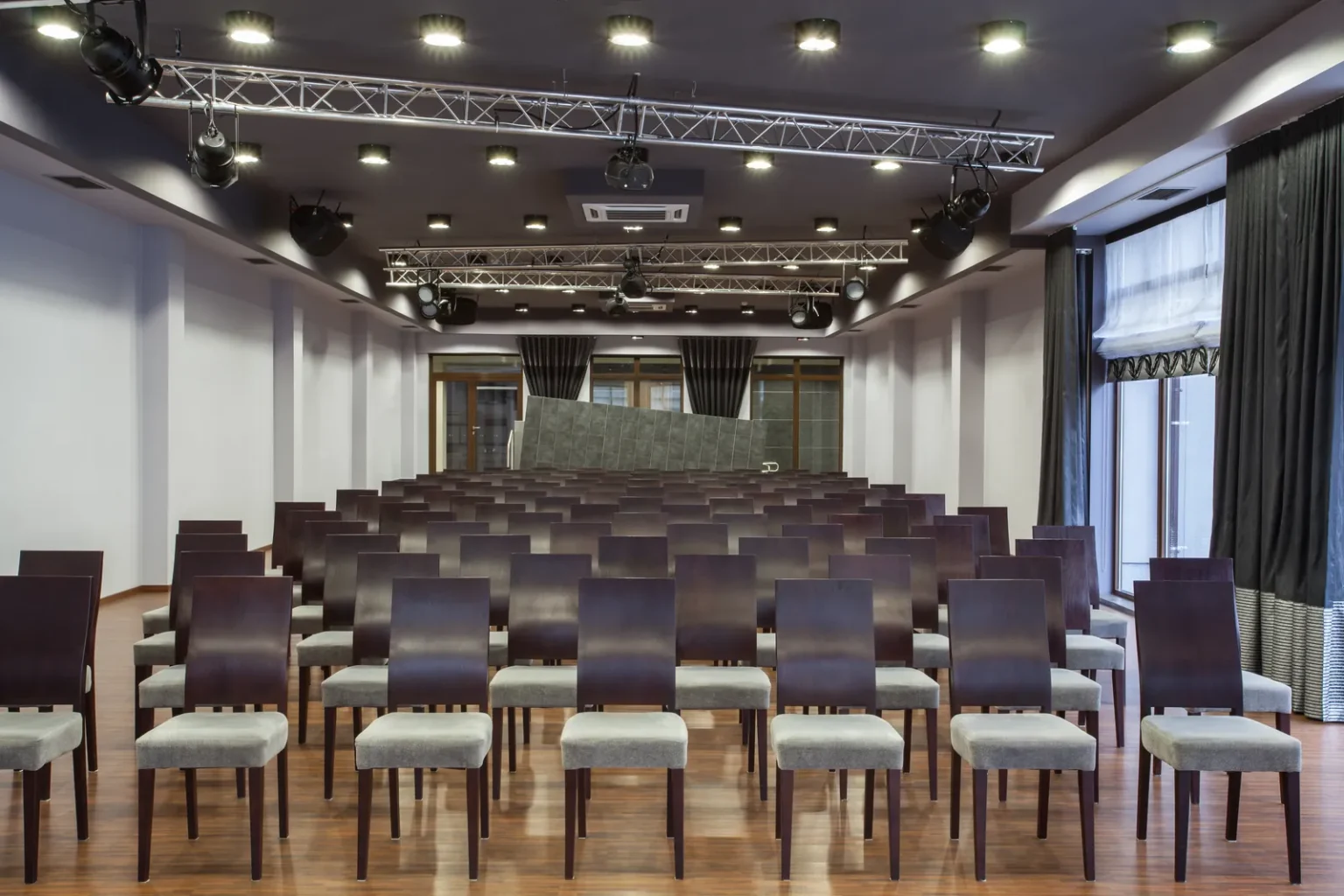
- Layout: Chairs in rows facing a stage or screen, no tables.
- Best for: Product launches, award announcements, large presentations, AGM-style gatherings.
- Watch out: Guests have no surface to write on, so it fails for long sessions.
Classroom Style
- Layout: Rows of narrow tables with chairs on one side, all facing the front.
- Best for: Training programmes, workshops, exam-style sessions, anything with note-taking.
- Watch out: It uses more floor space per person than theatre, so capacity drops.
U-Shape Style
- Layout: Tables form a U with the open end towards the screen; guests sit on the outside.
- Best for: Interactive training, small review meetings, product demonstrations.
- Watch out: The trainer can walk into the centre, but the layout swallows floor space fast.
Boardroom Style
- Layout: One long table, or several joined, with everyone seated around it.
- Best for: Board meetings, negotiations, interviews, leadership offsites.
- Watch out: Guests at the far ends struggle to hear and see, so group size matters.
Hollow Square Style
- Layout: Tables form a closed square with chairs on the outside and an empty centre.
- Best for: Discussion meetings where every participant should have equal standing.
- Watch out: No presenter space, so slides on a screen only work for one side of the room.
Banquet Rounds Style
- Layout: Round tables, each with a full set of chairs, spread across the floor.
- Best for: Weddings, gala dinners, family functions, corporate dinners.
- Watch out: Some guests will sit with their back to the stage unless you plan the table angle.
Cabaret Style
- Layout: Round tables with seating only on the side facing the stage.
- Best for: Award nights, cultural programmes, entertainment with a meal.
- Watch out: Fewer seats per table than rounds, so it needs more floor space for the same headcount.
Reception Style
- Layout: A few cocktail tables and high tables, mostly standing space, perhaps lounge seating.
- Best for: Cocktail evenings, networking events, launch parties, sangeet openings.
- Watch out: Elderly guests and long evenings need seating pockets, or they will leave early.
Herringbone Style
- Layout: Rows of tables angled in a V shape, so guests face the front without twisting.
- Best for: Training sessions where the trainer needs a clear sightline to every learner.
- Watch out: The angle makes the room look odd in photographs, and it takes longer to set.
How Do You Choose Between Banquet Setup Types?
Choose among banquet setup types by purpose first and headcount second. Ask what guests will do in the room (listen, write, talk, eat or stand) and the layout follows from the answer.
| Setup | Best when guests will | Poor fit when |
|---|---|---|
| Theatre | Listen and watch | They need to write |
| Classroom | Take notes for hours | The hall is tight |
| U-shape | Discuss with a trainer | The group is large |
| Banquet rounds | Eat and socialise | Everyone must face front |
| Reception | Stand and network | The event runs very long |
Notice how one question sorts the banquet setup types in this table. If the event is a meal, you are in rounds or cabaret. If it is a session, you are in theatre, classroom, U-shape or herringbone. If it is a conversation among equals, you are in boardroom or hollow square.
Food service shifts the answer too. An event with a plated meal needs aisle room for service staff, so it takes more space than the same headcount at a buffet. Plated, buffet and family-style service each change the floor plan, so settle the service style before you settle the layout.
Want your banquet team to pick the right layout the first time? Ask about Adevo’s food and beverage training for banquet teams built around your property.
Which Banquet Setup Types Suit Indian Events?
Indian events lean towards social and long-duration formats, so banquet rounds and reception styles carry most weddings, while corporate and MICE business favours theatre, classroom and U-shape. A single hall often hosts both on the same weekend, which makes quick changeovers part of the daily job.
Weddings and social functions usually mix two or three banquet setup types in one evening: reception style for the arrival, rounds for dinner, and theatre-style rows for a ceremony or performance. Corporate events use one of the banquet setup types for the whole day, which puts pressure on getting it right at the start.
Public-sector hotels publish layout capacities openly. ITDC, the India Tourism Development Corporation, lists one of its convention halls at 2,000 in theatre style, 650 in classroom style and 160 in U-shape. Same hall, same walls, and the numbers differ by more than twelve times.
That gap is the lesson. Sales teams that quote a hall’s maximum capacity without naming the layout set up an argument for later. This is why the banquet event order carries a room setup section. Our guide to the banquet event order explains how to write the layout, the table plan and the stage details so the floor team never has to guess.
Take Meera, a banquet manager at a resort in Goa. A corporate client booked the ballroom for a 150-guest sales conference and a dinner on the same day. She set theatre rows for the morning, listed a changeover window on the event order, and had rounds stacked and ready by the stage. The reset took the team under an hour because everyone knew the plan. The client saw one smooth day, not two events glued together.
What Does the Banquet Team Check Before Every Setup?
Whichever of the banquet setup types you are building, check the event order, the room, the equipment and the guest profile, in that order. A layout is only correct if the floor matches the paper, and a banquet captain who skips the paper check will eventually reset a room in front of a client.
- Confirm the layout on the event order: If it names a headcount but no setup, call the sales contact before touching a chair.
- Mark the floor: Use tape or a chalk line to fix the front, the aisles and the exits first.
- Set the tables: Place tables or rows to the plan, then add chairs last.
- Walk the sightlines: Stand in the back row and the side seats to check you can see the screen and hear the speaker.
- Test the fire exits and service aisles: A blocked exit is a safety failure, not a style issue.
- Stage the extras: Water, stationery, microphones and table numbers go in last, once the layout is final and the aisles are clear.
Run this checklist with the whole floor team, not just the captain, so that every steward knows why the tape is on the floor. Banquets are one of several outlets a hotel runs, and each has its own pace and standards. For the table-level detail, see our guide to banquet table setups, and to match a layout to an event, read choosing the right banquet setup for your event type.
Ready to train a banquet team that sets the right room every time? Talk to Adevo about banquet training and we will map a programme to your venue.
Conclusion
Knowing the nine banquet setup types is the difference between a room that works and a room that gets reset in front of the client. Start every event with one question: what will guests do in this room? Then pick from the banquet setup types, write it on the event order, and check the floor against the paper before the doors open.
Think of Karthik, a new banquet supervisor in Chennai who kept a one-page layout card in his pocket for his first three months. By the fourth month he did not need it, and his team had stopped asking him which setup suited which booking. Layouts are a learnable skill, and a team that learns them together stops guessing.
Frequently Asked Questions: Banquet Setup Types
Q: What are the main banquet setup types?
A: The main banquet setup types are theatre, classroom, U-shape, boardroom, hollow square, banquet rounds, cabaret, reception and herringbone. They sort into audience layouts, table-work layouts and social layouts. The event’s purpose decides which family to use.
Q: What is the difference between theatre and classroom setup?
A: Theatre setup uses rows of chairs with no tables, while classroom setup adds narrow tables in front of each row. Theatre seats more guests in the same hall. Classroom suits events where guests need to write or use laptops.
Q: Which of the banquet setup types is best for a wedding?
A: Banquet rounds suit most wedding dinners, with reception style for arrivals and theatre rows for ceremonies or performances. Many Indian weddings use two or three layouts in one evening. Plan changeover time on the event order.
Q: Why does capacity change across banquet setup types?
A: Each layout gives every guest a different amount of floor and table space. Theatre needs only a chair, while U-shape and boardroom need table space and aisle room. A hall listed by ITDC shows this clearly, with theatre capacity far above U-shape in the same room.
Q: Which of the banquet setup types is best for a training session?
A: Classroom, U-shape and herringbone suit training. Classroom works for large groups taking notes, while U-shape and herringbone work for interactive sessions where the trainer must see every learner.
Q: Who decides the banquet setup for an event?
A: The client’s event purpose decides it, the sales team records it on the banquet event order, and the banquet manager confirms the room can hold it. The floor team then sets the room to that written plan.