
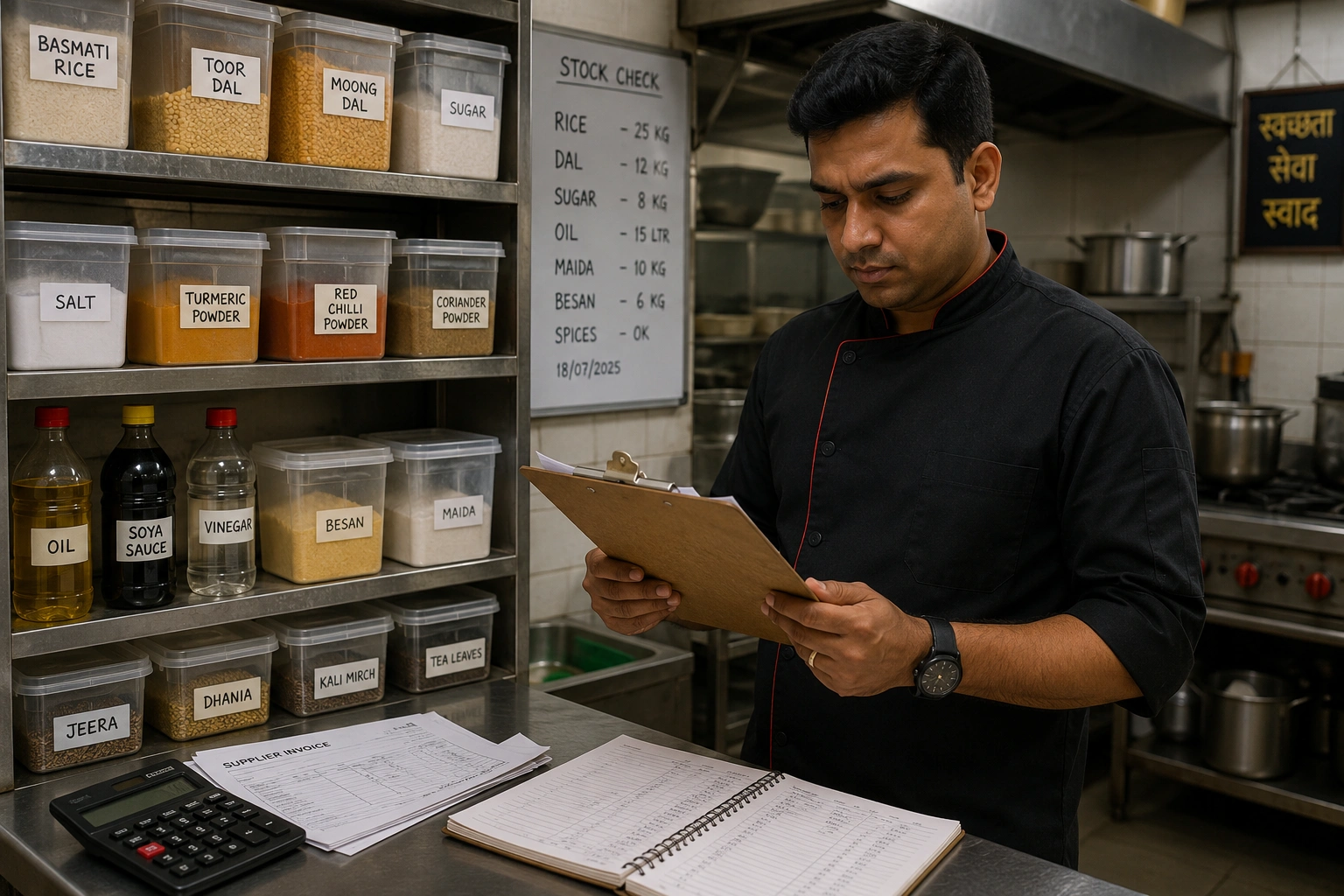
Most Indian restaurant owners can quote their rent and their salary bill from memory. Ask for last month’s food cost percentage, and the answer usually starts with “let me pull the invoices.” That gap is expensive: food cost is typically the single largest controllable expense line on a restaurant’s P&L, and it moves every single week whether anyone is watching it or not.
Food cost calculation itself is simple arithmetic. Holding that number down, month after month, in a real kitchen with real staff turnover, is a different problem entirely — and it’s the one this guide actually solves. You’ll get the exact formula, a full worked example, Indian benchmarks by restaurant format, and the operational fix competitors’ guides leave out: how hospitality management courses turn a spreadsheet formula into a habit your kitchen actually follows.
Key Takeaways
– Food Cost % = (Beginning Inventory + Purchases − Ending Inventory) ÷ Food Sales × 100, tracked weekly, not monthly.
– Indian casual dining restaurants typically run 28–35% food cost; QSR formats run leaner at 25–30%.
– Per-dish plate costing is what actually sets a correct menu price — restaurant-level percentage alone can’t.
– The gap between ideal and actual food cost is almost always a training gap, not a math error.
What Is Food Cost Calculation and Why Does It Matter?
Food cost calculation is the process of measuring what percentage of your food sales revenue was consumed by the ingredients used to produce that food. It’s the fastest diagnostic a restaurant owner has for profitability, because unlike rent or salaries, it moves week to week based on purchasing discipline, portioning, and waste.
A restaurant with 34% food cost and one with 28% food cost can have identical menus and identical footfall — and a completely different bottom line. On ₹50 lakh in annual food sales, that 6-point gap is ₹3 lakh a year, most of it leaking out through causes nobody is tracking. (Food cost is just one line on the full statement — see Restaurant Profit and Loss Statement for how it fits into the bigger picture.)
How Do You Calculate Food Cost Percentage?
The Core Formula
The standard formula, used across every SERP-ranking guide and every Indian restaurant accounting system, is:
Food Cost % = (Beginning Inventory + Purchases − Ending Inventory) ÷ Food Sales × 100
- Beginning Inventory: value of food stock on hand at the start of the period
- Purchases: everything bought during the period
- Ending Inventory: value of food stock left at period close
- Food Sales: total revenue from food (excluding beverages, if tracked separately)
Worked Example With Real Numbers
Take a standalone casual-dining restaurant in a Tier-1 Indian city, tracked over one week:
| Line Item | Amount (₹) |
|---|---|
| Beginning Inventory | 1,20,000 |
| Purchases (week) | 2,10,000 |
| Ending Inventory | 1,05,000 |
| Food Sales (week) | 8,25,000 |
Cost of food used = 1,20,000 + 2,10,000 − 1,05,000 = ₹2,25,000
Food Cost % = 2,25,000 ÷ 8,25,000 × 100 = 27.3%
That number alone tells you almost nothing without a benchmark to compare it against — which is the next question. (For the COGS formula behind this calculation broken down further, see Restaurant Food Cost Formula.)
What Is a Good Food Cost Percentage for an Indian Restaurant?
Benchmarks by Format
| Restaurant Format | Target Food Cost % |
|---|---|
| Quick Service (QSR) | 25–30% |
| Casual Dining | 28–35% |
| Fine Dining | 30–40% |
| Buffet-Style | 32–38% |
| Cafes & Bakeries | 25–30% |
These ranges are general guidelines from Restaurant India’s food cost benchmarks, not fixed rules — treat them as a starting point for your own format and menu mix. Fine dining runs higher because portion sizes, protein-heavy menus, and plating waste are structurally harder to control than a QSR’s standardized, high-volume recipes. If your casual-dining restaurant is sitting at 27.3% like the worked example above, you’re inside range — the work now is holding it there, not chasing it lower.
How Do You Calculate Food Cost Per Dish (Plate Costing)?
Step-by-Step Plate Costing Method
Restaurant-level food cost percentage tells you if you have a problem. Plate costing tells you which dish is causing it.
- List every ingredient in the recipe with exact quantities (grams, ml, units)
- Price each ingredient at current purchase cost, not last quarter’s rate
- Sum the total ingredient cost for one plate
- Add a garnish/condiment allowance (typically 3–5% of the raw total)
A butter chicken plated with 220g chicken, gravy ingredients, and a side of naan might cost ₹95 in raw ingredients. That number is the floor for every pricing decision on that dish.
Using Plate Cost to Set Menu Prices
Divide plate cost by your target food cost percentage to get the menu price: ₹95 ÷ 0.30 = ₹317. Round to a psychologically clean price point (₹319 or ₹329), and you’ve priced the dish to hit a 30% target while staying legible to the guest. (For how this feeds into your overall profitability, see Profit Margin in Food Business.)
Ideal Food Cost vs. Actual Food Cost — Where Is the Money Leaking?
Ideal food cost is what your recipes say you should spend. Actual food cost is what you did spend, pulled from real inventory counts. The gap between the two — usually a noticeable, avoidable gap in kitchens that haven’t standardized recipes — is where profit quietly disappears.
Common Causes of the Gap
- Portion drift: a cook plating 250g of protein against a 220g standard recipe card
- Spoilage and over-production: prepping more than the day’s cover forecast needs
- Untrained receiving: accepting short-weight or substandard deliveries without checking against the purchase order
- Uncontrolled staff meals: kitchen staff eating from sellable inventory without a logged allowance
None of these show up in the food cost formula itself. They show up in the variance between ideal and actual — which is why chasing the formula alone never fixes a rising food cost trend. (For the full set of waste-reduction methods, see Food Cost Control.)
Why Does Food Costing Break Down in Real Kitchens?
The formula never fails. The people executing it, day after day, under service pressure, are where the number actually gets won or lost. A kitchen can have a perfect recipe card and a spreadsheet-literate manager and still bleed food cost if the line cooks were never trained to follow the portion standard under a Friday-night rush.
Portion Control and Standard Recipe Cards
Every dish needs a written, laminated recipe card at the pass with exact weights — not “a handful,” not “to taste.” Recipe cards only work if new hires are trained on them during onboarding and re-certified when the menu changes, not handed a laminated sheet and left to interpret it.
Receiving and Storage Discipline
Every delivery should be weighed and checked against the purchase order before it’s signed for, and stored using FIFO (first in, first out) rotation the same day. FSSAI’s food safety regulations set the compliance floor for storage and labelling — but compliance alone doesn’t stop shrinkage; a trained receiving clerk who checks weight against invoice does.
Staff Accountability and Ongoing Training
India’s food services industry is growing fast, which means more competition for the same trained kitchen staff. That makes in-house training discipline — not just hiring experienced cooks — the durable way to hold a food cost target. A food and beverage training program that certifies staff on portioning, receiving, and waste logging turns food cost control from a monthly spreadsheet exercise into a daily kitchen habit.
For a closer look at where food safety training and cost discipline intersect at the receiving dock, see Adevo’s guide to kitchen staff food safety training.
FAQ
Q: What is the formula for food cost calculation?
A: Food Cost % = (Beginning Inventory + Purchases − Ending Inventory) ÷ Food Sales × 100. Track it weekly using actual inventory counts, not monthly estimates.
Q: What is a good food cost percentage in India?
A: As general guidelines, casual dining typically runs 28–35%, QSR formats 25–30%, fine dining 30–40%, and buffet-style 32–38%. Benchmarks vary by format because portion control difficulty differs — see the format table above for full ranges.
Q: How do you calculate food cost per dish?
A: List every ingredient at current purchase price, sum the raw cost, add a 3–5% garnish allowance, then divide by your target food cost percentage to set the menu price.
Q: Why is my actual food cost higher than my ideal food cost?
A: The gap almost always comes from portion drift, spoilage, untrained receiving, or unlogged staff meals — operational leaks the formula itself can’t detect.
Q: How often should a restaurant calculate food cost?
A: Weekly, using a physical inventory count. Monthly-only tracking hides the exact week a leak started, making it far harder to trace the cause.
Conclusion
Food cost calculation is a ten-minute formula. Keeping the result inside benchmark, week after week, is a training problem: portion cards followed under pressure, receiving checked against the purchase order, and staff who understand why the number matters. Get the operational discipline right and the formula takes care of itself.
Book a free consultation on Adevo’s kitchen operations and F&B training programs to build the staff-training system that holds your food cost number where it belongs.