
A restaurant can run at full capacity every night and still lose money if nobody is tracking food cost against revenue. Most Indian restaurant owners price their menu on instinct — what feels fair to charge — rather than on the cost-of-goods-sold math underneath it. This guide gives you the exact restaurant food cost formula, a worked INR example, and the hospitality management courses that build the tracking habit into your kitchen’s weekly rhythm, not just your spreadsheet.
Key Takeaways
– Restaurant Food Cost % = Cost of Goods Sold (COGS) ÷ Food Sales × 100.
– COGS = Beginning Inventory + Purchases − Ending Inventory.
– Indian casual dining restaurants typically run 28–35% food cost; fine dining runs 30–40%.
– Menu costing per dish, including the Q factor (garnishes and condiments), is what actually sets a correct price.
What Is the Restaurant Food Cost Formula?
The restaurant food cost formula measures what share of your food revenue was consumed by the ingredients that produced it: Food Cost % = COGS ÷ Food Sales × 100. It’s the single fastest number for diagnosing whether a restaurant’s purchasing, portioning, and waste discipline are under control — for the full breakdown of benchmarks and a worked example, see Food Cost Calculation: The Complete Guide.
The Cost of Goods Sold (COGS) Formula
COGS itself has its own formula: Beginning Inventory + Purchases − Ending Inventory. This captures what was actually consumed during the period, not just what was bought — a restaurant that overbuys and lets stock sit is understating its real cost problem until the inventory count catches it.
How Do You Calculate Food Cost Percentage?
Take a mid-size casual-dining restaurant in Bangalore, tracked over one week:
| Line Item | Amount (₹) |
|---|---|
| Beginning Inventory | 95,000 |
| Purchases (week) | 1,80,000 |
| Ending Inventory | 88,000 |
| Food Sales (week) | 6,60,000 |
COGS = 95,000 + 1,80,000 − 88,000 = ₹1,87,000
Food Cost % = 1,87,000 ÷ 6,60,000 × 100 = 28.3%
That figure sits comfortably inside the casual-dining benchmark range — the next question is whether that benchmark itself is realistic for your format.
What Is Ideal Food Cost Percentage for a Restaurant?
Benchmarks by Restaurant Type
| Restaurant Type | Ideal Food Cost % |
|---|---|
| QSR | 25–30% |
| Casual Dining | 28–35% |
| Fine Dining | 30–40% |
These are general guidelines, not fixed rules — restaurants should weigh their own menu mix and format against them. Fine dining runs structurally higher because premium proteins, elaborate plating, and lower table turnover all push the ratio up — a fine-dining restaurant at 36% may be performing better than a QSR stuck at 32%, once format is accounted for.
How Do You Calculate Menu Costing for Individual Dishes?
Restaurant-level food cost percentage flags a problem. Per-dish menu costing tells you exactly which item is causing it. List every ingredient at current purchase price, total the raw cost, then divide by your target food cost percentage to get the menu price. A dish costing ₹85 in raw ingredients, priced against a 30% target, should sell at ₹283 — round to ₹289 for a clean price point.
Accounting for the Q Factor
The “Q factor” covers garnishes, condiments, and small unavoidable waste — the chutney, the mint sprig, the trim from cleaning a vegetable — that rarely get costed into a recipe card but add up across hundreds of covers. Indian kitchens with chutney- and condiment-heavy menus should budget an extra 3–5% on top of the core ingredient cost to account for this, rather than treating it as a rounding error.
Why Do Indian Restaurants Struggle to Control Food Cost?
Portioning Inconsistency and Staff Training Gaps
A recipe card means nothing if the cook plating the dish never received formal training on it. Over-portioning against the standard recipe, multiplied across hundreds of covers a week, is where most food cost overruns actually originate — not in the purchasing office.
Inventory Counting and Waste
Over-production, spoilage, and trim waste all eat into food cost without ever showing up in the formula itself — until an inventory count exposes them. That’s exactly why counting cadence matters as much as the formula.
How Often Should You Track Food Cost?
Weekly, using a physical inventory count, not a monthly estimate pulled from invoices. Monthly-only tracking can hide three weeks of drift before the problem surfaces, by which point the cause is much harder to trace. Assign ownership to a single kitchen manager or chef, not a rotating duty, so the count method stays consistent week to week.
How Do You Reduce Food Cost Without Cutting Quality?
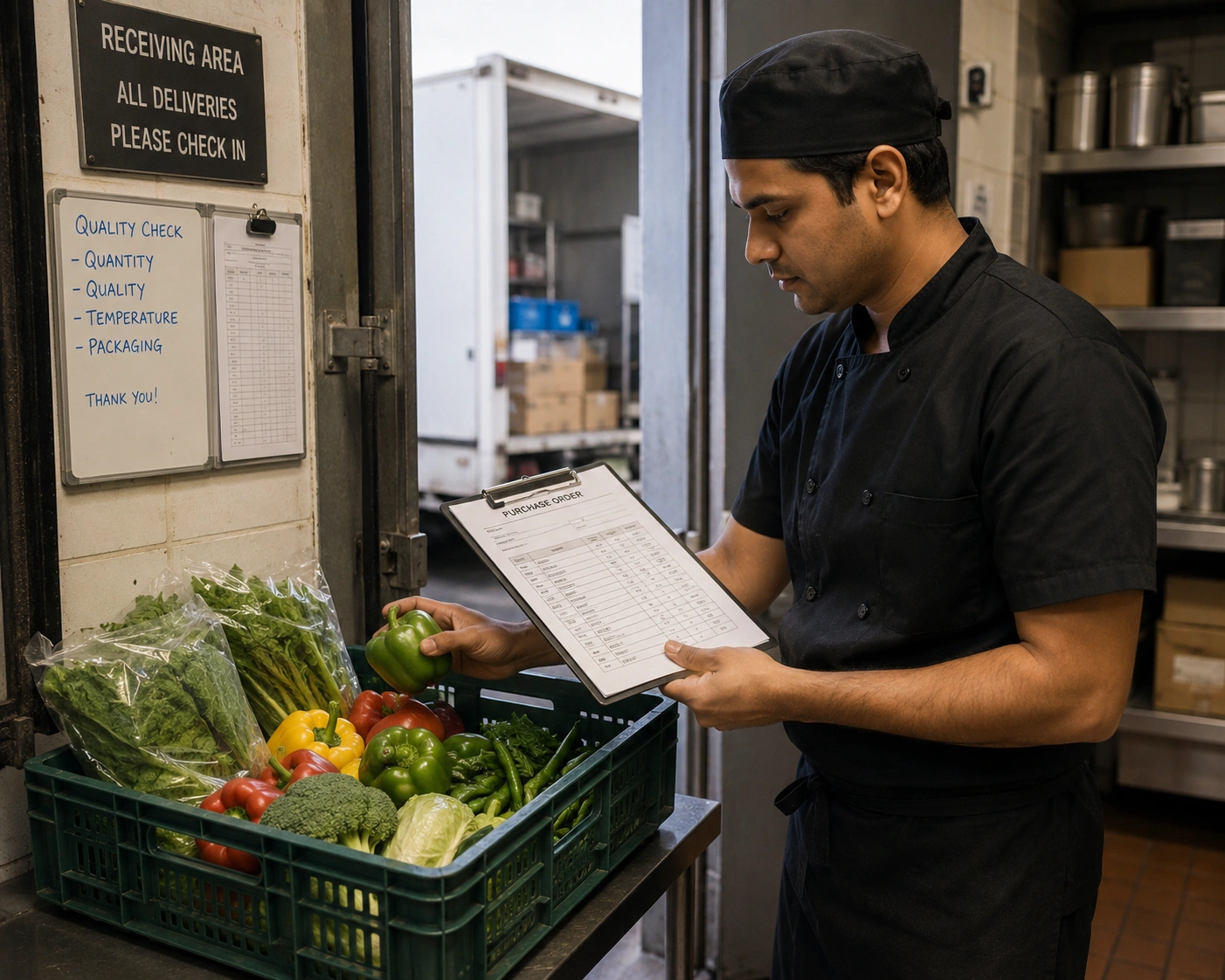
Standardize recipe cards with exact weights, train receiving staff to check every delivery against the purchase order, negotiate supplier pricing on a quarterly cycle rather than reactively, and track waste by category (spoilage vs. over-production vs. trim) so you can fix the actual cause instead of guessing. None of these require lowering ingredient quality — they require consistent execution, which is a training outcome, not a purchasing one.
India’s food services market is projected to grow from ₹7,95,330 crore in FY26 to ₹14,28,150 crore by FY31, per IBEF — a doubling that will reward restaurants with disciplined costing over those still pricing menus on instinct. Adevo’s Kitchen Operations & Culinary training builds exactly this discipline into daily kitchen routine.
How to Set Up a Weekly Food Cost Tracking Routine
The formula is only useful if the inputs going into it are accurate and consistent. Weekly tracking works in practice when it follows the same method every time — different counting styles week to week produce incomparable results that hide trends rather than reveal them.
A practical weekly routine for a standalone Indian restaurant: count physical inventory at the same time each week (Sunday close works for most operations), record every purchase during the week against actual delivery receipts rather than memory, and run the formula the same morning the count is done. Assign the count to one named person — not a rotating duty — so the methodology stays consistent and discrepancies are spotted before they compound.
For hotels with multiple outlets, the minimum is tracking by outlet rather than by property. A 30% property average can conceal one outlet running at 28% and another running at 40%, which is a management problem that only becomes visible when each outlet’s COGS is separated out. Most hotel PMS or F&B management systems support outlet-level cost reporting if configured correctly from the start — the data is usually there; it just needs someone assigned to read it weekly rather than quarterly.
FAQ
Q: What is the restaurant food cost formula?
A: Food Cost % = COGS ÷ Food Sales × 100, where COGS = Beginning Inventory + Purchases − Ending Inventory.
Q: What is a good food cost percentage for a restaurant in India?
A: As general guidelines, QSR runs 25–30%, casual dining 28–35%, and fine dining 30–40% — format directly affects what’s achievable, as explained in the benchmarks section above.
Q: What is the Q factor in food costing?
A: It’s the cost of garnishes, condiments, and small unavoidable waste not itemized on a recipe card — budget 3–5% extra to account for it accurately.
Q: How is menu costing different from food cost percentage?
A: Food cost percentage measures the whole restaurant; menu costing prices a single dish by dividing its raw ingredient cost by your target food cost percentage.
Q: How often should a restaurant track food cost?
A: Weekly, with a physical inventory count, so drift is caught within days rather than hidden inside a monthly average.
Adevo’s Food and Beverage training courses provide structured, India-specific training for F&B and hospitality teams.
Conclusion
The restaurant food cost formula is simple math. What separates restaurants that hold 28% from ones that drift to 38% is weekly tracking, standardized recipe cards, and staff trained to follow them under pressure — not a better spreadsheet.
Book a free demo of Adevo’s F&B training modules to build the costing discipline your kitchen needs.