If your bar team doesn’t have a documented bar SOP, you’re leaving money on the counter. Literally. Bars without standardised procedures lose revenue through over-pouring, inconsistent drinks, incorrect billing, and avoidable compliance lapses. If you’re enrolled in hospitality management courses or running a hotel F&B operation, you already know the margin in bar operations is thin. A solid bar standard operating procedure is what keeps it intact across every shift, every bartender, and every service period.
A bar SOP (standard operating procedure) is a documented, step-by-step instruction for completing a specific task in bar operations, from opening setup and drink preparation to inventory counting and closing routines. SOPs ensure every shift runs consistently, regardless of which staff member is on duty.
In India, bar SOPs carry additional weight. State excise laws vary. Legal drinking ages differ across Karnataka, Maharashtra, Goa, and Kerala. Dry-day compliance is non-negotiable. FSSAI rules apply to bar snacks. Without a documented bar sop, one non-compliant shift can result in licence suspension. That’s not a risk any hotel can afford.
Key Takeaways
– A bar sop covers opening, service, closing, inventory, hygiene, and compliance
– Indian hotel bars must account for state-specific excise laws, L-16/L-16F licensing, and FSSAI requirements
– Dry-day and election-ban compliance must be written into every bar sop as a non-negotiable protocol
– Documented bar standard operating procedures cut training time and reduce revenue leakage from inconsistency
What Is a Bar SOP and Why Does Every Hotel Bar Need One
A bar SOP is not a general guideline. It’s a specific, repeatable instruction that removes ambiguity from every task in bar operations. It tells a new bartender exactly how to open the bar, how much spirit goes into a standard pour, how to count closing inventory, and what to do when a guest appears intoxicated. Without this, your operations run on individual habit, not hotel standard.
Hotel bars face demands that standalone bars don’t. Room-charge billing must match the POS. Minibar integration affects closing stock counts. Loyalty programme beverage inclusions need to be tracked separately. Banquet bar setups require their own bar sop variants. A food and beverage sop that covers restaurants but ignores bar operations is incomplete for any hotel running a licensed bar.
The business case is straightforward. A bar sop shortens induction time for new bartenders, reduces pour variance, gives supervisors a basis for performance conversations, and creates an audit trail for excise inspections. Properties running structured bar standard operating procedures consistently outperform those that rely on verbal instruction passed shift to shift.
Bar Opening Procedures: The Setup Checklist Every Shift Needs
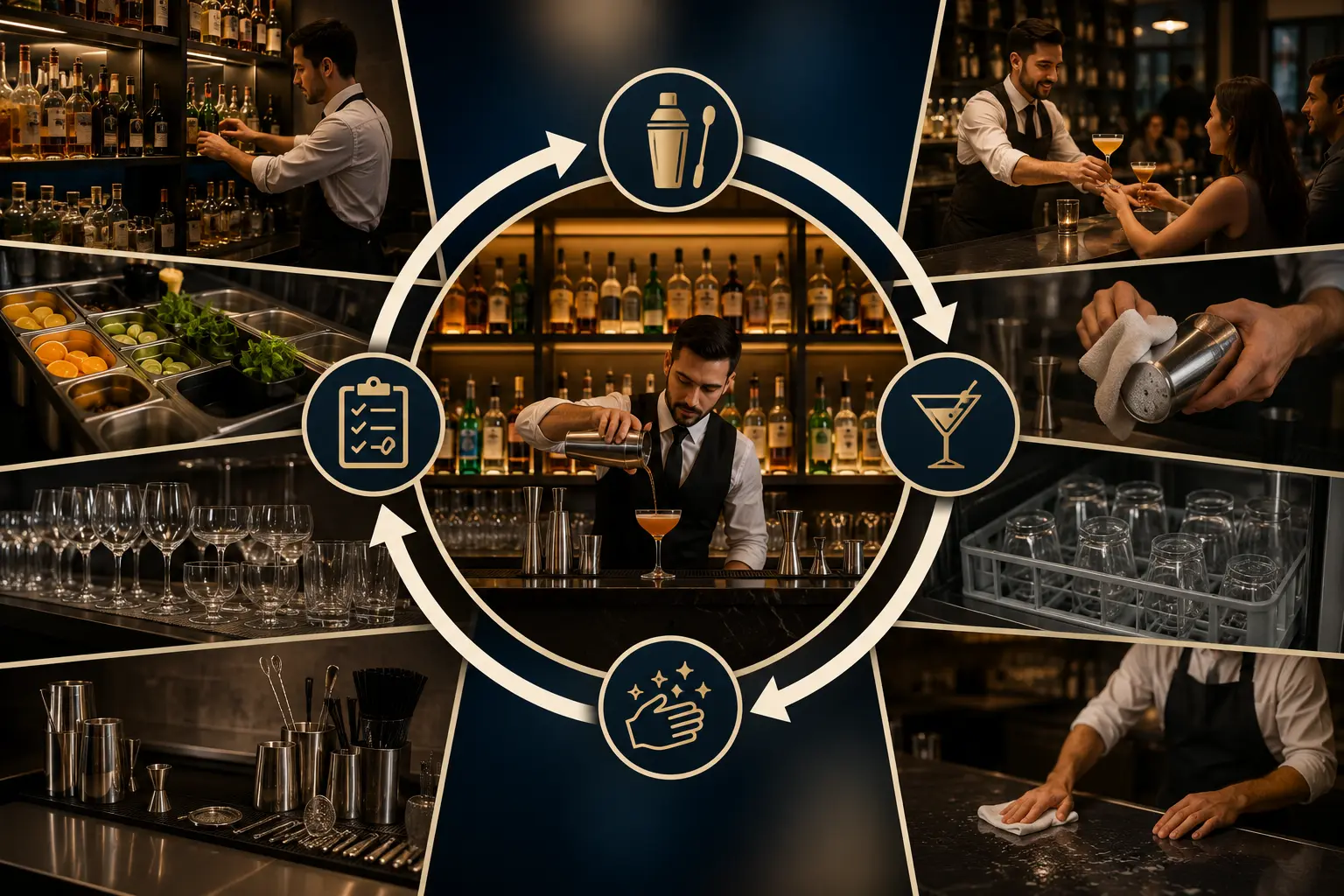
The first 45 minutes of any shift determine how the next eight hours will run. A bar sop for opening is not a checklist of nice-to-haves. It’s a sequence that ensures the bar is legally compliant, operationally ready, and guest-facing from the moment doors open.
In hotel bar operations, most service failures trace back to opening shortcuts taken under time pressure. A bartender who skips the ice machine sanitation check or fails to verify the daily dry-day status before setup creates problems that can’t be fixed mid-service. The bar sop for opening exists to prevent exactly that.
Equipment and Infrastructure Check
Walk the bar before anything else. Every piece of equipment must be confirmed operational before the first guest arrives. A bar sop for this stage should cover:
- Switch on refrigeration units and verify temperature (below 5°C for beer, mixers, and garnishes)
- Test the glass washing machine and confirm detergent and rinse-aid levels
- Check ice machine output and inspect interior for mould or scale buildup
- Power up POS terminals and confirm shift login credentials are functioning
- Test draught beer lines (prime if needed) and verify CO2 pressure
- Inspect bar lighting, including ambience fixtures and display shelf backlighting
If anything fails this check, escalate to engineering immediately. Opening with faulty equipment violates your bar sop and creates a liability during service.
Stock and Inventory Check
The opening inventory count is not optional. It’s your baseline for calculating closing variance and identifying theft or over-pouring. Your bar sop should require:
- A full bottle count by brand and category (spirits, wine, beer, mixers, juices)
- FIFO rotation check on refrigerated stock (First In, First Out means older bottles come forward)
- Garnish prep: fresh citrus cut, cherries restocked, cocktail umbrellas and straws replenished
- Par level check against yesterday’s closing inventory to flag short stock before service
Log everything in your daily opening register. Excise inspectors in Maharashtra, Delhi, and Karnataka expect this register to be current and signed by the shift manager.
Bar Opening Checklist
| Task | Done | Notes |
|---|---|---|
| Refrigeration temperature verified (below 5°C) | ||
| Glass washer running, detergent checked | ||
| Ice machine sanitised and producing | ||
| POS terminals live, shift login confirmed | ||
| Draught lines primed and tested | ||
| Opening bottle count completed | ||
| FIFO rotation confirmed | ||
| Garnish prep complete (citrus, cherries, herbs) | ||
| Bar counter polished, glassware set | ||
| Menu cards clean and in position | ||
| Day’s dry-day status confirmed | ||
| Shift briefing conducted |
Beverage Service Procedures: Running the Bar During Operations
The service bar sop covers everything from the moment a guest sits down to the point their bill is settled. Consistency here is what separates a hotel bar from an average one. Guests at Taj, Marriott, or ITC properties expect the same Martini to taste the same on Monday as it does on Saturday. That only happens with a documented service bar standard operating procedure.
Order of Service and Guest Interaction
Your bar sop for service should follow a clear sequence:
- Greet the guest within 60 seconds of seating
- Present the menu and give a 30-second verbal on specials or featured cocktails
- Take the order with repetition confirmation
- Prepare the drink following the standard recipe card exactly
- Serve with appropriate garnish, glassware, and napkin presentation
- Return within 3 minutes for a check-back
- Process billing accurately, confirming whether it’s cash, card, or room charge
No deviation from recipe. No free-pouring. Every spirit goes through a jigger. This is not about distrust; it’s about your pour cost, your brand standard, and your excise compliance.
Standard Recipe Cards and Pour Standards
Pour cost is the ratio of the cost of a drink’s ingredients to the revenue it generates, expressed as a percentage. The formula: (Cost of Goods / Beverage Revenue) x 100. For hotel bars in India, a well-managed pour cost sits between 18% and 24%. Above that, your bar sop for pouring isn’t being followed.
Standard recipe cards are the operational backbone of any bar sop. Each card specifies the exact spirit measure (typically 30ml or 60ml for a standard or double), the mixer volume, the garnish, the glassware, and the preparation method (stirred, shaken, built). Laminate these and post them at each bartending station. Review them quarterly for cost changes.
Bartenders following recipe cards and pour standards consistently are the product of structured training, not just a printed document. Well-run hotel bars pair their bar sop with hands-on pour cost and excise compliance training so the standard is demonstrated, not just described.
Responsible Alcohol Service
This is where your bar sop must be precise, not vague. In India, responsible alcohol service has legal consequences. Your bar sop should specify:
- Age verification: Check government-issued photo ID (Aadhaar, driving licence, passport) for every guest who appears under 30. Digital IDs on phones are not accepted as valid proof under most state excise rules. Accept physical documents only.
- Intoxication protocol: A bartender who serves an already-intoxicated guest is personally liable under some state excise acts. Your bar sop must include a clear decision tree: slow service, offer water, escalate to supervisor, stop service.
- Dry-day compliance: Display your dry-day calendar at the bar manager’s station. Republic Day (26 January), Independence Day (15 August), Gandhi Jayanti (2 October), and state-specific dry days must result in complete bar closure. Election day dry periods apply from 48 hours before polling closes in many states.
| State | Legal Drinking Age | Notes |
|---|---|---|
| Karnataka | 21 | Beer and wine: 18 in some contexts |
| Goa | 18 | Lowest in India |
| Maharashtra | 25 | Enforced strictly in Mumbai hotels |
| Delhi | 25 | Recent change from 21 |
| Kerala | 23 | Only BEVCO outlets and 5-star hotels |
| Tamil Nadu | 21 | TASMAC retail only; hotel bars under licence |
| Rajasthan | 18 | One of the more liberal frameworks |
Bar Closing Procedures: End-of-Shift Checklist
Closing is where revenue leakage happens most often. A rushed closing shifts the problem to the next day’s opening team and creates inventory variances that supervisors then spend hours explaining. Your bar sop for closing is not optional and should not be shortened to save time.
Financial Reconciliation
Every transaction must be accounted for before the closing bar sop is complete:
- POS session close with total sales by category (spirits, beer, wine, cocktails, non-alcoholic)
- Cash drawer count matched against POS cash total
- Credit card batch settlement confirmed
- Room-charge vouchers tallied and sent to front office
- Any voids or complimentary drinks recorded with manager authorisation
Discrepancies above a defined threshold (your property should set this, typically ±3%) trigger an investigation the same night, not the following morning.
Stock and Security
Your closing bar procedure must address bottles, not just cash:
- Complete closing inventory count, logged in the closing register
- Seal all open bottles with pourers removed (Maharashtra excise rules require this)
- Lock the spirits cabinet; log the key handover in the key register
- Verify closing stock against opening stock plus deliveries, minus POS sales
- Flag any variance above par tolerance for supervisor review
Bartenders who know a closing inventory count happens every night report far fewer shrinkage incidents. The count is as much a cultural signal as a control measure.
Cleaning and Shutdown
| Task | Done | Notes |
|---|---|---|
| POS closed and Z-report printed | ||
| Cash count completed and recorded | ||
| Room charge vouchers submitted | ||
| Closing bottle count logged | ||
| Open bottles sealed, pourers removed | ||
| Spirits cabinet locked | ||
| Bar surfaces sanitised | ||
| Glassware washed and stored | ||
| Drains flushed and cleaned | ||
| Ice machine emptied and door propped | ||
| Draught lines flushed | ||
| Equipment shut down (refrigerators excluded) | ||
| Floor mopped and waste disposed | ||
| Key handover recorded |
Consistent closing procedures are only as good as the team executing them. Explore Adevo’s food and beverage training courses to build the bar manual knowledge and hands-on skills your team needs to run opening, service, and closing routines without the shortcuts that cause revenue leakage.
Bar Inventory Management and Beverage Cost Control
Par level is the minimum stock quantity that must be on hand at any time to carry the bar through service without running out. Setting the right par level is a foundational part of any bar procedure. Too high, and you’re tying up capital in excess stock. Too low, and you run out mid-service, which is a guest experience failure.
Indian hotel bars often set par levels based on historic consumption but fail to adjust for seasonal demand. A beach resort in Goa has dramatically different spirit par levels in December versus July. A corporate hotel in Bangalore sees a different weekend pattern from its weekday one. Your bar manual should require a quarterly par level review, not an annual one.
Inventory Counting Methods
The most practical method for hotel bar inventory is the tenthing method, where bottles are measured in tenths of a full bottle (a half-full bottle records as 0.5). This allows for exact variance calculation between opening and closing counts.
Weekly physical inventory catches variances early. Monthly full inventory ties into your finance team’s cost of goods reporting. Both should be written into your bar procedure as scheduled, non-negotiable tasks.
Beverage Cost and Pour Cost Tracking
Track pour cost weekly. When your actual pour cost exceeds your standard by more than 2 percentage points, your bar manual for pouring isn’t being followed. Common causes:
- Free-pouring instead of jigger use
- Bartenders preparing staff drinks off-record
- Garnish spoilage not logged properly
- Theft from bottle-sealing bypass at closing
Correct the process before correcting the person. Most pour cost variance is procedural, not intentional. Your bar procedure, when followed, is the solution.
Bar Hygiene and Safety Standards
A bar that passes the guest’s eye test but fails a health inspection is a bar that hasn’t implemented its bar manual fully. Hygiene isn’t just about appearance in a hotel setting. FSSAI compliance for bars serving food has legal teeth, and inspectors do check.
Daily Hygiene Protocols
Your bar procedure hygiene section should cover:
- Surface sanitisation before and after each service period (countertops, speed rail, garnish trays)
- Glassware inspection: cracked or chipped glasses removed from service immediately
- Ice machine interior cleaning weekly; full descaling monthly
- Draught lines flushed every two days to prevent bacteria buildup
- Staff personal hygiene: clean uniform, trimmed nails, no jewellery below wrist during service
- Hand washing protocol: before handling garnishes, after handling cash, after touching face
These aren’t suggestions. They’re your bar manual requirements and should be signed off during opening inspection.
FSSAI Compliance for Bar Snacks
If your bar serves any food, including pre-packaged snacks, bar bites, or a full bar snack menu, FSSAI compliance applies. Under the Food Safety and Standards Authority of India’s FoSCoS licensing portal, hotel food businesses serving alcohol alongside food require FSSAI registration or licensing depending on turnover.
The July 2026 FSSAI alcoholic beverage labelling rules require that any alcoholic beverages served must comply with updated label information requirements. Your bar procedure should include a label verification step during weekly stock checks.
Temperature control matters: hot snacks must be held above 60°C, cold items below 5°C. These are FSSAI-mandated thresholds, not preferences.
India-Specific Compliance: Excise Laws, Licensing, and Dry Days
This is the section no other bar manual resource on the internet covers. Every competitor page on this topic is written for US or UK bars. Indian hotel bars operate under a completely different framework, and your bar procedure must reflect that.
Hotel Bar Licensing: L-16 and L-16F
In most Indian states, hotel bars operate under one of these licences:
- L-16 licence: Permits sale of Indian-made foreign liquor (IMFL) in hotel premises. Issued by the state excise department.
- L-16F licence: Covers foreign liquor (imported brands) in addition to IMFL. Required if your bar serves imported Scotch, gin, or wine.
Licence conditions typically include restrictions on operating hours, mandatory display of the licence on premises, prohibition of service to minors, and requirements to maintain a daily consumption register. Non-compliance results in penalties, suspension, or cancellation.
Your bar manual must include a verification step at opening: confirm the excise licence is current, prominently displayed, and that no conditions are being violated.
State-Specific Regulations and Prohibition Awareness
Some Indian states have partial or full prohibition. Bihar, Gujarat, Nagaland, Mizoram, and Lakshadweep are fully dry. If your hotel group operates in multiple states, your bar procedure must be state-specific, not a single national document.
For state-specific guidance on bar licensing in India, review your state excise department’s published bar licence categories and compliance requirements before finalising your bar manual.
Record-Keeping and Audit Readiness
Your bar procedure for compliance must include daily record-keeping requirements:
- Daily consumption register: brand-wise, quantity sold
- Opening and closing stock register signed by the shift manager
- Excise returns filed on schedule (monthly in most states)
- Guest ID verification log maintained for a minimum of 90 days
- Dry-day closure records confirming no sales occurred
Excise inspectors in Delhi, Mumbai, and Bengaluru conduct unannounced audits. A bar that can produce 90 days of clean, signed registers gets through these audits. One that can’t is looking at a notice.
Training Your Bar Team on Bar manuals
A documented bar procedure is only useful if the team follows it. You already know this if you’ve ever handed a new bartender a printed SOP and watched it sit untouched for two weeks. Documentation without training is shelf decoration.
For F&B teams looking to build structured competency, Adevo’s food and beverage training courses cover bar operations, service standards, FSSAI compliance, and responsible alcohol service in an India-specific context. It’s the kind of training that connects your bar manual to actual staff behaviour, not just paper compliance.
The training approach that works for bar teams in Indian hotels follows three stages:
- Induction: Walk through every section of the bar procedure before the first shift. Don’t assume. Explain the why behind each step, especially excise compliance and hygiene requirements.
- Supervised floor time: New bartenders shadow an experienced team member for the first week. The senior bartender follows the bar manual visibly, so the standard is demonstrated, not just described.
- Quarterly refreshers: Bar procedures need to be retrained, not just revised. Seasonal changes, new menu additions, and regulatory updates all require a structured refresher, not a group WhatsApp message.
For hotels with multilingual teams, which is most hotel properties in India, the bar manual itself should be available in Kannada, Hindi, Tamil, or the dominant regional language of your property’s workforce. An SOP no one reads because of language barrier is not an SOP. It’s a document.
A practical resource for ensuring your team actually internalises these procedures is Adevo’s hotel SOP guide, which covers the adoption gap between documentation and execution.
Frequently Asked Questions: Bar procedure
Q: What is a bar manual?
A: A bar procedure (standard operating procedure) is a documented, step-by-step instruction for completing a specific task in bar operations, from opening setup and drink preparation to inventory counting and closing routines. SOPs ensure every shift runs consistently, regardless of which staff member is on duty.
Q: What are the standard operating procedures for opening a bar?
A: Opening bar manual steps include: switch on all equipment and verify temperatures; complete an opening bottle count; confirm FIFO rotation on refrigerated stock; prepare garnishes and mise en place; polish glassware and set up the bar counter; check the dry-day calendar; and conduct a team briefing. All steps should be completed and signed off before guests arrive.
Q: What should a bar closing checklist include?
A: A bar closing checklist should cover: POS session close and Z-report print; cash drawer count matched against POS; credit card batch settlement; room-charge voucher submission; closing bottle count; sealing all open bottles; locking the spirits cabinet; surface sanitisation; equipment shutdown; and key handover with log entry.
Q: How often should bar procedures be updated?
A: Bar manuals should be reviewed quarterly and updated immediately after any regulatory change. In India, updates to state excise rules, FSSAI compliance requirements, or changes in dry-day schedules all trigger an immediate bar procedure revision. Annual-only review cycles miss too much.
Q: What is pour cost and how do you calculate it?
A: Pour cost is calculated as: (Cost of Goods Sold / Total Beverage Revenue) x 100. A pour cost between 18% and 24% is the standard benchmark for well-managed hotel bars. Anything above 25% indicates over-pouring, waste, or theft that the bar manual is not preventing.
Q: What licences does a hotel bar need in India?
A: Hotel bars in most Indian states require an L-16 licence for Indian-made foreign liquor (IMFL) and an L-16F licence if they serve imported brands. FSSAI registration or licensing is additionally required if the bar serves any food. Licences are issued and regulated by the state excise department.
Conclusion
A bar procedure is not a one-time exercise. It’s an operational system that governs every shift, every pour, and every compliance decision your bar team makes. In the Indian hotel context, that system must go beyond the generic opening-and-closing guides available elsewhere. It must cover L-16 licensing conditions, state-specific drinking age enforcement, FSSAI requirements for bar snacks, dry-day protocols, and the record-keeping that keeps excise inspectors satisfied.
The bar standard operating procedures in this guide are designed to be practical, not theoretical. Take the checklists and adapt them to your property’s service style, staffing levels, and state-specific excise framework. Build the training around them, not after them.
If you want your bar team to execute these bar manuals consistently, the training has to match the documentation. Adevo’s food and beverage training programmes offer structured, India-specific bar and beverage service training that connects SOPs to real shift behaviour rather than leaving them as shelf documents.
This bar SOP is one component of your complete hotel SOP system – which covers front office, housekeeping, kitchen, and F&B procedures.