
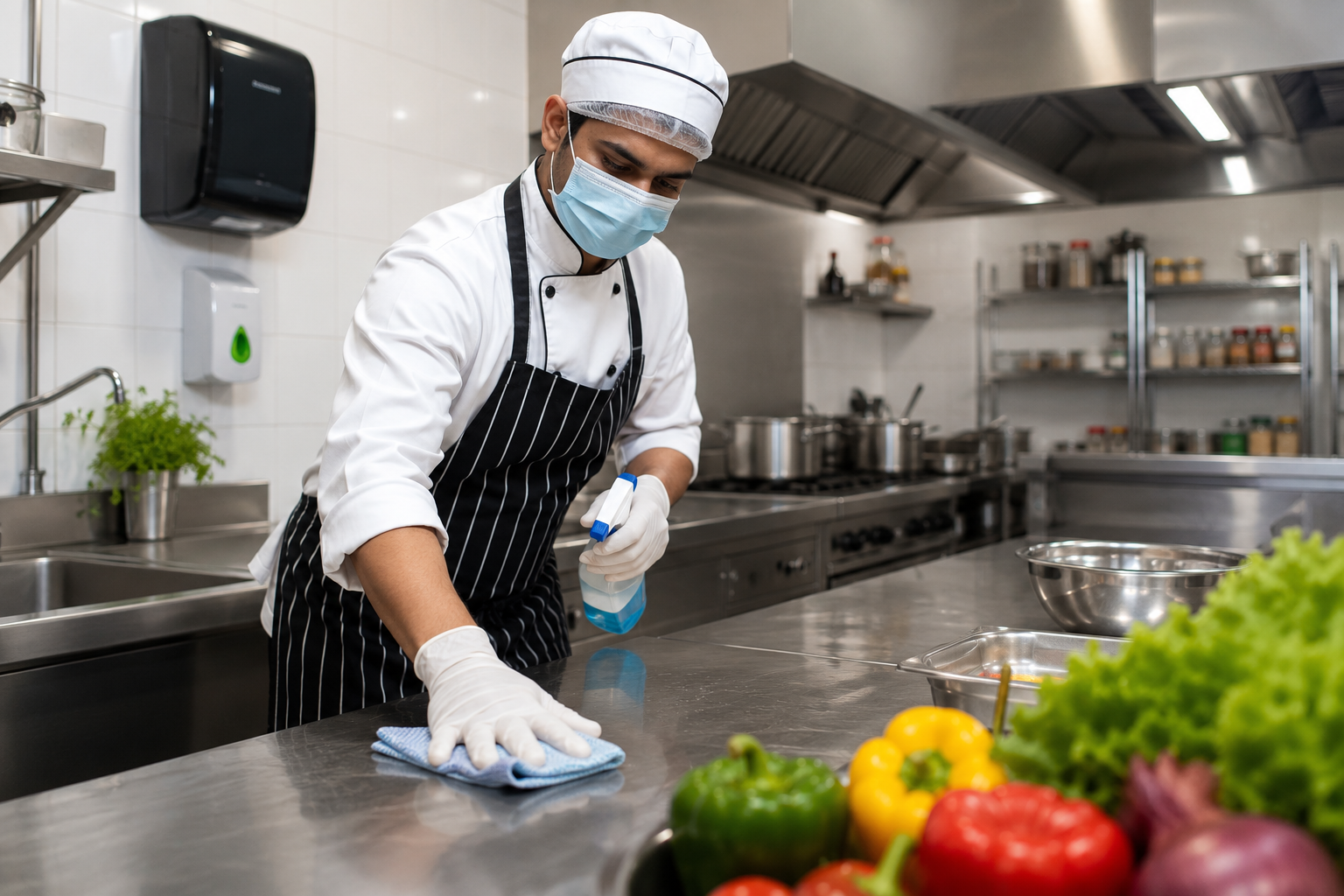
One failed FSSAI inspection can cost you real money, or worse. kitchen hygiene isn’t something you think about only when the inspector walks in. It’s something your crew practices every single shift. Skip it once, and it falls apart right when it matters most. If you’re training through soft skills training courses or running a kitchen team, this guide gives you hygiene practices your staff can actually put to use, not a compliance document written for lawyers.
Most kitchen cleanliness guides online are aimed at owners worried about their licence. This one is written for CDPs, Sous Chefs, and kitchen teams, the people who enforce hygiene on the floor every day. We’ve built it around shift-based routines, since that’s how real kitchens run, not monthly checklists you file away and forget.
Key Takeaways
– FSSAI requires 1 certified Food Safety Supervisor per 25 food handlers – non-compliance starts at Rs 25,000 fines (FSS Regulations, 2011).
– commercial kitchen hygiene is shift-based: pre-service, during service, post-service, and weekly deep-clean routines.
– Indian commercial kitchens face unique challenges: tandoor stations, monsoon humidity, veg/non-veg separation, and multilingual staff training.
What Does FSSAI Require for Kitchen Hygiene Standards?
FSSAI’s Schedule 4 sets the legal floor for sanitation standards in every commercial kitchen in India, under the Food Safety and Standards Act, 2006, which empowers FSSAI to set these requirements. None of it is optional.
The core rules are simple: smooth, washable surfaces on floors, walls, and ceilings; separate prep zones for raw and cooked food; strong airflow and good lighting; handwash stations at every workstation, stocked with soap and sanitiser; correct waste sorting; monthly pest treatment by a licensed contractor; and staff medical fitness certificates renewed each year.
The hygiene protocols rule that trips up most kitchens is the 1-per-25 requirement. Every food business needs at least one certified Food Safety Supervisor for every 25 food handlers. Want to know which certificate applies to you? Read our food safety course guide. A hotel kitchen with 40 staff needs two certified supervisors on the floor, not just listed on a roster somewhere.
Since 2026, FSSAI has switched to a licence that never expires, tracked instead through geo-tagged checks. Inspectors can turn up any day, with zero warning. What matters is the state of your kitchen on an ordinary Tuesday afternoon, not the scramble that happens when someone tips you off about a visit.
What Are the Personal Kitchen Hygiene Rules for Food Handlers?
- Wear a clean uniform at the start of every shift, no exceptions
- Tie back all hair with a cap or hairnet before entering food areas
- Keep nails short and bare, no polish
- Take off all jewelry, watches, and rings before touching food
- No phones, eating, drinking, or smoking in food prep zones
- Wash hands for at least 20 seconds with soap and warm water: before work starts, after touching raw meat, after using the restroom, after handling waste, after a sneeze or cough
- Dry hands with disposable towels only, never on clothing or a shared cloth
What Kitchen Safety Rules Prevent Contamination and Accidents?
Cross-Contamination Prevention
Cross-contamination is the single biggest hygiene practices risk in any commercial kitchen. Colour-coded chopping boards are your first line of defence: red for raw meat, green for vegetables, blue for fish, yellow for cooked food, white for dairy and bread.
Indian commercial kitchens carry one extra layer here: veg/non-veg separation. This isn’t purely a food safety matter. It carries real cultural and religious weight too. Hotels serving both veg and non-veg guests need their own prep zones, their own tools, and staff who get that sharing one surface for paneer and chicken isn’t a minor slip. It breaks guest trust, and that kind of damage to a property’s name can last for years.
Temperature Control
The danger zone sits between 4 degrees C and 60 degrees C. Food parked in that range for more than two hours turns unsafe. Cold storage stays below 4 degrees. Hot-holding stays above 60. Blast chillers should carry cooked food through the danger zone inside 90 minutes.
Digital thermometers run Rs 500 to Rs 8,000. They aren’t optional kit for a real kitchen. Every station needs one, checked on a set schedule. A monthly check takes barely five minutes per unit.
Fire and Burn Safety
Kitchen safety rules cover fire too. Check fryer oil levels each day. Check gas lines each month. Keep fire extinguishers within arm’s reach of every cook station, never locked in a cupboard across the room. Keep a first aid kit stocked and easy to grab. Every staff member should know exactly where the fire blanket lives and how to use it under stress.
What Should the Daily Kitchen Hygiene Routine Look Like?
Most commercial kitchen hygiene articles skip this part entirely. They hand you a pile of rules without saying when to apply them. food safety practices runs on shift-based routines, not vague good intentions.
Pre-Service Checklist
- Sanitize all work surfaces with food-safe solution.
- Check and log refrigerator temperatures.
- Stock handwash stations with soap and disposable towels.
- Run a 30-second personal hygiene check on every team member , uniform, nails, hair covering.
- Position colour-coded cutting boards correctly at each station.
- Empty and line all waste containers before the first order.
During Service Standards
- Wipe surfaces between every task , clean-as-you-go is non-negotiable during service.
- Change cutting boards when switching between protein types.
- Check and log hot-holding temperatures every 30 minutes.
- Empty waste bins before they reach capacity , overflowing bins are a contamination hazard.
Post-Service Deep Clean
- Sanitize all equipment surfaces thoroughly.
- Clean grease traps.
- Scrub floors with food-grade cleaning solution.
- Clear and clean all drains.
- Check and reset pest traps.
- Label all stored items with contents and preparation date before closing.
Weekly Deep-Clean Schedule
- Degrease exhaust hoods.
- Wipe down all walk-in cooler shelving.
- Clean behind and beneath equipment , the areas missed in daily cleaning.
- Wash walls from floor level to 6 feet.
- Calibrate thermometers and weighing scales.
What Kitchen Hygiene Challenges Do Indian Commercial Kitchens Face?
Most hygiene protocols guides picture a cool Western kitchen serving one type of food. Indian commercial kitchens deal with problems those guides never even touch.
Open tandoor stations throw off constant smoke and radiant heat. food hygiene near tandoor areas demands extra surface cleaning, added air checks, and ash cleanup that Western playbooks skip. Some hotel kitchens clean the tandoor section every two hours during service, twice the pace of other stations.
Monsoon humidity speeds up mould growth on walls, ceilings, and inside cold storage. hygiene practices protocols need a seasonal shift: tighter air checks, more frequent anti-mould treatment, and daily cold-storage checks for damp patches. A routine that holds up fine in January can break down badly by July without that adjustment.
Water quality in tier-2 and tier-3 towns can’t be taken for granted. commercial food hygiene there calls for water testing, filter upkeep, and ice-making checks that metro hotels rarely think about.
Multi-cuisine veg/non-veg separation at banquet scale means running distinct production lines for 500 vegetarian covers and 300 non-vegetarian covers during the same event. That takes dedicated equipment, split workflow paths, and prep planning that accounts for the split from day one, the same discipline our roundup of top culinary schools in India covers, where hygiene protocol training separates the strongest programmes from the rest.
How Do You Train Your Kitchen Team on Hygiene Practices?
Language is the real training obstacle in Indian kitchens. Your crew might speak Hindi, Kannada, Tamil, Telugu, and Malayalam between them. A sanitation standards manual written only in English reaches almost no one on the floor.
Pictures beat paragraphs. A poster with photos of handwash steps gets more buy-in than a three-page written rule sheet. Colour-coded labels that match your boards need no reading at all. Pre-service briefings that show the hygiene check, not just talk about it, cross every language barrier with ease. Staff who complete this training can then move toward formal certification, and our kitchen staff food safety training in India maps the full pathway.
Daily repetition beats an annual seminar every time. A two-minute hygiene protocols reminder in the pre-service briefing, said every shift, builds habits a one-day workshop never can. Kitchens with the strongest hygiene records aren’t the ones with the thickest manuals. They’re the ones where the CDP brings up hygiene every single day, out loud.
Multilingual kitchen sanitation modules that your whole team can pull up on a phone, in their own language, make this daily habit practical at real scale, across every shift and every outlet.
How Does FSSAI Hygiene Rating Give Your Kitchen a Competitive Advantage?
FSSAI’s optional Hygiene Rating scheme is becoming a real point of difference for restaurants and hotels. Properties that score well on the hygiene practices audit can display their rating, and more guests now look for it. Food and beverage training aligned to FSSAI audit rules gives F&B teams the groundwork inspectors want to see.
The hygiene rating inspection scores properties across food handling, personal hygiene, storage, cleaning steps, pest control, and paperwork, with higher compliance levels earning progressively better ratings.
For chefs building a career and wanting to stand out, knowing the rating system puts you ahead of most kitchen managers. Knowing how to get a kitchen ready for a hygiene rating audit, and hold those standards daily rather than just for inspection day, is a skill GMs actively seek when filling Sous Chef and Head Chef posts. Explore leadership and management skills training to build the team skills and rule know-how that set career kitchen managers apart from merely talented cooks.
How Do You Prepare for an FSSAI Kitchen Hygiene Inspection?
Keep these documents ready and current before any FSSAI inspection:
- Valid FSSAI licence , check renewal date and set a 60-day advance reminder
- Staff medical fitness certificates , renewed annually; set reminders 30 days before each expiry
- Pest control logs , minimum monthly, dated and signed by the contractor
- Temperature logs , daily entry from the first morning check, no gaps
- Water testing reports , periodic intervals per FSSAI schedule
- FoSTaC training certificates for all food safety supervisors
The four most common failure points , and how to head them off:
- Expired medical certificates , calendar reminders 30 days ahead of each expiry date
- Missing temperature logs , make the first morning check a non-delegable opening task
- Incorrect food labelling in storage , enforce contents and prep-date labels on every stored item, every shift
- Lapsed pest control schedule , set automatic vendor follow-up if monthly treatment isn’t confirmed
Your Next Step
commercial kitchen sanitation isn’t a quarterly audit topic. It’s a daily discipline that runs shift by shift, station by station. Kitchens that hold this line day after day pass inspections without a scramble. They serve safe food every time, and they build a name that keeps guests coming back.
Start with today’s shift. Run the pre-service checklist. Do the 30-second personal hygiene check on your team. Fill in the temperature log. Clean as you go. Those four moves, repeated every shift, build the food safety practices culture that protects your licence, your guests, and your career.
Frequently Asked Questions
Q: What are the basic sanitation standards rules?
A: Basic hygiene protocols rules include clean uniforms every shift, hair covered, and short nails. Wash hands before and between tasks. Use colour-coded chopping boards for different food types, and keep raw and cooked food apart. Hold cold food below 4 degrees C and hot food above 60 degrees C. Clean as you go during service, and label and date everything in storage.
Q: What does FSSAI require for kitchen sanitation?
A: FSSAI Schedule 4 asks for smooth, washable surfaces and separate raw and cooked prep areas. Kitchens also need good airflow and lighting, handwash stations at every workstation, and proper waste sorting. Monthly pest control is a must, along with staff medical fitness certificates and at least one certified Food Safety Supervisor per 25 food handlers. Break these rules, and penalties can range from monetary fines up to losing your licence.
Q: How often should a commercial kitchen be deep cleaned?
A: Clean daily after service: surfaces, equipment, floors, and waste bins. Go deeper each week: exhaust hoods, walk-in cooler shelves, behind and under equipment, and walls. Once a month, service the air system, treat for pests, and calibrate your gear. In the monsoon, clean more often. Damp air brings more mould risk.
Q: What is the temperature danger zone for food?
A: The danger zone runs from 4 degrees C to 60 degrees C. Bacteria grow fast when food sits in that range. Keep cold food below 4 degrees and hot food above 60. Throw out anything left in the danger zone for more than two hours. Blast chillers should move cooked food through that zone within 90 minutes.
Q: Is food hygiene certification mandatory in India?
A: Yes. Under FSSAI rules, every food business needs certified food safety supervisors on staff. The FOSTAC programme runs the required hygiene practices certification. Certificates last 2 years, and you need refresher training to renew. Regular food handlers need basic food safety training; supervisors need the advanced course.