India’s hotel and restaurant industry needs three million additional skilled workers by 2028. Yet only 1% of candidates entering the workforce have any formal culinary training (THSC Skill Gap Study, 2024). That gap isn’t just a statistic. It’s an opportunity for anyone willing to learn how to become a chef through the right training and career path. If you’re exploring hospitality management courses or considering a culinary career, this guide lays out the real steps – written by hospitality operators, not a culinary school brochure.
Most online guides about how to become a chef in India read like admission brochures. They list courses and fees but skip the parts that actually matter: what your first two years feel like, what hiring managers evaluate beyond your certificate, and whether you can build a career starting from a tier-2 city. We’ve drawn on 80+ years of combined kitchen and hotel operations experience across Taj, Oberoi, and Le Meridien to write the guide we wish someone had handed us at 18.
Key Takeaways
- Three entry points exist: after 10th (craft certificate), after 12th (diploma/degree), or as a career changer at any age.
- The accredited diploma (9-12 months) qualifies you for Commis Grade 1 at five-star hotels. A certificate limits you to Grade 3.
- The CDP-to-Sous Chef jump is where most careers stall – it requires management skills, not better cooking.
- Tier-2 cities (Goa, Jaipur, Kochi) offer faster career progression with less competition than metros.
5 Steps to Become a Chef in India:
- Choose your entry point – after 10th (craft certificate), after 12th (diploma or degree), or as a career changer at any age.
- Complete an NSDC/THSC-accredited programme – a 9-12 month diploma is the recommended path for hotel kitchen careers.
- Build technical and soft skills – knife work and food safety get you hired; communication and team leadership get you promoted.
- Secure a kitchen internship – treat it as a six-month job interview and convert it into a full-time position.
- Progress through the brigade – Commis to CDP to Sous Chef to Executive Chef, building operational skills at each level.
What Does a Chef Actually Do?
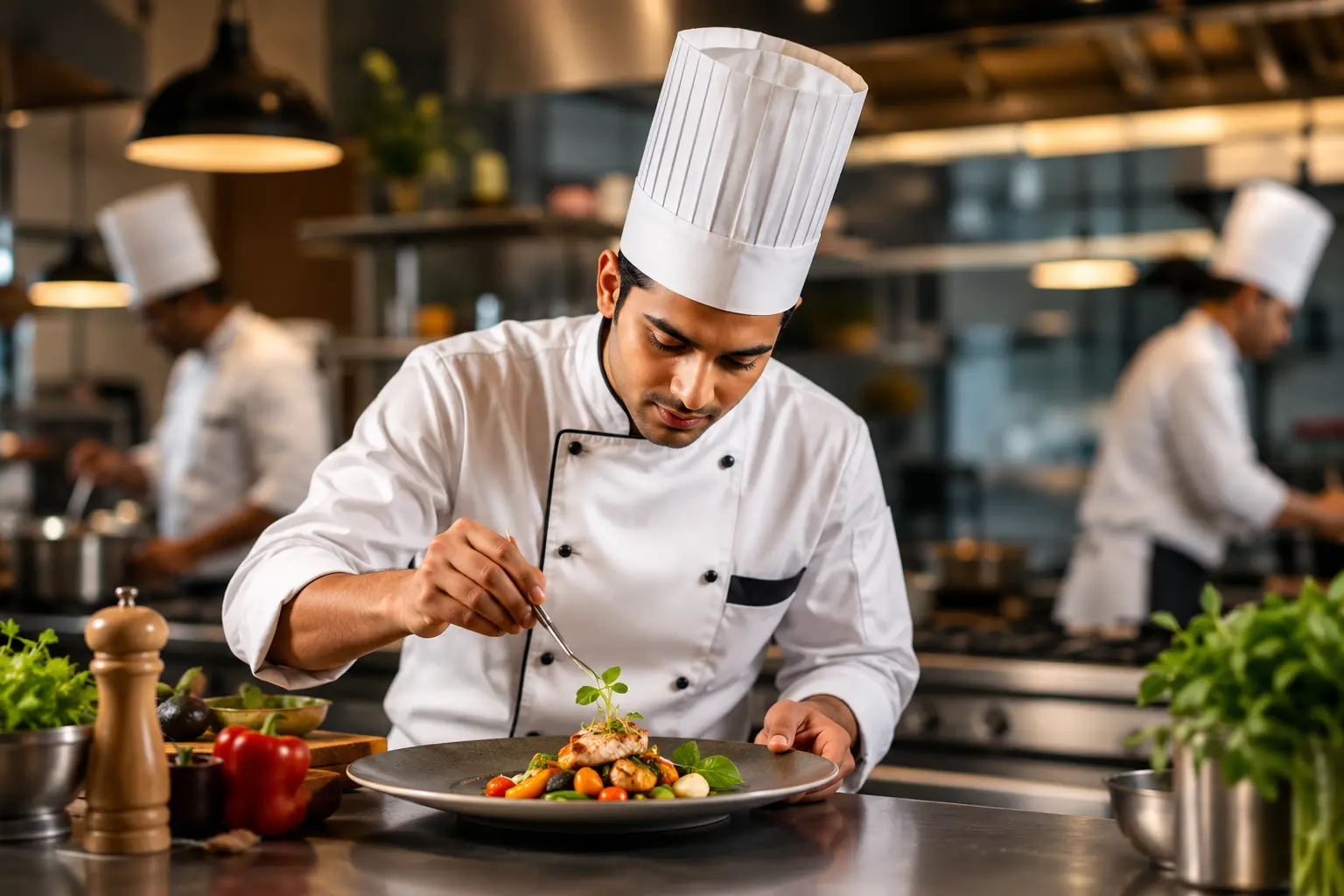
A chef – from the French chef de cuisine, meaning “chief of the kitchen” – is a trained professional who runs a kitchen. That means food production, cost control, team management, and hygiene compliance. Every shift. The difference between a cook and a chef? Ownership. A cook follows instructions. A chef decides what goes on the plate, trains the people making it, and answers for the result.
In Indian hotel kitchens, that means managing a brigade of 15 to 40 cooks across cuisine stations – tandoor, continental, garde manger, pastry. You’re coordinating across languages too. A chef at an Oberoi property in Bangalore might switch between Hindi, English, and Kannada within a single service just to get one dish out on time.
A typical day goes something like this. You arrive before service to check mise en place – the prep system that organises every ingredient and tool before cooking begins. Taste sauces. Check protein portions. Verify cold storage temperatures are logged. During service, you’re expediting orders from the pass and quality-checking every plate that leaves the kitchen. After service, food cost reports, tomorrow’s prep list, and whatever hygiene issues came up during the shift.
If that sounds demanding, it is. Most people who dream about becoming a chef picture the creative side – plating and flavour profiles. They don’t picture the 12-hour shifts on your feet in a kitchen that hits 45 degrees during summer service.
So before you decide to become a chef, ask yourself two things. Do you enjoy leading a team under pressure? And can you do that for years before the pay catches up? If yes, the rewards do come.
Who Can Become a Chef in India?
With only 1% of India’s culinary workforce formally trained (THSC, 2024), the barrier to entry isn’t competition – it’s getting the right credential. Almost anyone with the willingness to start at the bottom and complete accredited training can become a chef. You don’t need to come from a hospitality family. You need a clear entry point and a realistic understanding of the path ahead.
After 10th Standard
If you’ve completed your 10th, you can enter a craft course or certificate programme in food production. These typically run three to six months and teach basic cooking techniques, hygiene, and kitchen operations. Several Industrial Training Institutes (ITIs) offer food production certificates at minimal cost.
The trade-off? Certificate holders typically enter kitchens at Commis Grade 3 – the lowest rung – with starting salaries between Rs 10,000 and Rs 13,000 per month (industry compensation data, 2025).
After 12th Standard
This is where most aspiring chefs begin. After 12th, you can pursue a diploma in culinary arts (9-12 months), a Bachelor of Hotel Management (3-4 years), or a specialised culinary degree. The diploma route – especially one with NSDC/THSC accreditation – is the sweet spot for most people who want to become a chef. It’s fast enough to start earning within a year and credentialed enough to get past five-star hotel HR filters.
For a detailed comparison of every course type, see our guide on culinary degree vs short-term chef course (publishing soon).
Career Changers and Non-Traditional Paths
Not 18 years old? Already working in another field? You can still become a chef. Career changers who enter at 25 or 30 bring transferable skills that kitchens desperately need – project management, cost awareness, the ability to manage people. The diploma route works best here too. It’s fast enough that you’re not losing years of income, and practical enough that you’re kitchen-ready when you graduate.
What matters more than age is your willingness to start at Commis level. Nobody skips the brigade ladder, regardless of their previous career.
How to Become a Chef: Qualifications and Courses Compared
India offers three main culinary education paths: certificate courses (3-6 months, Rs 50,000-1,50,000), NSDC/THSC-accredited diplomas (9-12 months, Rs 1-5 lakh), and BHM degrees (3-4 years, Rs 3-15 lakh). The accredited diploma is the recommended path – it qualifies graduates for five-star hotel kitchens at Commis Grade 1 level within one year.
| Path | Duration | Typical Fees | Entry Level | Best For |
|---|---|---|---|---|
| Certificate | 3-6 months | Rs 50,000 – Rs 1,50,000 | Commis G3 | Entrepreneurs, career changers, cloud kitchen founders |
| Diploma (NSDC/THSC) | 9-12 months | Rs 1 – Rs 5 lakh | Commis G1 | Hotel kitchen career track – the recommended path |
| Degree (BHM) | 3-4 years | Rs 3 – Rs 15 lakh | Commis G1/CDP | Management track, international careers |
The single biggest mistake aspiring chefs make? Choosing a course based on the institute’s brand name rather than its accreditation. An NSDC/THSC-accredited diploma from a lesser-known institute will get you hired at a Taj property. A flashy certificate from an unaccredited academy might not.
NSDC (National Skill Development Corporation) and THSC (Tourism & Hospitality Skill Council) are the two accreditation bodies that five-star hotel HR departments check before evaluating any other credential. If your course doesn’t carry one of these recognitions, your application goes into a different pile – one that rarely leads to an interview.
In our experience working with hotel HR teams across India, the first filter in the hiring process isn’t grades or institute prestige. It’s accreditation. We’ve seen candidates from well-known academies get turned away because their course lacked NSDC recognition, while diploma holders from smaller institutes walked straight into branded hotel kitchens.
If you want to understand how to become a chef without spending years in a classroom, the accredited diploma is your answer. It gives you 70%+ hands-on training, industry internship experience, and a credential that hotel chains actually recognise.
What Skills Do Hotels and Restaurants Actually Hire For?
Hotels and restaurants in India hire chefs for technical cooking ability and soft skills equally. Every commercial kitchen requires one certified FSSAI Food Safety Supervisor per 25 food handlers – a regulatory requirement that makes food safety knowledge a non-negotiable hiring criterion. But beyond compliance, the chefs who advance fastest are those who communicate clearly under pressure and manage multilingual teams.
Technical Skills
These are your foundation. You need knife skills, an understanding of heat and cooking methods across cuisines, food cost calculation basics, and menu planning ability. FSSAI (Food Safety and Standards Authority of India) compliance isn’t optional – every commercial kitchen must follow Schedule 4 hygiene requirements. Having a FOSTAC (Food Safety Training and Certification) certificate on your resume shows employers you understand the regulatory side.
The Soft Skills Gap Nobody Talks About
Most chef career guides list “communication” and “teamwork” as nice-to-haves. They’re not. These are the skills that separate a career-long CDP from a Sous Chef earning three times the salary. Can you give clear instructions to a team that speaks four different languages? Can you handle a supplier who delivered the wrong cut of meat 30 minutes before a 400-cover banquet?
From training kitchen teams across 50+ properties, we’ve seen the same pattern repeatedly: the chefs who advance fastest aren’t the most talented cooks. They’re the ones who build strong teams, communicate clearly under pressure, and solve operational problems before they escalate to the guest.
If you’re serious about becoming a chef with a career that actually progresses, invest in your soft skills alongside your culinary technique. Structured training designed for hospitality professionals can speed this up – putting communication and conflict resolution modules directly on your phone, in the language your team actually speaks.
Explore Adevo’s Kitchen Operations & Culinary Training – practical skill development built by people who’ve actually run hotel kitchens, delivered through a multilingual LMS directly to your team’s phones. Book a free L&D consultation at adevo.in
The Kitchen Brigade: Your Career Ladder from Commis to Executive Chef
The kitchen brigade – the brigade de cuisine – is the hierarchy every professional kitchen in India follows, from standalone restaurants to five-star hotels. Knowing it helps you set realistic expectations about how long it actually takes to become a chef at each level. (Spoiler: longer than most guides claim.)
| Role | Experience | Monthly Salary | What You Actually Do |
|---|---|---|---|
| Commis Grade 3 | 0-1 year (certificate) | Rs 10,000 – Rs 13,000 | Basic prep, learning station work, following instructions |
| Commis Grade 1 | 0-1 year (diploma) | Rs 15,000 – Rs 18,000 | Station work with some autonomy, prep leadership |
| Chef de Partie (CDP) | 2-4 years | Rs 20,000 – Rs 40,000 | Own a station, train commis, manage section output |
| Sous Chef | 4-7 years | Rs 45,000 – Rs 90,000 | Second in command, menu planning, team management |
| Head Chef | 7-12 years | Rs 80,000 – Rs 1,80,000 | Full kitchen responsibility, cost control, quality standards |
| Executive Chef | 12+ years | Rs 1,50,000 – Rs 4,00,000+ | Multi-outlet oversight, business strategy, P&L responsibility |
Salary data: industry compensation benchmarks, five-star hotel chains, 2025
The timeline above is honest, not aspirational. Some articles claim you can become a chef – meaning Executive Chef – in five years. That’s not realistic. For a detailed look at the full discipline, read our complete guide to culinary arts in India. The jump from CDP to Sous Chef is where most careers stall for three to five years. Not because chefs can’t cook. Because they haven’t developed the management skills the role demands.
The biggest pay jump in a chef’s career happens at this CDP-to-Sous threshold. A CDP earning Rs 35,000 per month can jump to Rs 60,000 or more as a Sous Chef. But this transition depends less on cooking ability and more on operational readiness. Can you manage food costs, lead a team of 15, and coordinate with the service team during a 500-cover banquet? The chefs who figure this out early cross the threshold faster.
Want to know exactly what chefs earn at every level, including service charge and city-wise breakdowns? Our detailed guide on chef salary in India covers the numbers most articles skip.
How Much Do Chefs Earn in India?
Chef salaries in India range from Rs 10,000 per month at Commis entry level to over Rs 4 lakh per month for Executive Chefs at five-star hotel chains (industry compensation data, 2025). The first two years are financially tough – a Commis in Mumbai earning Rs 15,000 per month is effectively living below the city’s comfort line. That’s the honest reality.
But the salary curve steepens significantly after the first few years. A Sous Chef at a five-star property earns Rs 45,000 to Rs 90,000 per month in base salary alone. At the Sous Chef level and above, service charge distributions add another Rs 8,000 to Rs 25,000 per month – a component most salary guides ignore entirely.
At Executive Chef level in chains like Taj, Oberoi, and ITC, total compensation can exceed Rs 4 lakh per month when you factor in base salary, service charge, accommodation, and meals. Rs 15,000 to Rs 4 lakh over 12-15 years. That’s the actual trajectory for chefs who keep progressing.
What determines where you fall in these ranges? Five factors, roughly in order of importance:
- Your qualification – diploma vs certificate creates a Rs 5,000/month gap from day one
- City – Mumbai and Delhi pay more but cost more to live in
- Hotel star rating and brand – five-star chains pay highest base plus service charge
- Cuisine specialisation – pastry and regional Indian specialists command premiums
- Soft skills and management ability – the factor that determines promotions, not just pay
Which Culinary Specialisation Should You Choose?
Specialists command higher salaries and have more bargaining power when switching properties. Most kitchens need chefs who can work across cuisines, but choosing a specialisation early gives you a defined career identity as you become a chef. That identity opens doors.
Continental and European cuisine remains the default at five-star hotels. Most structured career path, best international mobility. If you want to work abroad, start here.
Indian regional cuisine – Chettinad, Awadhi, Malvani, Kashmiri – is where the growth is. Premium restaurants are rediscovering regional cooking, and a chef who can do authentic Awadhi or Chettinad at scale brings skills nobody can replicate from a YouTube video.
Bakery and pastry is its own career track with its own brigade. Pastry chefs often earn more than their hot-kitchen counterparts at the same experience level.
Vegetarian and Jain specialisation is uniquely Indian. Hotels hosting large Jain or Marwari events need chefs who understand the specific restrictions and can deliver 500-plate vegetarian menus without compromise. This demand isn’t going away.
Institutional and bulk cooking – QSRs, airline catering, railway catering, large-scale event management. Not glamorous. But stable, and growing fast.
Whatever path you choose, don’t skip food safety. FSSAI compliance is mandatory for every commercial kitchen, and a FOSTAC certification on your resume tells employers you understand the regulatory side before they have to teach you.
How to Get Your First Kitchen Job in India
Most hotels fill their commis vacancies from their own intern pool. That makes the training internship your best shot at a first kitchen job. If your institute includes a mandatory 3-6 month hotel placement, treat it like a six-month job interview. Show up early. Volunteer for extra shifts. Learn every station you can.
Direct Hotel Applications
If your institute doesn’t have strong placement cells, apply directly to hotel HR departments. Focus on properties that are expanding or pre-opening – new hotels hire in bulk and are more open to fresh graduates. Keep your resume to one page. Mention your accreditation, your internship experience, and any FOSTAC or food safety certification.
Standalone Restaurants and Cloud Kitchens
Don’t overlook these. Standalone restaurants offer faster responsibility and often more creative freedom than hotel kitchens. Cloud kitchens are booming in tier-1 and tier-2 cities. They’re excellent places to become a chef who understands both cooking and the business side of food production.
What Hiring Managers Actually Look For
Beyond your certificate, hiring managers evaluate three things: your attitude during the trial shift, your hygiene awareness (do you instinctively wash hands, tie your apron properly, handle food safely?), and your ability to take feedback without defensiveness. These aren’t things you learn from a textbook. They come from kitchen exposure and deliberate practice.
Common Mistakes Aspiring Chefs Make
Five-star hotel HR departments filter for NSDC/THSC accreditation before they look at anything else on your resume. That one fact should shape every decision you make about how to become a chef. We’ve watched hundreds of hospitality professionals make the same avoidable mistakes.
Choosing a course by brand name, not accreditation. A popular institute without NSDC/THSC recognition limits your options. An accredited diploma from a lesser-known institute opens more doors than an unaccredited certificate from a famous academy.
Ignoring soft skills. You can be the best cook on your station, but if you can’t communicate clearly, handle pressure, or train your juniors, you’ll stay at CDP level for years. The chefs who advance fastest invest in their leadership and communication abilities alongside their culinary technique.
Underestimating the first two years. The starting salary is low, the hours are long, and the work is physically demanding. Many talented chefs quit within the first 18 months. Those who stay and build their foundation during this period are the ones who reach Sous Chef and Head Chef roles.
Not learning food safety from day one. FSSAI compliance isn’t just a regulatory box to tick. It’s a career differentiator. A chef with FOSTAC certification and genuine hygiene knowledge stands out in every interview.
Only targeting metros. Mumbai, Delhi, and Bangalore are crowded. Goa, Jaipur, Kochi, Chandigarh – these cities have a growing hospitality sector with far less competition for positions. Starting in a tier-2 city can mean faster career progression and more diverse experience than fighting for the same entry slots in a metro.
Frequently Asked Questions
Can I become a chef without a degree in India?
Yes. A degree isn’t required to become a chef in India. A 9-12 month diploma with NSDC/THSC accreditation is sufficient to get hired at five-star hotel kitchens. Many successful Executive Chefs in Indian hotels started with diplomas, not degrees. What matters more is your accreditation, kitchen experience, and willingness to learn on the job.
How long does it take to become a chef in India?
Reaching Commis level takes 9-12 months of formal training. Progressing to Chef de Partie typically takes 2-4 years of kitchen experience. To become a Sous Chef, expect 4-7 years total. Reaching Executive Chef – the top of the brigade – usually takes 12 or more years of sustained effort, skill building, and career moves across properties.
What is the best course to become a chef after 12th?
A diploma in culinary arts from an NSDC/THSC-accredited institute is the best balance of time, cost, and career outcome for most students after 12th. It takes 9-12 months, costs Rs 1-5 lakh, and qualifies you for Commis Grade 1 positions at branded hotels. A full BHM degree (3-4 years) makes sense only if you’re targeting management roles or international careers.
Is chef a good career in India in 2026?
India’s hospitality sector is projected to reach USD 55.67 billion by 2031, growing at 14.76% CAGR (Mordor Intelligence, 2025). The demand for trained chefs far outstrips supply. With only 1% of candidates formally trained, a qualified chef with the right soft skills and food safety knowledge has strong career prospects. The trajectory from Commis to Executive Chef offers real income growth over 10-15 years.
Can I become a chef at 30 or after engineering?
Yes. Career changers who enter culinary training at 25 or 30 actually bring useful skills – analytical thinking, project management, cost awareness – that transfer well to kitchen operations. Complete a 9-12 month accredited programme, start at Commis level, and use your prior experience to progress faster than the average fresh graduate. Your age isn’t the barrier. Your willingness to start at the bottom is.
How much does a chef course cost in India?
Certificate courses (3-6 months) cost Rs 50,000 to Rs 1,50,000. Diploma programmes (9-12 months) range from Rs 1 lakh to Rs 5 lakh. A full BHM degree at a government IHM costs Rs 3-6 lakh over three years, while private institutes charge Rs 5-15 lakh. Always verify that your chosen programme carries NSDC or THSC accreditation before enrolling – an unaccredited course, regardless of price, limits your career options.
Your Next Step
The path to become a chef in India is demanding but clear. Get accredited. Build soft skills alongside technical ones. Survive the first two years. Keep pushing through the brigade system. Three million roles need filling by 2028, and the overwhelming majority of people entering the field have zero formal training.
That gap is your opening. Whether you’re 18 and choosing after 12th or 30 and leaving a desk job, the kitchen has room for anyone willing to learn and put in the work. Start with an accredited diploma. Treat your internship like it decides your career – because it often does. And invest in your soft skills as much as your knife skills. The chefs who do both are the ones who make it to the top of the brigade.