
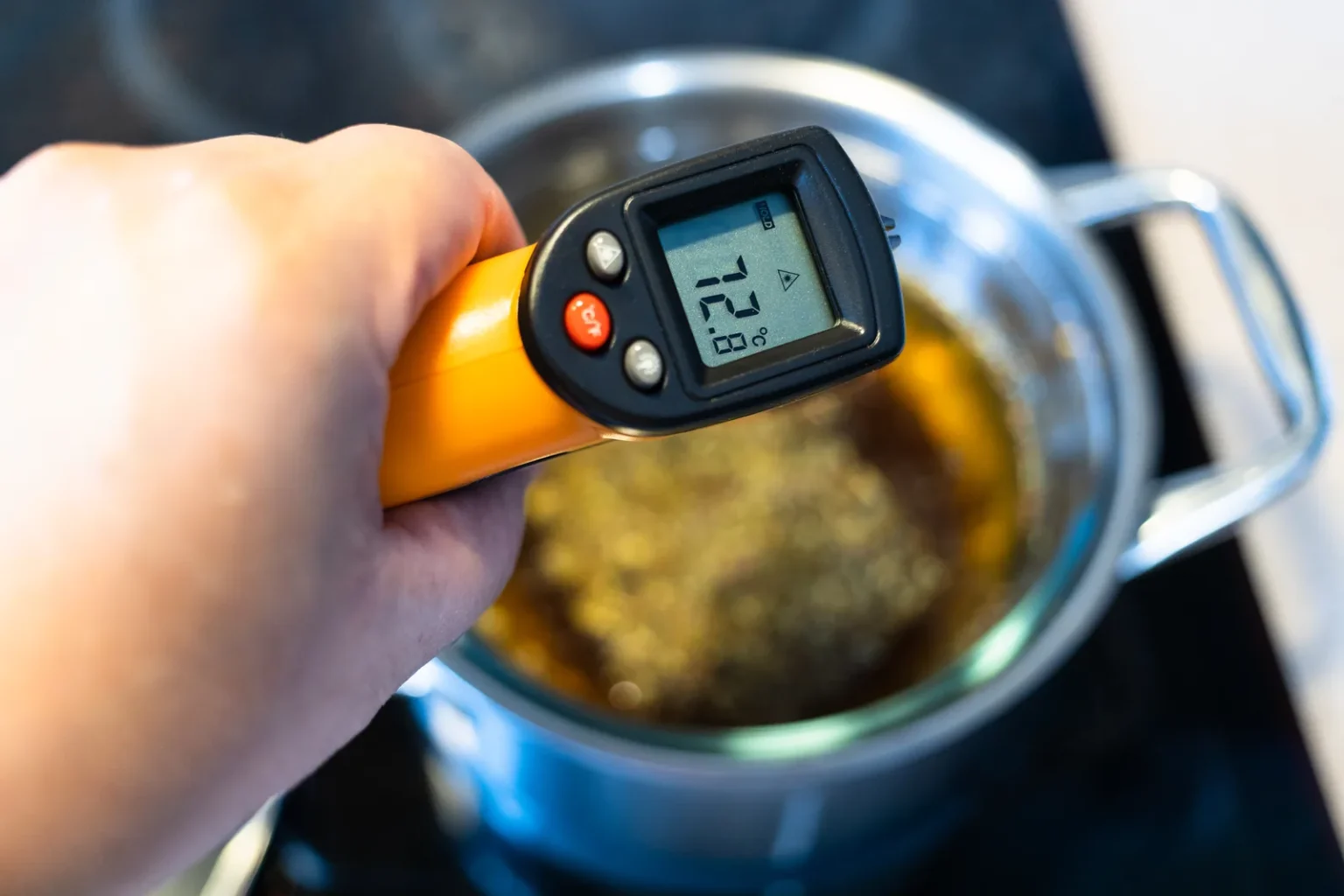
The 7 principles of HACCP are a step-by-step method for finding food safety hazards in your kitchen and controlling them before a dish reaches a guest. Most food safety failures do not come from a dirty kitchen. They come from nobody checking the one step that mattered. This guide explains each principle in plain kitchen terms and shows who owns it on the floor. For structured service and operations training, see Adevo’s food and beverage training programmes.
Key Takeaways
- The 7 principles of HACCP run in a fixed order: find hazards, mark the control points, set limits, monitor, correct, verify and record.
- A HACCP plan works only when the person at the stove can read the critical limit and knows what to do when it is missed.
- Records are the proof. A step that was never written down is, to an auditor, a step that never happened.
- Service staff are part of the plan too, because allergen handling and hot-holding fail at the pass as often as in the kitchen.
What Is HACCP and Why Do Indian Kitchens Need It?
HACCP stands for Hazard Analysis and Critical Control Points. It is a preventive system: instead of tasting or inspecting the final dish, you control the steps where a hazard can enter or be removed.
Think of a 60-cover restaurant in Pune that cooks chicken tikka for dinner service. The risk is not “chicken”. The risk is undercooked chicken, or cooked chicken left warm on the pass for too long. HACCP names those two moments and puts a check on each.
Indian kitchens carry extra pressure points. Power cuts affect cold storage, monsoon humidity affects dry stores, and a single outlet may serve both a hot buffet and an à la carte menu. A written system gives a new cook the same instructions as the head chef, and the 7 principles of HACCP are the backbone of that system.
The seven steps come from the Codex Alimentarius framework, and the FAO training manual states that the HACCP system consists of seven principles. Indian regulators expect food businesses to run a food safety management system built on this logic, so the framework is not optional theory for a licensed kitchen.
What Are the 7 Principles of HACCP at a Glance?
The 7 principles of HACCP are applied in one order, and each one feeds the next.
| Principle | What it asks | Kitchen example |
|---|---|---|
| 1. Hazard analysis | What can go wrong at each step? | Raw chicken carries bacteria |
| 2. Critical control points | Where must we stop it? | The cooking step |
| 3. Critical limits | What number is safe? | Core temperature at the set limit |
| 4. Monitoring | Who checks, and how often? | Cook probes every batch |
| 5. Corrective action | What happens if it fails? | Return to heat, log the batch |
| 6. Verification | Is the plan really working? | Weekly review by the supervisor |
| 7. Records | Where is the proof? | Signed temperature log |
How Does Each of the 7 Principles of HACCP Work on the Kitchen Floor?
Each principle answers one question. Here is how a sous chef or captain can read them in daily service.
Principle 1: Conduct a hazard analysis
List every step from receiving to serving and ask what could harm a guest at that step. Hazards fall into three groups: biological (bacteria, viruses), chemical (cleaning agents, allergens) and physical (glass, metal, bone).
A banquet kitchen that receives paneer in the morning and serves it at night has at least three hazard points: receiving temperature, storage and reheating.
Principle 2: Determine the critical control points
A critical control point (CCP) is a step where you can prevent, remove or reduce a hazard, and no later step can fix a failure. Cooking is the classic CCP. Chilling cooked rice quickly is another.
Not every step is a CCP. Mark twenty of them and nobody checks any of them properly, which is why most kitchens end up with only a handful.
Principle 3: Establish critical limits
A critical limit is the line between safe and unsafe, written as a number or a clear condition: a core temperature, a holding time, a pH value. Use the limit your food safety authority and your own plan set, and print it where the cook can see it.
A limit like “cook well” is not a limit. A limit like “probe reads the set core temperature before plating” is.
Principle 4: Establish a monitoring system
Monitoring answers three questions: who checks, with what, and how often. Give the task to a named role, never to “the kitchen”, and equip that person with calibrated probe thermometers, timers or test strips.
Many hotel kitchens now use a simple shift checklist for this, and the same discipline applies to FSSAI food safety training for hospitality teams.
Principle 5: Establish corrective actions
Decide in advance what happens when a limit is missed. The cook needs a clear instruction, not a debate during a rush: continue cooking, hold the batch, discard it, or call the supervisor.
Corrective action also covers the cause. If the oven runs cold, repair it, and log both the batch and the repair.
Principle 6: Establish verification procedures
Verification, the sixth of the 7 principles of HACCP, checks that the plan itself works. A supervisor reviews the logs, recalibrates thermometers, and then stands at the station to watch a real cooking step from start to finish. Reviews like this catch drift early. A thermometer that slowly stopped reading true is a typical example.
Principle 7: Establish documentation and record keeping
Record keeping, the last of the 7 principles of HACCP, shows that you did what you planned. Keep temperature logs, corrective action notes, supplier checks and training records. Short, signed, dated entries beat long essays.
Consider Rohan, a kitchen supervisor in a Bengaluru hotel. After a guest complaint, he could not show that the chicken had reached its temperature that night. Nothing had gone wrong, but with no log he could not prove it. The next week his team started signing a one-line log per batch, and the next complaint was closed in minutes.
Who Owns Each of the 7 Principles of HACCP in an Indian F&B Team?
Each of the 7 principles of HACCP needs an owner. Without one, the plan lives in a folder and not on the line.
- Head chef or kitchen manager: owns the plan, the CCP list and the verification review.
- Sous chef or section lead: runs monitoring each shift and signs the logs.
- Cooks and stewards: take readings, follow the limits and report a miss at once.
- Restaurant captains and service staff: check hot-holding at the pass and handle allergen requests correctly.
- Store keeper: checks receiving temperatures and supplier documents.
The same ownership logic runs through hospitality leadership. Supervisors who coach their teams well, which is the focus of Adevo’s soft skills training courses, get faster reporting of problems, and fast reporting is what a corrective action needs.
What Mistakes Make the 7 Principles of HACCP Fail in Practice?
Plans rarely fail on paper. They fail in daily habits, and the 7 principles of HACCP only protect guests when those habits hold. These five mistakes appear again and again:
- Copying a template without a hazard analysis: The plan describes a kitchen that is not yours.
- Too many CCPs: Staff stop checking when everything is critical.
- Unrealistic monitoring: A check every ten minutes during peak service will be faked.
- Records filled in at the end of the shift: Entries written from memory prove nothing.
- No refresher training: New joiners learn from whoever is nearest, not from the plan.
Meera, a captain at a busy South Indian restaurant in Chennai, noticed that her steward wrote hot-holding temperatures for the whole evening at 10 pm. She replaced the form with a laminated card at the pass and asked the steward to initial each reading at the time. Readings became accurate within a week, and one dropped-temperature sambar was caught and reheated before it reached a table.
How Should F&B Staff Be Trained on the 7 Principles of HACCP?
Train for behaviour, not for definitions. A cook who can recite the 7 principles of HACCP but cannot read a probe is not trained.
A practical sequence for a restaurant or hotel works like this:
- Start with the hazard walk: Walk the actual route from receiving to service with the team and ask where things can go wrong.
- Teach the CCPs one at a time: Practise the real check at the real station.
- Role-play a miss: Let staff run the corrective action, so they have done it once before it counts.
- Audit the logs weekly: Give feedback on specific entries.
- Refresh every quarter: Repeat the walk when the menu or equipment changes.
Once the plan is running, read what FSSAI checks in a food safety audit to see which of your records an inspector asks for.
Want this built into your own outlet? Talk to us about a modular programme for your kitchen and service teams.
Conclusion
The 7 principles of HACCP give a kitchen one repeatable way to prevent, check and prove food safety. Start with a real hazard walk, keep CCPs few, give each check an owner and write records at the moment of the check.
Ready to build this into your team? Ask about Adevo’s F&B training for your outlet built around your menu and your kitchen.
Frequently Asked Questions: 7 Principles of HACCP
Q: What are the 7 principles of HACCP?
A: The 7 principles of HACCP are hazard analysis, critical control points, critical limits, monitoring, corrective actions, verification and record keeping. They are applied in that order. Together they form a preventive food safety system.
Q: Are the seven principles of HACCP mandatory in India?
A: Licensed food businesses in India must run a food safety management system, and HACCP is the method most plans use. The exact requirement depends on your licence category and business type. Check your licence conditions with your food safety officer or consultant.
Q: What is a critical control point in a restaurant kitchen?
A: It is a step where a hazard can be prevented or removed and no later step can fix a failure. Cooking chicken to its safe core temperature is a common example. Chilling and reheating cooked food are others.
Q: Who is responsible for HACCP in a hotel or restaurant?
A: The head chef or kitchen manager owns the plan, but every staff member carries a part. Cooks take readings, supervisors verify, and service staff handle hot-holding and allergens at the pass.
Q: How often should a HACCP plan be reviewed?
A: Review it at least once a year and again whenever the menu, equipment or supplier changes. Verification of logs should be weekly. A review also follows any complaint or near miss.