Silver service is a formal style of restaurant service in which a waiter transfers food from a platter onto the guest’s plate at the table, using a service spoon and fork held in one hand. It is the polished, practised technique behind most formal banquets in Indian five-star hotels. Adevo’s food and beverage training courses teach it as a core skill, and this guide breaks the technique into steps you can practise.
Think of Zoya, a trainee at a banquet team in Hyderabad. On her first practice shift she lifted a piece of fish with the spoon and fork, and it slid off before reaching the plate. Her supervisor did not scold her. He handed her a damp cloth, an empty platter and a bag of dry rolls and told her to practise ten minutes before every shift. Within a fortnight, her hands were steady.
Key Takeaways
- Silver service moves food from a platter to the guest’s plate using a service spoon and fork in one hand.
- Food is served from the guest’s left, and the technique needs regular practice to look smooth.
- It is used at banquets and in top-class hotels, where presentation matters as much as speed.
- Trainees improve fastest with short, daily drills on an empty platter before live service.
What Is Silver Service in F&B?
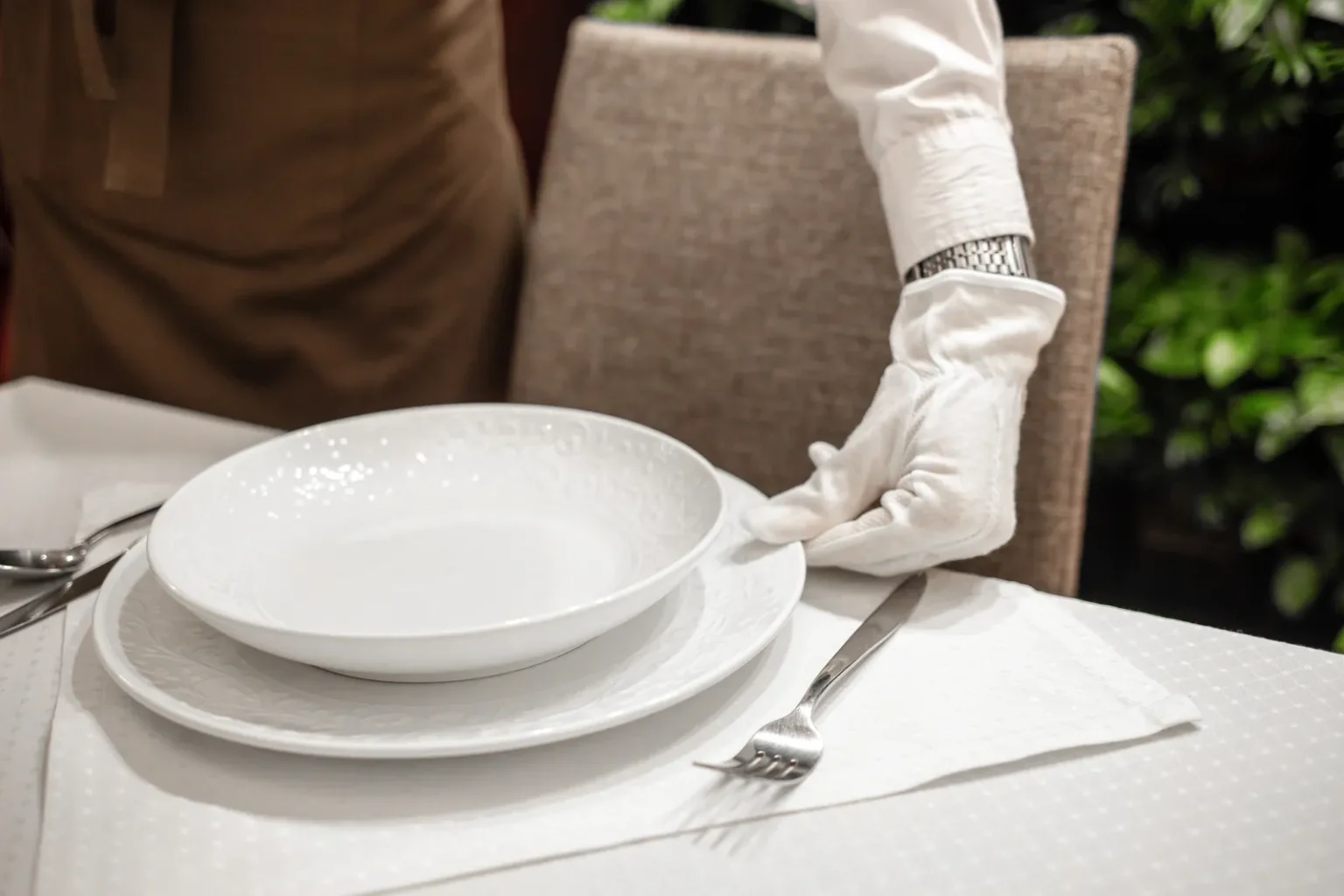
This style is a table-service technique in which a waiter serves food from a service dish or platter onto the guest’s plate using a service spoon and fork. It is a formal, skilled style, named after the silver platters traditionally used. Stainless steel and other dishes now do the same job.
Study material from UOU, the Uttarakhand Open University, describes it as a technique that requires much practice, almost always used for banquets in top-class hotels, restaurants and cruise liners. The food is served from the guest’s left side with a spoon and fork.
Many Indian textbooks treat silver service and English service as close relatives. Both use platters at the table. This style is the one where the waiter does the serving, and the technique is what sets it apart.
How Does Silver Service Work Step by Step?
Silver service follows a clear order. Learn it as a routine, and the skill becomes automatic.
- Set the table: lay the cover with warmed plates, clean cutlery and glassware.
- Prepare the platters: the kitchen portions the dish, garnishes it and places it on a hot platter.
- Carry the platter: hold it on a folded napkin in the left hand and approach from the guest’s left.
- Present the dish: show it to the host for approval before serving anyone.
- Serve with spoon and fork: lower the platter to the plate, lift each portion with the service spoon and fork and set it down neatly.
- Move around the table: serve in the order your outlet follows, then offer more if the menu allows.
- Clear the course: remove plates and platters together before the next course.
The key to a smooth routine is steady, unhurried movement. Trainees who want to polish their poise can pair floor practice with our hospitality management courses, which build the guest awareness that sits behind good technique.
How Do You Hold the Service Spoon and Fork?
The spoon and fork work together like a pair of tongs, held in one hand. The spoon sits in the palm side with the fork on top. A gentle squeeze lifts the food, and a quick release sets it on the plate.
Practise the grip with an empty platter first. Then add soft items, such as bread rolls, and later food that is harder to grip, such as fish or vegetables with sauce. Do not rush this step. A secure grip in training means a calm table in service.
Keep your elbow close to your body and your wrist level. Move the platter, not your arm, so the food never travels far. Small, controlled movements always look more polished than big ones.
Where Is Silver Service Used in India?
This style is used at formal banquets, hotel set-menu dinners, wedding receptions in luxury properties and fine-dining rooms. It is the style a guest expects when a formal dinner comes with matched tableware and a fixed menu.
It is rare in fast casual outlets. Those places need speed, and a plated dish carried from the kitchen is quicker than a platter served at the table. A guest at a corporate banquet in a metro five-star will usually meet this style. A guest at a neighbourhood cafe will not.
Dev, a banquet captain at a Jaipur hotel, ran a wedding reception for a large family. He split his team into small groups, each with a lead waiter who called the order. Every table was served in the same wave, and the family noticed. A calm lead made the technique look easy.
What Are the Advantages and Limits of Silver Service?
The main advantage is presentation. Food reaches the guest hot and neatly arranged, and the waiter can adjust portions to what each guest wants. It gives a formal dinner a sense of occasion without the full theatre of tableside cooking.
The limits are practical:
- Practice needed: the technique takes weeks to feel natural.
- More staff: each waiter serves fewer guests than in plated service.
- Slower pace: serving guest by guest takes longer than carrying plates.
- Equipment: platters, warmers and matching service spoons and forks must be ready and clean.
For most banquets, those costs are worth paying. For a quick lunch service, they are not. Our guide to the restaurant general manager role shows how managers weigh staffing and style choices like this one.
How Does Silver Service Differ From Other Styles?
Silver service differs from the others in where food is portioned and who does it. The waiter does it at the table, with the platter in hand.
| Style | Where food is portioned | Who does it |
|---|---|---|
| American | Kitchen | Kitchen staff |
| English | Table | Host or waiter |
| Silver | Table, from the platter | Waiter |
| Russian | Table, from the platter | Waiter |
Many outlets treat this style and Russian service as near neighbours. Both serve from platters onto plates. The difference is mostly in how elaborate the presentation is and how the term is used in your service manual.
What Mistakes Do New Servers Make in Silver Service?
Most mistakes come from rushing and from a loose grip. A server who hurries drops food or splashes sauce. A server with a weak grip lets the portion slide.
Watch for these slips:
- Wrong side: serving from the right instead of the left.
- Heavy platter: carrying too much and losing control of the angle.
- Cold plates: serving onto plates that have not been warmed.
- No eye contact: working silently without acknowledging the guest.
A short pre-service rehearsal fixes most of these. Ten minutes of drills before the doors open is worth more than an hour of lecture.
How Do You Train Staff in Silver Service?
Train silver service in three stages. Start with the grip, move to carrying and approach, then practise the full serve at a table. Add live service only when the trainee can serve a full course without a mistake.
Use a simple scorecard to track steadiness, order, timing and guest contact. Pair trainees with a senior server for their first banquet. Our guide to the types of restaurant service shows where this technique sits on the training ladder and what to teach before it.
Want every server on your banquet team to serve with the same steady hands? Ask about Adevo’s F&B training for banquet servers built around your property.
Conclusion
Silver service is a skill built on practice. A steady grip, a calm approach and the right order make the difference between a nervous server and a polished one.
Start with the spoon and fork on an empty platter, add live service in steps and rehearse before every banquet. Adevo’s F&B programmes help your team build that routine.
Frequently Asked Questions: Silver Service
Q: What is silver service in F&B?
A: Silver service is a formal style in which a waiter serves food from a platter onto the guest’s plate at the table, using a service spoon and fork in one hand. It is used at banquets and in top-class hotels.
Q: From which side is food served in silver service?
A: Food is served from the guest’s left side. The waiter holds the platter low and lifts each portion with the spoon and fork onto the plate.
Q: Why is it called silver service?
A: It is named after the silver platters and dishes traditionally used to carry food to the table. Today, stainless steel and other service dishes are used as well.
Q: What is the difference between silver service and English service?
A: Both use platters at the table. In English service, the host often portions the food. In silver service, the waiter does the serving using a spoon and fork.
Q: Where is silver service used in India?
A: It is used at formal banquets, hotel set-menu dinners, wedding receptions in luxury properties and fine-dining rooms. Casual restaurants use plated service instead.