
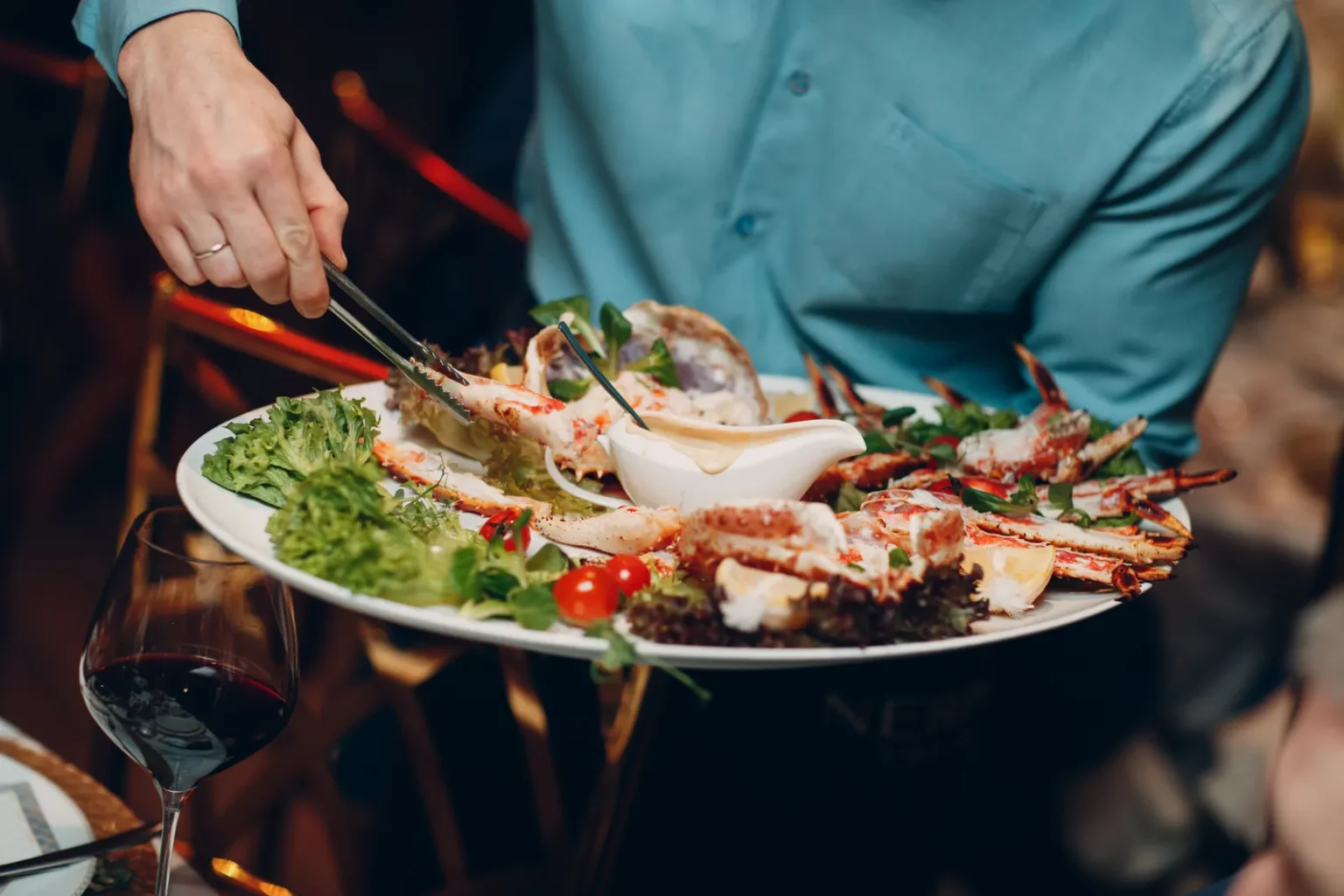
Russian service is a formal style of restaurant service in which food is carried to the table on platters, shown to the host and then served onto each guest’s plate by the waiter. It is the style behind many polished banquets, and it gives guests hot food and individual attention at the cost of more staff. Adevo’s food and beverage training courses teach it alongside the other classic styles, and this guide shows how it works on an Indian floor.
Consider Nandini, a banquet captain at a five-star in Chennai. A corporate client asked for a formal dinner with a table of guests who would “not have to wait for anything”. She switched from plated service to platter service for the main course. Guests were served one by one from the platter, hot and unhurried. The client’s feedback was a single line: “It felt looked after.”
Key Takeaways
- Russian service brings finished food to the table on platters and serves each guest onto their plate.
- It is more formal and more personal than plated service, but needs more waiters per guest.
- Indian textbooks agree on the platter but differ on small points, so outlets should set one clear standard.
- It suits banquets, private dining and luxury hotel dinners, not fast turnaround outlets.
What Is Russian Service in F&B?
This style is a platter-based table-service style in which each course is brought to the table, presented to the guests and served guest by guest. The food is prepared and portioned in the kitchen, placed on a silver platter and carried to the dining room. Food moves from the platter to the plate in front of each guest.
The style draws on an old tradition of presenting large joints, whole fish and whole birds in full view before carving. Indian hotel management books agree on the core idea, even where their details differ. That is why trainees meet slightly different versions in different outlets.
How Does Russian Service Work Step by Step?
Russian service follows a clear sequence for every course. Teach it in this order and your team will serve evenly.
- Set the cover: lay each place with the plates and cutlery the course needs, with a warm plate in front of each guest.
- Prepare the platters: the kitchen portions the dish, garnishes it and loads the platters hot.
- Carry in together: waiters bring the platters in a single wave so the table is served at once.
- Show the host: present the platter to the host first for approval.
- Serve guest by guest: use a service spoon and fork to lift food from the platter onto each guest’s plate.
- Offer seconds if the menu allows: go round again with the platter.
- Clear together: remove each course in one coordinated wave.
Timing is what makes it work. Every guest should see food arrive within moments of the others. New staff can build this sense of rhythm through our soft skills training courses before their first banquet shift.
What Are the Key Characteristics of Russian Service?
This style has a handful of defining features that separate it from plated and French service.
- Platter-based: food is carried on platters and portioned in front of the guest.
- Sequential courses: each course is served and cleared before the next.
- Host presentation: the host sees and approves the dish first.
- Individual attention: a waiter serves each guest personally.
- Hot food: dishes reach the plate directly from the platter.
Training material from Bharat Skills, a government portal, describes the style as built around a carving trolley or sideboard: the dish is visible to the guest, then carved, portioned and garnished before it is served onto the plate. The same source calls it a very expensive form of service, using skilled labour and specialty equipment. That is the practical cost of its polish.
Where Is Russian Service Used in India?
This style is used at formal banquets, weddings in luxury hotels, corporate dinners and private dining rooms. Hotels also use it for set-menu galas where every guest must receive the same dish at the same moment.
It is rare in cafes and casual restaurants. Those outlets need speed and low staffing, which plated service gives them. A restaurant that tries Russian service on a busy lunch usually finds its floor team stretched too thin.
Aman, a banquet manager at a Delhi hotel, rostered one waiter to every two guests for a formal dinner. The team served each course in a clean wave, and the client complimented the pace. He then ran the same dinner with one waiter per four guests and watched the waves collapse. Staffing ratio, not effort, decided the result.
What Are the Advantages and Limits of Russian Service?
The main advantage is the experience. Guests receive hot food, personal attention and the sense of an occasion. The style also lets the host control the pace of the table.
The limits are practical:
- Staff heavy: it needs more waiters per guest than plated service.
- Skill dependent: serving from a platter takes steady hands and practice.
- Slower: each course takes longer to complete.
- Equipment: platters, warmers and service spoons and forks must be ready and clean.
For a banquet, those costs are usually worth it. For a quick lunch, they are not. For banquet-ready floors, our guide on the banquet event order shows how teams plan the staffing and timing behind a formal dinner.
How Does Russian Service Differ From Other Styles?
This style differs from the others mostly in who portions the food and where. It sits between plated service and tableside French service in skill and cost.
| Style | Where food is portioned | Staff need |
|---|---|---|
| American | Kitchen | Low |
| English | Table, host or waiter | Medium |
| French | Beside the table | High |
| Russian | Table, from platter to plate | High |
Some outlets also blend this style with English or French styles for parts of a menu. The mix works as long as the team knows which course uses which style and has practised the switch.
What Mistakes Do New Waiters Make in Russian Service?
New waiters usually stumble on timing and platter control. A platter that wobbles or a waiter who serves too slowly breaks the wave. Practice the carry with an empty platter before putting food on it.
Common slips are:
- Wrong order: serving guests before the host has approved the dish.
- Overloading: piling a platter so high that food slides.
- Cold plates: serving onto plates that have not been warmed.
- Lost wave: one waiter running behind the rest of the team.
Run a short rehearsal before each formal event and walk the floor with the team. Ten minutes of drilling saves an evening of trouble.
How Do You Train Staff in Russian Service?
Train Russian service in stages. Start with plated service, then add platter carrying, then serving from the platter onto the plate with a spoon and fork. Practise the full wave with a team before the first live event.
Use role-play and timing drills. One trainee plays the guest, another serves and a supervisor checks posture, order and pace. Our guide to the types of restaurant service shows where each style fits in a property’s service mix.
Want your banquet team ready for formal platter service? Ask about Adevo’s F&B training for banquet teams built around your property.
Conclusion
Russian service is the banquet style: platters, hosts and guests served one by one while food is hot. It needs more staff and more skill than plated service, and it rewards teams who practise the wave.
Train plated service first, add platter skills and rehearse before each formal event. Adevo’s F&B programmes help your team build each step.
Frequently Asked Questions: Russian Service
Q: What is Russian service in F&B?
A: Russian service is a formal style in which food is carried to the table on platters, presented to the host and served onto each guest’s plate by the waiter. Courses are served and cleared in sequence.
Q: What are the main characteristics of Russian service?
A: Food comes on platters, courses are sequential, the host approves first and a waiter serves each guest personally. The style needs more staff than plated service and gives guests hot food.
Q: Where is Russian service used in India?
A: It is used at formal banquets, luxury hotel dinners, weddings in hotels and private dining rooms. Casual restaurants use plated service instead.
Q: What is the difference between Russian and French service?
A: In Russian service, a waiter serves from a platter onto the plate. In French service, food is presented or finished beside the table, often on a trolley. French is more theatrical.
Q: Why is Russian service expensive?
A: It needs more waiters per guest, skilled staff and specialty equipment such as platters and warmers. Those costs make it suitable for banquets and premium dining.