Outsourced revenue management. The practice of contracting an external specialist to own a hotel’s pricing, rate calendar, and distribution strategy, in place of a salaried in-house revenue manager. It gives independent hotels the commercial expertise chain properties have long kept in-house, without paying for a full-time hire. Soft skills training courses in Bangalore develop the commercial skills an existing team needs to support and execute that strategy.
However, the strategy itself is what drives measurable improvement in room revenue, and building it is what a specialist is engaged to do.
Key Takeaways
– Outsourced revenue management provides specialist pricing, distribution, and channel strategy expertise without the overhead of a full-time senior in-house role.
– In India, the practical alternative to outsourcing is not typically an in-house revenue manager. Instead, it is no systematic revenue management at all. That is the comparison to make.
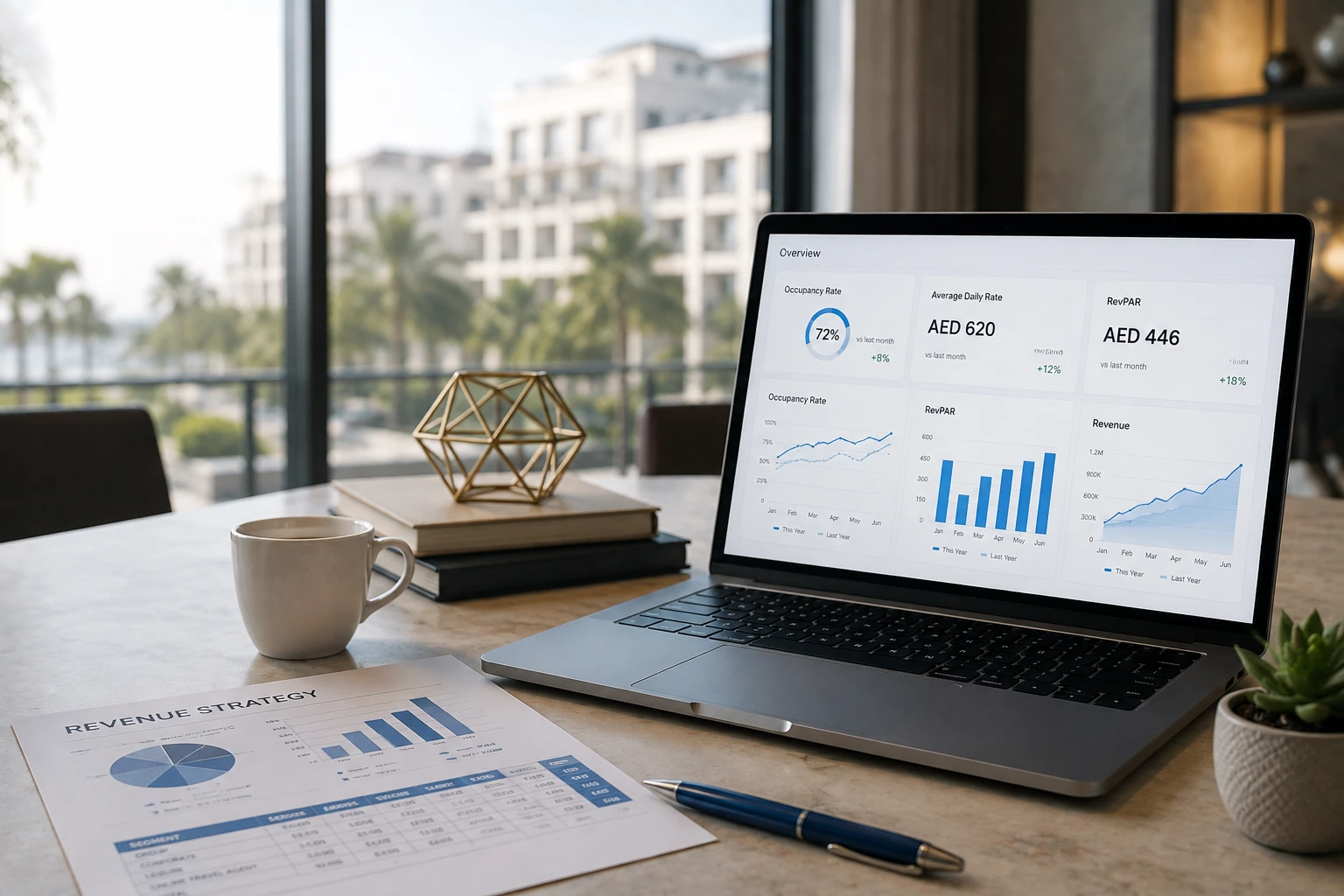
– On Adevo’s market estimate, outsourcing costs an independent Indian hotel ₹10,000 to ₹80,000 per month depending on property size and scope, with the return usually visible as RevPAR improvement inside the first quarter.
– The right provider tracks output KPIs (RevPAR, ADR, channel mix), not just input activities (rate updates completed, reports delivered).
What Are the Benefits of Outsourcing vs. an In-House Revenue Manager?
Outsourced revenue management wins on cost and on access to expertise, because for most independent Indian hotels a full-time in-house revenue manager was never a realistic option to begin with. As a market observation, Adevo sees senior revenue manager salaries in India running roughly ₹6,00,000 to ₹12,00,000 per year, plus statutory contributions.
For a single property in the ₹2-3 crore annual room revenue band, that fixed cost is heavy and the utilisation simply is not there. One property of moderate complexity does not fill a senior specialist’s week. As a result, the role either goes unfilled or gets absorbed by whoever has capacity.
The real comparison, then, is outsourced revenue management versus ad-hoc rate management by the front office manager. Measured against that alternative, four benefits stand out.
Specialist expertise. A dedicated revenue management professional, or a small team, whose entire focus is on pricing and distribution optimisation, working to recognised hospitality industry role competency standards. The front office manager fits rate decisions in between guest check-ins; this person does nothing else.
Comparable market data. Hotel revenue management companies that work across multiple properties have access to benchmarking data from comparable operations. Rate decisions informed by actual competitive set performance are more reliable than decisions made from intuition or single-property history.
Technology access. Many outsourced providers work with channel management tools, rate shopping software, and OTA optimisation platforms that an individual property would not justify purchasing independently. The cost is effectively shared across the provider’s client base.
Consistent process. An outsourced revenue management provider runs a defined rate update cadence and reporting structure, so the rate calendar moves on schedule rather than when someone finds time for it. An outsourced revenue management engagement applies that same documented discipline to the commercial function, which is the one area most independent properties leave undefined.
The performance gap is visible in the market data. In 2025, India’s branded hotels recorded 64% occupancy alongside an average RevPAR of ₹5,522, per Horwath HTL’s India hotel performance data. Independent properties without structured outsourced revenue management are competing directly against this level of commercial rigour.
What Does Outsourced Revenue Management Cost in India?
Outsourced revenue management in India typically costs between ₹10,000 and ₹80,000 per month, depending on scope. The ranges below are Adevo’s own market observations across Indian hospitality engagements, not published industry rates.
| Service Model | Indicative Monthly Cost |
|---|---|
| Basic rate management (rate updates, OTA maintenance) | ₹10,000 to ₹25,000 |
| Full-service outsourcing (strategy, channel mix, reporting) | ₹25,000 to ₹60,000 |
| Full outsourced with RMS software access included | ₹40,000 to ₹80,000 |
Outsourced revenue management costs vary by property size, number of distribution channels managed, and the depth of competitive benchmarking included. Properties with higher room counts and more complex channel mixes carry higher fees.
Fee levels only make sense against what the market is doing. India’s hospitality sector is on a sustained growth path, with the market projected to grow significantly through the decade, per Mordor Intelligence’s India Hospitality Market report. Those gains reward properties that actively manage rate, which is precisely the work outsourced revenue management performs.
The relevant cost comparison is therefore not a full-time in-house revenue manager, but the revenue lost by operating with no structured revenue management at all.
As a worked example, take a hotel generating ₹1 crore in annual room revenue. A ₹40,000 per month engagement costs ₹4.8 lakh a year. A 10% RevPAR improvement on that base returns ₹10 lakh. The arithmetic is not subtle, but it only holds if the improvement is measured rather than assumed.
What Should You Look for When Choosing a Provider?
Work through four criteria before signing an outsourced revenue management contract: India experience, output-based reporting, pricing discipline, and contract flexibility. Each one screens out a different kind of weak provider. For a complete overview of how hotel revenue management works as a discipline, Adevo’s revenue management consultant guide covers the KPI framework that any outsourced engagement should be built around.
- India market experience and track record. A provider who has managed revenue for Indian independent hotels understands the domestic OTA mix (MakeMyTrip, Goibibo, Booking.com, Agoda), corporate account management in Indian business destinations, and the pricing dynamics of tier-2 city markets. Generic revenue management experience from outside India takes real adaptation before it applies here.
- Output-based reporting. The provider should report on RevPAR, ADR, occupancy, and channel mix at defined weekly and monthly intervals, benchmarked against competitive set performance where possible. Activity-based reporting (“we updated rates twice this week”) is not the same thing. A property pays for results, not for effort.
- Rate floor and ceiling discipline. Ask explicitly whether the provider will ever sell rooms below a defined rate floor without management approval. A provider who cannot answer that clearly does not have a structured pricing methodology, however impressive the sales deck looks.
- Contract flexibility. A three-month trial or a month-to-month structure is reasonable for a first engagement. Long lock-ins of 12 to 24 months, agreed before any performance has been demonstrated, are not. If results justify a longer relationship, that can be settled after the initial period.
In Adevo’s advisory work with independent Indian hotels, the recurring failure point in outsourced revenue management engagements is not the provider’s pricing skill. It is the absence of an agreed reporting standard at the start. Six months in, nobody can say with confidence whether the engagement worked, because no one defined at the outset what “worked” would look like.
When Does In-House Revenue Management Still Make More Sense?
An in-house revenue manager makes more sense once scale and complexity can absorb the fixed cost. Two situations qualify, in Adevo’s experience.
The first is size. A hotel above roughly 100 to 120 rooms, with a diversified channel mix, multiple F&B outlets contributing to total revenue, and a complex competitive set, generates enough revenue and enough daily decisions to justify a dedicated resource on a cost-benefit basis.
The second is brand affiliation. A franchise property where the franchisor requires specific data access and reporting integration often needs someone in-house who can own that relationship directly.
Adevo’s Kitchen Operations and Culinary training develops the operational team that works alongside the revenue function. A hotel where rooms and F&B are both actively managed for performance is one where an in-house revenue role, supported by specialist consulting, may eventually make sense.
For most independent Indian hotels below 100 rooms, outsourced revenue management remains the more cost-effective structure until the property generates sufficient revenue to justify the fixed cost of a senior in-house hire.
Is Outsourced Revenue Management Worth the Cost?
For most independent Indian hotels, yes, because the realistic alternative is ad-hoc rate management rather than a formal in-house capability. Outsourced revenue management is the most direct path from no structured practice to a KPI-tracked commercial function — and it is the one option that delivers specialist expertise without the fixed cost of a senior hire.
The market context supports the case. India’s hotel sector remains on a sustained growth trajectory, and that growth keeps attracting new supply. New supply is what turns disciplined pricing from a refinement into a defensive necessity.
The return on a well-structured outsourced revenue management engagement is typically visible as RevPAR improvement within the first quarter. However, that only counts as evidence if a baseline was recorded before the provider started.
Book a free consultation with Adevo to discuss a revenue management engagement for your property.
Frequently Asked Questions: Outsourced Revenue Management
Q: What is the difference between a hotel revenue management company and revenue management software?
A: Software provides data, automation, and forecasting tools. A hotel revenue management company provides the human expertise to interpret that data and make the pricing and distribution decisions that the software supports. Most independent Indian hotels do not need enterprise RMS software. They need someone who knows how to read occupancy trends and act on them. That is a human expertise problem, not a software problem.
Q: How quickly can an outsourced revenue management provider start producing results?
A: In Adevo’s advisory engagements, initial results in high-demand periods usually appear within 60 to 90 days of start. That is when the first rate adjustments under the new strategy begin translating into booking behaviour. Longer-term gains from channel mix optimisation and corporate account development take closer to 6 to 12 months to materialise fully.
Q: Can an outsourced revenue management provider work alongside our existing front office team?
A: Yes, and this is the standard model. The provider handles pricing strategy, rate updates, and channel optimisation. The front office team handles reservations, OTA inventory management within the strategy parameters, and direct guest communication. The provider trains the front office team on the rate update process so the property can operate during periods when the provider is not immediately available.
Q: What happens if we are not satisfied with the provider’s performance?
A: This is why contract structure matters at engagement start. A provider who does not allow termination within a defined notice period (typically 30-60 days) for underperformance is not managing on behalf of the property’s interests. The contract should specify what performance benchmarks define success and what recourse exists if they are not met.