Introduction
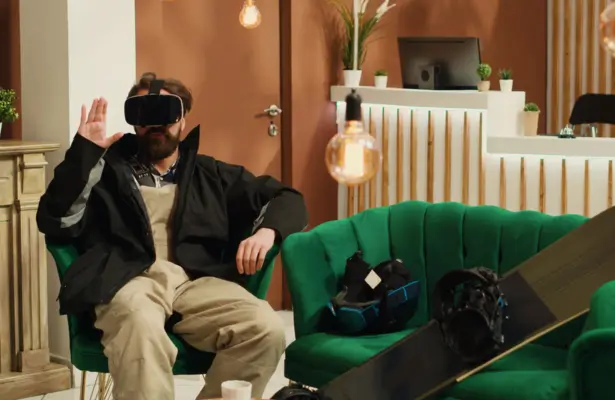
Meera, a front desk executive at a 70-room hotel in Indore, slipped on a VR headset for the first time last January. Within seconds, she was standing in a virtual hotel lobby. A guest avatar walked up—visibly upset, raising his voice about a room mix-up. Meera’s hands trembled. She took a breath, recalled her training prompts, and responded with calm empathy. When she removed the headset ten minutes later, her supervisor noticed something different. Meera was smiling. “I feel like I’ve already handled my worst day,” she said. That confidence followed her to the real front desk. Her guest complaint resolution scores improved within weeks. This is what soft skills training courses look like when technology meets hospitality.
VR training for hotels is no longer science fiction. It is happening in Indian metros right now, and early pilots are emerging in tier-2 cities. But let’s be honest—VR is not a magic solution for every training problem. It works brilliantly for some scenarios and makes no sense for others. This guide gives you a realistic, India-focused roadmap for understanding, evaluating, and implementing VR training at your property.
What Is VR Training and Why Does It Matter for Hospitality?
Immersive Simulations Using VR Headsets
Virtual reality training places staff inside computer-generated environments that simulate real hotel scenarios. Staff wear headsets that block out the physical world and immerse them in a 360-degree digital space. They interact with virtual guests, navigate virtual kitchens, or respond to virtual emergencies—all without real-world consequences.
The key difference from video training or classroom lectures is practice. VR lets staff rehearse high-pressure scenarios repeatedly. They make mistakes safely. They build muscle memory for responses that matter when a real guest is standing in front of them.
Learning Impact: Why VR Gets Results
Emerging research on immersive learning shows VR delivers approximately 70% better knowledge retention compared to traditional classroom methods. The reason is straightforward—active participation beats passive listening. When your housekeeping staff physically looks around a virtual room to spot cleanliness issues, the learning sticks. When your front desk team practices de-escalation with an AI-powered angry guest, the skill transfers to real interactions.
Current Reality in India
Let’s set expectations. VR training in Indian hospitality is still in its early stages. Most adoption is concentrated in large hotel chains in metros like Mumbai, Bangalore, and Delhi. Tier-2 and tier-3 hotels are just beginning to explore pilots. The global technology market for hospitality is projected to reach $29.65 billion by 2026, with VR and AI forming a growing component of that investment.
This means opportunity. Early adopters who pilot VR training now—even with basic mobile setups—gain a competitive edge in staff quality before the technology becomes mainstream.
Where VR Makes Sense (And Where It Doesn’t)
Not every training challenge needs a VR solution. Here’s an honest assessment.
VR Makes Sense For:
- High-pressure guest scenarios. Handling an angry guest, upselling a room upgrade, managing a complaint—these situations cause anxiety. VR provides unlimited, risk-free practice.
- Safety and emergency training. Fire evacuation, kitchen hazard response, earthquake protocols. You cannot simulate these safely in a real hotel without VR.
- Consistent multi-location training. If your chain has properties in five cities, VR ensures every staff member receives identical training regardless of location.
- Repetitive skill practice. Reservation systems, check-in procedures, service sequences. VR allows practice until staff achieve mastery.
VR Doesn’t Make Sense For:
- Basic onboarding. Teaching staff where the supply closet is or how to fill out a form. Traditional methods are faster and cheaper.
- Properties with very tight budgets. If your total annual training budget is under ₹20,000, VR is hard to justify today.
- Rapidly changing content. VR scenarios cost money to develop. If your training content changes monthly, the investment won’t pay off.
- Staff deeply resistant to technology. Some teams need time. Forcing VR adoption creates resentment, not learning.
- Properties with strong hands-on mentorship. If your senior staff actively coach junior team members on the floor, live training remains superior to simulation.
Five VR Training Use Cases for Indian Hotels
Use Case 1: Guest Service Simulation
Ravi manages a 90-room business hotel in Bangalore. His biggest challenge was consistent guest interaction quality. New hires would freeze during difficult conversations. Ravi introduced mobile VR guest service scenarios for his front desk and restaurant teams.
Staff practised handling complaints, managing group check-ins, and responding to special requests. The AI-powered virtual guests responded differently each time—sometimes patient, sometimes aggressive, sometimes confused. After four weeks, Ravi noticed his team handling real guest situations with noticeably more composure.
Why it works: Guest service skills are emotional, not just procedural. VR lets staff experience the emotional pressure without real consequences. They build confidence before they need it.
Use Case 2: Kitchen Safety and Procedures
Virtual kitchens simulate hazards that are dangerous to recreate in training—hot oil splashes, knife accidents, gas leaks, slippery floors. Staff identify risks, practise emergency response, and learn correct handling procedures.
Why it works: Kitchen safety training often involves showing videos. VR makes staff active participants. They physically look around, identify the hazard, and take corrective action. The learning is deeper and retention is stronger.
Use Case 3: Emergency Response
Fire evacuation is the most common VR training scenario globally. Staff navigate smoke-filled corridors, guide virtual guests to exits, use fire extinguishers, and communicate under simulated stress.
Why it works: You cannot run a fire drill during peak occupancy. VR complements your annual physical drills with additional practice opportunities throughout the year.
Use Case 4: Housekeeping Quality Inspection
A virtual hotel room is set up with intentional cleanliness issues—stained curtains, improperly made beds, missed spots. Staff enter the virtual room and identify problems within a time limit.
Why it works: This standardises quality assessment across your entire team. Every housekeeper trains against the same benchmark. It is especially valuable for properties where quality consistency is a challenge.
Use Case 5: Cultural Sensitivity and Guest Interaction
India’s hotels serve guests from every region and many countries. Virtual scenarios expose staff to guests with different cultural expectations, dietary requirements, religious practices, and communication styles.
Why it works: Cultural sensitivity is difficult to teach through lectures. VR creates empathy by placing staff in situations they may not encounter daily but must handle gracefully when they arise.
VR Equipment and Cost Options for Indian Hotels
Understanding your options is critical before any investment. Here are four tiers suited to different property sizes and budgets.
Option 1: Mobile VR (Most Affordable Entry Point)
- Equipment: Staff’s existing smartphone + VR headset attachment (₹2,000-8,000 per headset)
- Content: App-based scenarios (some free, premium ₹500-2,000 per module)
- Setup: Minimal. No IT infrastructure needed. Works offline after download.
- Best for: Small properties running a 1-2 headset pilot. Budget-conscious hotels testing VR for the first time.
- Limitations: Lower immersion quality. Smaller content library. Screen size limits realism.
Option 2: Standalone VR Headset (Mid-Range)
- Equipment: Dedicated VR headset like Meta Quest series (₹25,000-50,000 per unit)
- Content: Store-based apps plus custom development (₹50,000-200,000 for Indian developers)
- Setup: WiFi required. Moderate IT support for setup and updates.
- Best for: Medium properties with 80-120 staff. Scalable hospitality management courses enhanced with immersive practice.
- Limitations: Moderate ongoing cost. Requires careful handling. Replacement risk if dropped.
Option 3: Premium VR (Large Properties and Chains)
- Equipment: Professional headset + PC setup (₹1,50,000-5,00,000+)
- Content: Fully custom enterprise solutions (₹2,00,000-10,00,000+)
- Setup: Dedicated VR training room. IT infrastructure. Ongoing technical support.
- Best for: Large chains with 200+ staff. Properties committed to long-term immersive training.
- Limitations: High upfront cost. Complex setup. Requires dedicated support staff.
Option 4: Shared VR Training Centre (Collaborative Model)
This emerging model suits tier-2 cities where individual hotels cannot justify standalone investment.
- Setup: 3-5 hotels in a city share one VR training centre with equipment and content.
- Cost: Approximately ₹1,00,000 total (₹20,000-25,000 per participating hotel)
- Staffing: One part-time trainer manages the programme.
- Best for: Independent hotels in tier-2 and tier-3 cities. Properties that want VR exposure without full investment.
Four-Phase Implementation Path for Indian Hotels
Phase 1: Feasibility Assessment (Month 1)
Before buying any equipment, answer five questions:
- What specific training problem will VR solve? Guest service under pressure? Safety compliance? Emergency preparedness?
- Is your staff reasonably tech-comfortable? If most staff have never used a smartphone app, VR adoption will need extra support.
- Do you have basic WiFi infrastructure? Standalone headsets need WiFi for setup and updates.
- What is your realistic budget? ₹20,000 for a pilot? ₹2,00,000 for a full programme?
- Do your current training gaps justify VR? Or would better classroom training solve the problem at lower cost?
Phase 2: Pilot Programme (Months 2-3)
Sunita, an L&D manager at a mid-range hotel in Pune, started her VR pilot with just two mobile VR headsets and one guest complaint scenario. She selected ten early-adopter staff members—people who were curious about technology. Over four weeks, each person completed two VR sessions: one for practice, one for assessment.
Pilot checklist:
- Start with 1-2 headsets (mobile or standalone)
- Choose one high-impact scenario (guest complaint handling is usually the best starting point)
- Select 5-10 willing staff members
- Run the pilot for 4 weeks
- Measure knowledge retention, staff feedback, and confidence scores
Phase 3: Scale and Integration (Months 4-6)
If your pilot shows positive results, expand carefully:
- Add 2-3 more VR scenarios (safety, emergency, housekeeping quality)
- Roll out to all relevant staff (rotate through VR training, 1-2 hours per staff member)
- Integrate VR into your existing training calendar—not as a replacement, but as a supplement
- Connect VR training records with your broader online skill development courses tracking
Phase 4: Optimisation and Expansion (Month 6+)
- Track long-term metrics: knowledge retention over time, behavioural change on the floor, ROI
- Update VR content to keep scenarios fresh and relevant
- Share learnings with partner properties
- Explore new use cases based on what your team finds most valuable
Barriers to VR Adoption and How to Overcome Them
Motion Sickness
Research indicates 10-20% of users experience some degree of VR motion sickness during initial sessions. This is real and must be addressed.
Solution: Keep sessions short (15-20 minutes maximum). Allow break time between sessions. Start with stationary scenarios (standing in one place) before introducing movement. Most staff adapt within 1-2 sessions.
Technology Resistance
Older staff members or those unfamiliar with digital tools may feel anxious about wearing a VR headset.
Solution: Start with a low-pressure demo. Let resistant staff watch others use it first. Frame VR as an exciting tool, not a test. Peer encouragement works better than management mandates. Never force participation in the first week.
Content Availability
Most VR hospitality training content is designed for Western markets. Limited content exists in Indian languages or with India-specific scenarios.
Solution: For pilots, use English-language content that covers universal hospitality skills. For scaled programmes, invest in custom content development through Indian VR studios (₹50,000-2,00,000 depending on complexity). The Indian VR development ecosystem is growing, with studios in Bangalore, Hyderabad, and Pune offering hospitality-specific content creation.
Connectivity and Infrastructure
Many tier-2 and tier-3 properties lack reliable broadband.
Solution: Choose offline-capable equipment. Standalone headsets allow content to be pre-downloaded over any connection and used offline. Mobile VR works entirely offline after initial download.
Cost and ROI Uncertainty
VR is still emerging technology. ROI timelines are 2-3 years for most properties.
Solution: Start with mobile VR (₹8,000-20,000 total pilot cost). Measure results before scaling. Do not invest ₹5,00,000 based on excitement alone. Let data drive your scaling decisions.
Cost-Benefit Analysis by Property Size
Small Hotel (30-50 Rooms, 30-40 Staff)
- Upfront investment: ₹20,000-40,000 (mobile VR, basic content)
- Annual maintenance: ₹5,000-10,000 (content updates)
- Expected ROI: Positive by year 2 if guest satisfaction measurably improves
- Verdict: Consider VR only if guest complaints are a significant business cost. Start with mobile VR, one scenario.
Medium Hotel (60-100 Rooms, 80-120 Staff)
- Upfront investment: ₹50,000-1,00,000 (standalone headsets, custom content)
- Annual maintenance: ₹15,000-25,000 (updates, minor support)
- Expected ROI: Positive by year 2-3 through improved staff efficiency and lower turnover
- Verdict: Stronger justification. Scale benefits across a larger team make the per-person cost reasonable.
Large Hotel (150+ Rooms, 200+ Staff)
- Upfront investment: ₹2,00,000-5,00,000 (premium VR, full content suite)
- Annual maintenance: ₹50,000-1,00,000 (dedicated support, regular content updates)
- Expected ROI: Positive by year 1-2 with measurable operational improvements
- Verdict: Strong ROI case. The per-staff training cost drops significantly at scale.
Integration with Traditional Training: VR as Supplement, Not Replacement
The Mistake Hotels Make
Some early adopters treat VR as a complete training replacement. This fails. VR cannot teach teamwork in a live kitchen. It cannot replicate the mentorship of a senior housekeeper guiding a new hire through their first room turndown. And it certainly cannot replace the human connection between a trainer and a nervous new employee.
The Right Framework: Hybrid Training
The most effective approach combines traditional and VR methods in a structured sequence:
- Weeks 1-2: Traditional training. Hands-on learning, shadowing, classroom sessions, mentorship.
- Week 3: VR practice. Staff apply what they learned in safe, simulated scenarios. They build confidence through repetition.
- Week 4: Real-world application. Staff handle live situations with a coach nearby for support.
- Ongoing: VR refreshers. Annual or semi-annual VR sessions to maintain skills and introduce new scenarios.
The Indian hospitality industry faces 25-30% annual staff turnover according to FHRAI data. VR training accelerates time-to-competency for new hires, which matters enormously when you are constantly onboarding replacements. But it works best when layered on top of strong foundational training, not instead of it.
Why Hybrid Works
- Faster learning. VR accelerates knowledge retention after foundational training is complete.
- Safer practice. Mistakes in VR cost nothing. Mistakes with real guests cost reviews and revenue.
- Consistent quality. VR ensures uniform training standards across shifts and locations.
- Confidence building. Staff feel genuinely prepared before facing real high-pressure situations.
Measuring VR Training Success
Track five key performance indicators to evaluate whether your VR investment is delivering value:
- Knowledge retention. Pre/post VR assessment scores. Target: 70%+ retention (versus approximately 50% with traditional methods alone).
- Staff confidence. Survey your team on their confidence handling specific scenarios. Target: 80%+ report feeling confident after VR practice.
- Behavioural change. Monitor guest complaint rates, service quality scores, and safety incident rates. Target: 20%+ improvement within 6 months.
- Time to competency. Measure how quickly VR-trained staff reach independent competency versus traditionally trained peers. Target: 25%+ faster.
- Return on investment. Calculate (revenue improvement minus training cost) divided by training cost. Target: positive ROI by year 2-3.
The Future of VR in Indian Hospitality
2026: Where We Are Now
VR training adoption is concentrated in metro-city luxury and business hotels. Tier-2 hotels are running pilot programmes. Mobile VR has made entry costs accessible. Content availability remains the biggest gap, particularly for India-specific, multilingual scenarios.
2027-2028: What’s Coming
Hardware costs will continue declining. More Indian VR studios will offer hospitality-specific content. Tier-2 adoption will accelerate as early pilot results demonstrate ROI. Shared VR training centres will emerge as a viable model for smaller properties.
2029 and Beyond: VR Meets AI
The most exciting development is the convergence of VR and artificial intelligence. Imagine virtual guests that adapt their behaviour based on each staff member’s skill level. AI-powered VR coaches that provide personalised feedback. Training scenarios that automatically adjust difficulty based on performance. This is not speculation—the Indian technology sector is investing heavily in AI development, and hospitality applications are a growing focus.
When to Choose VR Versus Traditional Training
Choose VR if:
- You have budget available (₹20,000+ for a meaningful pilot)
- You need to train staff for high-consequence or high-pressure scenarios
- Your staff need repetitive practice opportunities
- You operate multiple locations needing consistent training quality
- You have identified a clear ROI pathway
Choose traditional training if:
- Your budget is very tight (below ₹20,000 for training technology)
- Basic onboarding is your primary need
- Your staff are strongly resistant to technology
- You have an excellent existing hands-on training culture
- Your training content changes frequently
The best answer for most Indian hotels in 2026 is both. Use traditional training for foundation. Use VR for practice, confidence building, and high-pressure scenario preparation.
Getting Started: Your Next Step
VR training for hotels is not about chasing technology trends. It is about solving real training problems—guest complaint handling, safety compliance, service consistency—with a tool that delivers measurable results when used correctly.
Start by identifying your biggest training gap. If that gap involves high-pressure scenarios, safety training, or consistency across locations, VR deserves serious consideration. If your gaps are more foundational, invest in structured traditional training first and revisit VR when your team is ready.
Adevo’s L&D outsourcing services help hospitality properties evaluate training technology options, design hybrid programmes, and measure results. Whether you are exploring VR for the first time or looking to integrate immersive learning into your existing training programmes, a structured approach beats trial and error.
Book a free training consultation. We will assess your property’s readiness for VR, identify the right starting point, and help you build a training programme that blends the best of traditional and immersive methods.