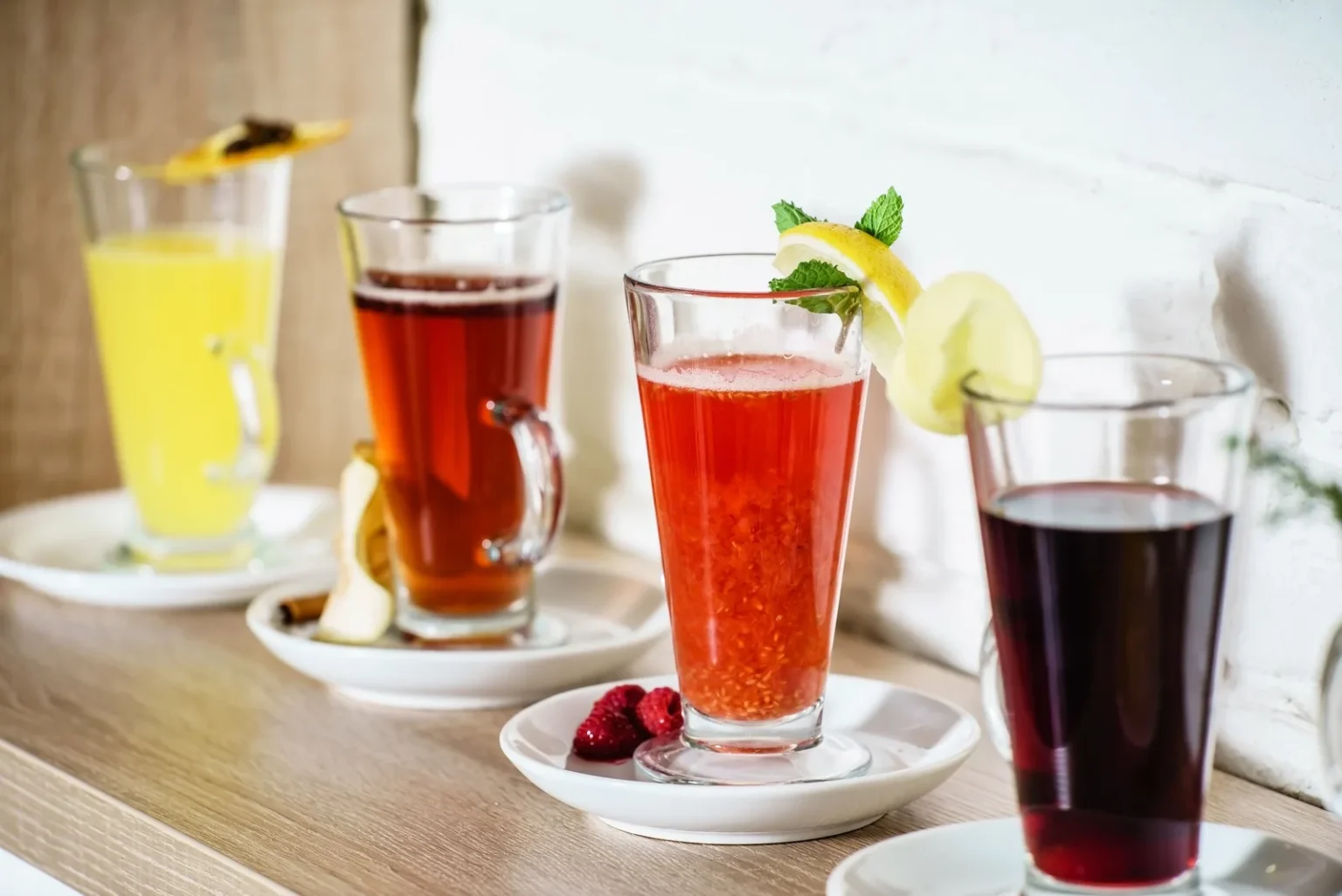
The classification of non alcoholic beverages sorts every drink without alcohol into three groups by what it does for the guest: stimulating, refreshing or nourishing. In India, FSSAI treats a drink as alcoholic only above 0.5% alcohol by volume (ABV), so the classification of non alcoholic beverages starts at or below that line. The three groups are easy to recite for an exam. Explaining why masala chai and jaljeera sit in different groups on the same tray is harder.
You already know the question every guest asks: what should I drink with this? This guide sets out the classification of non alcoholic beverages, the Indian rule on alcohol content and a menu map your floor team can use on the next shift. It covers the same ground as our food and beverage training courses for service staff.
Key Takeaways
- The classification of non alcoholic beverages has three groups: stimulating (tea, coffee, cocoa), refreshing (water, juices, soft drinks, nimbu pani) and nourishing (milk and malted drinks).
- Under FSSAI’s alcoholic beverages regulations, a drink is alcoholic only above 0.5% ABV, and a non-alcoholic counterpart must stay at or below 0.5% ABV.
- A de-alcoholised beer is a regulated counterpart of an alcoholic drink, not a mocktail, so servers should never use the two words as one.
- Grouping an Indian menu by these three functions gives servers a one-sentence way to recommend the right drink.
What Is the Classification of Non Alcoholic Beverages?
The University of Mumbai Food & Beverage Service II syllabus, approved in 2024 under NEP 2020, lists the classification of non alcoholic beverages as stimulating, refreshing and nourishing.
The classification of non alcoholic beverages works because it asks one question: what is this drink for? A guest who wants energy, one who wants relief from the heat and one who wants something mild and filling are three different guests.
Consider Meera, a captain in the tea lounge of a business hotel in Jaipur. A guest tells her late one evening that he wants something warm but needs to sleep soon. She knows tea and coffee sit in the stimulating group, so she suggests warm turmeric milk from the nourishing group. He orders it and asks for the same the next night.
Want every captain on your floor to make that call without thinking? Talk to Adevo about a short beverage module for your outlet.
How Does India Draw the Line in the Classification of Non Alcoholic Beverages?
FSSAI sets the legal boundary in its alcoholic beverages compendium (version dated 1 December 2025). Under clause 1.2.3, more than 0.5% ABV makes a drink alcoholic. Clause 1.2.8a defines a non-alcoholic counterpart of an alcoholic beverage as one at or below 0.5% ABV, and it attaches conditions of its own.
The counterpart rule carries two conditions:
- The drink must meet every requirement of the alcoholic drink it copies, except the ethyl alcohol content.
- The original drink must have gone through fermentation, with the alcohol removed afterwards.
For beer sold as alcohol free, the same text sets the limit at zero. Other countries draw their lines elsewhere, so a foreign label proves nothing about an Indian one.
On the floor, this splits the bar in two. Tea, fresh juice and nimbu pani need no special handling, while a de-alcoholised beer or wine follows rules of its own. A training room should teach the classification of non alcoholic beverages in that order: the legal line first, then function.
Want trainees to explain this line to a guest? Ask us to build a drill around your beverage card.
New joiners also need the theory before the first shift. Online skill development courses can cover the groups in advance, so trainees arrive at the floor drill already knowing them.
Classification of Non Alcoholic Beverages by Function
Each group in the classification of non alcoholic beverages answers a different guest need, and each carries clear Indian examples. Learn these three before you add detail on origin or brewing.
Stimulating Beverages
Stimulating drinks lift energy and alertness. Tea, coffee and cocoa belong here, whether served hot or cold.
- Typical in India: masala chai, filter coffee, cold coffee, hot chocolate
- Where you see it: breakfast service, tea lounges, cafe counters and room service trays
Refreshing Beverages
Refreshing drinks cool the guest or reset the palate. Water, soft drinks, packaged and fresh juices, and traditional coolers all sit in this group.
- Typical in India: nimbu pani, jaljeera, aam panna, fresh lime soda, coconut water
- Where you see it: poolside bars, thali restaurants, banquet welcome drinks
Mocktails belong here in most outlets, because a mixed drink without alcohol usually serves the same purpose as a cooler.
Nourishing Beverages
Nourishing drinks are mild, filling and built on milk, malt or nuts. They suit a guest who wants something close to a snack.
- Typical in India: badam milk, milkshakes, malted milk drinks, lassi
- Where you see it: breakfast buffets, dessert menus and children’s menus
Some drinks sit between groups. Lassi cools like a refreshing drink but is built on curd, so treat it as nourishing in your training notes and brief every shift on that call.
Non Alcoholic Beverages Classification on an Indian Menu
Map the three groups to your beverage page, and servers can recommend a drink in one sentence. A non alcoholic beverages classification printed as three headings does more than a long alphabetical list.
| Group | Guest need | Indian menu examples |
|---|---|---|
| Stimulating | Energy, focus, a warm start | Masala chai, filter coffee, cold coffee |
| Refreshing | Relief from heat, palate reset | Nimbu pani, jaljeera, aam panna, fresh juice |
| Nourishing | Something mild and filling | Badam milk, milkshake, lassi |
Picture Sandeep, the F&B manager of a standalone restaurant in Hyderabad. His beverage page was one long list, and guests kept asking servers to read it out. He rebuilt the page around the classification of non alcoholic beverages and trained the floor to name a group first. Servers began asking “something cooling or something warm?” and guests ordered faster.
The same grouping helps when you build the rest of the card. Our guide to restaurant menu planning shows how each section earns its place, and the beverage page should follow the same logic.
Where Do Borderline Drinks Go?
Agree the edge cases before the shift starts. Cold coffee is stimulating even though it is served chilled, because the coffee is the point. Flavoured milk is nourishing even when it arrives in a bottle. Packaged water and soda are refreshing, and a fresh lime soda stays refreshing whether it is sweet or salted.
Write these calls on a single page and pin it in the service station, so two servers give the same answer to the same guest.
How Do You Teach the Classification of Non Alcoholic Beverages on the Floor?
Teach it as a short drill, not a lecture. Fifteen spare minutes before service is enough to cover all three groups and the legal line. Hold it at the same point in every briefing so it becomes routine. Cards should carry drinks from your own menu, because trainees remember what they will serve tonight, and the whole drill should fit on one printed page.
A Five-Step Briefing Drill
- Start with the legal line: State the 0.5% ABV boundary and the difference between a mocktail and a counterpart drink.
- Name the groups: Name the three groups, and give each one an Indian example drawn from your own menu.
- Sort the cards: Put drink names on cards, then ask trainees to sort them into groups.
- Borderline drinks get a team decision: where do lassi, buttermilk and flavoured milk sit?
- Close with a guest request: Finish by reading a guest request aloud. The trainee names the group and the drink.
Rotate the person who leads the drill each week. A trainee who explains a group to a colleague remembers it far longer than one who only listens.
Outlets that want this built into onboarding can use Adevo’s F&B service training to run the same drills with a trainer.
The Non-Alcoholic Beer Mix-Up
Farah supervises the lounge at a hotel in Kochi. A guest asked for a non-alcoholic beer, and a new server said it was just a mocktail. Farah stepped in, explained that a de-alcoholised beer is a counterpart drink with its own rules, and checked the brand’s label for the stated ABV.
The guest got the right drink, and the server now asks which one the guest means. Later that week she added a line on reading the label to the lounge’s briefing sheet, so the check no longer depends on one person’s memory.
What Mistakes Weaken the Classification of Non Alcoholic Beverages on the Floor?
Four mistakes turn the classification of non alcoholic beverages into a memory test instead of a guest tool:
- Calling every alcohol-free drink a mocktail: A mocktail is a mixed drink, while a de-alcoholised beer is a counterpart product.
- Grouping by temperature: A hot drink is not automatically stimulating and a cold one is not automatically refreshing.
- Names without examples: trainees remember “refreshing” only when they can picture jaljeera or nimbu pani on a tray.
- Guessing alcohol content: The stated ABV on a bottle settles a guest’s question, so servers should read the label first.
A supervisor who knows what to listen for can catch each one in a briefing, and a month of that turns the scheme from exam content into something that shapes what guests drink.
Where Does the Classification of Non Alcoholic Beverages Sit in the Wider Beverage Tree?
Non-alcoholic drinks are one half of the beverage picture. The alcoholic half has its own families, and the two halves meet at the 0.5% ABV line. Beer and wine come from fermentation, spirits from distillation and liqueurs from blending, and each family follows a different routine for storage and pouring. For the full tree, read our guide to the classification of beverages, then return to the three groups here for the alcohol-free side.
A server who understands both halves can answer the awkward questions: is this beer really alcohol free, and which drink suits a guest who is driving home? The wider tree gives the context, and the three functional groups give the quick answer for the table. Treat the tree as background reading for senior staff and the three groups as the working tool for everyone on the floor.
How Can You Test the Classification of Non Alcoholic Beverages in Your Team?
Test the scheme with guest scenarios, because guests never ask for a “stimulating beverage”. Give each trainee three requests and ask for the group and the drink:
- A guest who has a long drive ahead and wants to stay alert.
- A guest who has walked in from the afternoon heat.
- A parent who wants something mild for a child at dinner.
A trainee who answers all three, and who can also say where the alcohol line sits, has absorbed the scheme. Repeat the test after two weeks, because recall fades quickly without practice on the floor.
Score each answer on two points: did the trainee pick the right group, and did they offer a drink your outlet actually sells? A trainee who misses either one needs another round of the card drill.
How Does Adevo Help With the Classification of Non Alcoholic Beverages?
Students, freshers and working servers who want to turn three drink groups into a confident recommendation can learn it at Adevo, an integrated skill development platform for hospitality whose name comes from Atithi Devo Bhava. Hotel groups, restaurants, clubs, caterers and healthcare and corporate teams use the same platform to upskill staff at scale, with online courses on its learning platform, on-site training at the property and consulting on SOPs and learning plans. Certifications give individuals a job-ready record of what they have learned. The co-founders have more than 80 years of combined experience, including time at the Taj and Oberoi groups, in running F&B outlets and in teaching hotel management. Courses are available in Hindi, Kannada, Tamil, Telugu and English.
Conclusion
The classification of non alcoholic beverages gives your team one clear question to ask: what is this drink for? Keep the 0.5% ABV line in mind, group the menu by function and treat counterpart drinks as a separate case. A server who can do that recommends with confidence and avoids label mistakes. Share the three groups with every new hire on day one, and revisit them whenever the beverage card changes.
Ready to turn this classification into floor habits? Ask Adevo about food and beverage training courses built around your outlet.
Frequently Asked Questions: Classification of Non Alcoholic Beverages
Q: What is the classification of non alcoholic beverages?
A: The classification of non alcoholic beverages groups alcohol-free drinks into stimulating, refreshing and nourishing beverages. Stimulating covers tea, coffee and cocoa. Refreshing covers water, soft drinks and juices, and nourishing covers milk and malted drinks.
Q: How many types does the classification of non alcoholic beverages have?
A: It has three types: stimulating, refreshing and nourishing. Mocktails and packaged waters are not separate types in this scheme, because both fall under refreshing.
Q: What alcohol percentage makes a drink non-alcoholic in India?
A: FSSAI treats a drink as alcoholic only above 0.5% ABV. A non-alcoholic counterpart of an alcoholic drink must stay at or below 0.5% ABV, as clause 1.2.8a puts it. Any training on the classification of non alcoholic beverages should start from that line, before anyone learns a single group.
Q: Which everyday drinks fall into each non-alcoholic group?
A: Tea and coffee are stimulating. Juices and soft drinks are refreshing, and milk-based drinks are nourishing. Add local drinks such as masala chai, nimbu pani and badam milk to each group when you train.
Q: Which classification of non alcoholic beverages does the University of Mumbai syllabus list?
A: The University of Mumbai’s F&B Service II syllabus lists the stimulating, refreshing and nourishing scheme. Hospitality students meet this scheme in class, so a short refresher on your own menu is usually enough.