When a new supervisor joins and nobody has written down how things work, the operation slows down. Worse, it starts producing different guest experiences on different shifts. SOP writing services exist to close exactly that gap. Pairing online skill development courses with a documented hotel SOP framework is what lets a property grow without depending on whoever happens to be on duty.
This guide covers what such an engagement includes, what it costs in India, and what to look for before hiring someone to build your documentation system.
Key Takeaways
– SOP writing services do more than produce documents: a professional engagement runs a five-stage sequence from process audit through floor validation to supervisor rollout.
– An external SOP consultant usually works better than an in-house attempt at any property above roughly 30 rooms or 50 restaurant covers without a dedicated L&D function.
– Adevo’s own market estimate puts Indian SOP engagements between ₹20,000 for a single department and ₹5,00,000 or more for a multi-outlet restaurant group.
– Choosing the right consultant means asking five screening questions that test hospitality operating experience, not documentation skill alone.
What Is a Hotel SOP — and Why Does It Matter More Than You Think?
A hotel SOP is the written instruction that fixes how one task gets done, on every shift, by every person. That is the whole job of the document.
Standard operating procedure (SOP). A documented, step-by-step guide for a single task (checking in a guest, closing a kitchen line, cleaning a hood filter), written plainly enough that a new hire can follow it without supervision.
A hotel SOP covers the full operational range of a property: front office, housekeeping, F&B, kitchen, security, and maintenance. A restaurant SOP is narrower. It concentrates on service sequences, kitchen operations, hygiene, and cost controls — for standalone restaurants rather than full properties, the five systems a restaurant SOP consultant builds covers that narrower scope.
SOPs matter because consistency is the product. When every team member handles a guest complaint, a reservation modification, or a food safety check the same way, guests notice. So does your compliance auditor. A hotel SOP makes that consistency repeatable without relying on memory or experience levels.
Most Indian hospitality operators already know what a good SOP looks like. But writing one properly takes time and operational distance that their management team does not have. When the failure sits in the process itself rather than in what gets written down, how a restaurant operations consultant finds and fixes day-to-day gaps is the more relevant engagement.
What Do SOP Writing Services Actually Include?
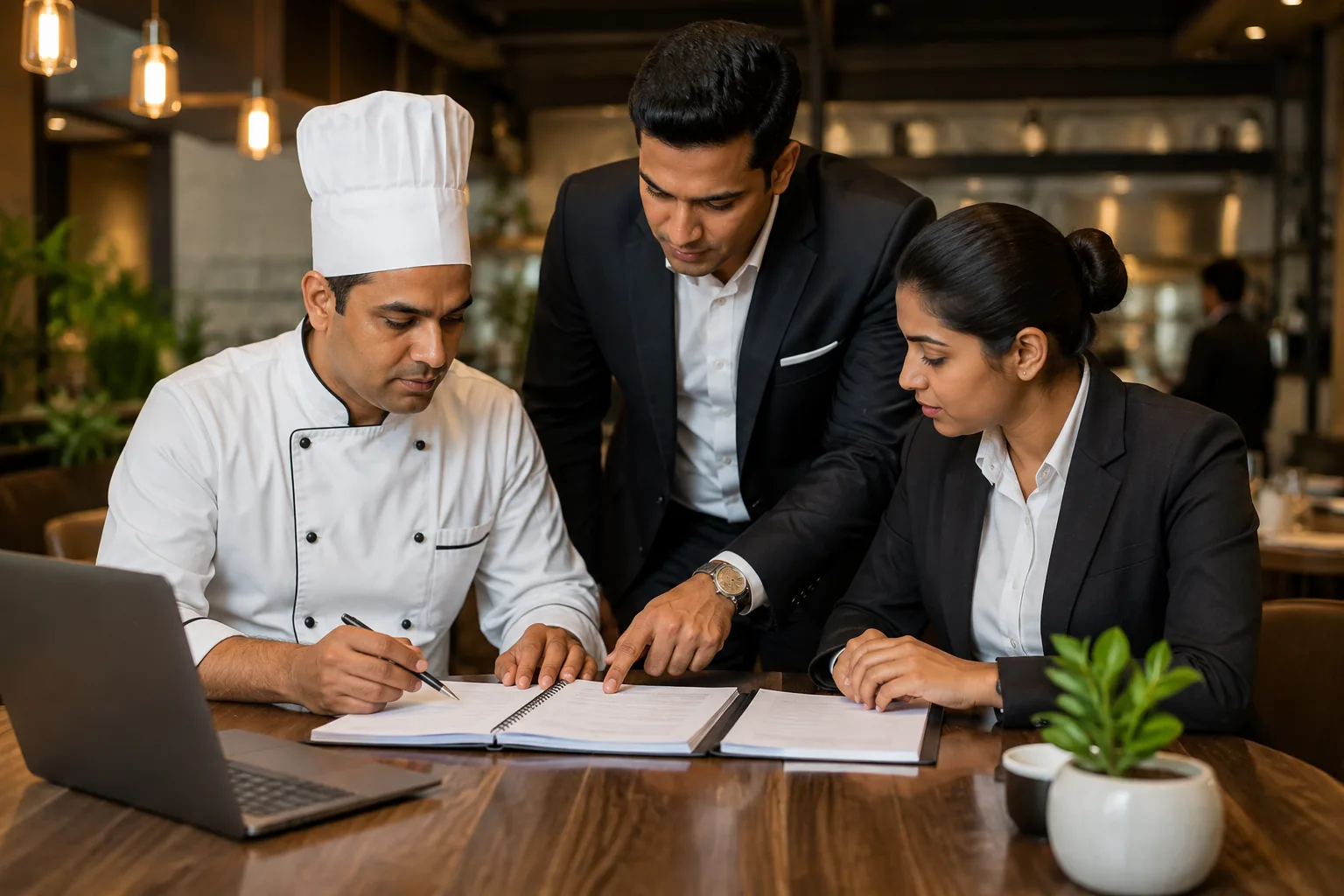
SOP writing services include four things: a process audit of how the property actually runs, department-by-department documentation, validation of each draft on the floor, and a rollout plan for supervisors. Professional SOP writing services are not a consultant sitting in a room typing from a template.
Because the audit comes first, the document that follows reflects your operation rather than a generic checklist. Most engagements run in a fixed sequence:
- Process audit. The consultant shadows shifts, interviews department heads, and records what staff actually do, including the workarounds nobody has admitted to management.
- Gap analysis. Undocumented steps, compliance exposure, and points where two shifts do the same task differently are listed and prioritised.
- Drafting. Each procedure is written in floor language, with a role owner, a trigger, numbered steps, and a check at the end.
- Floor validation. A supervisor runs the draft live for a week. Anything that does not survive contact with a busy service gets rewritten.
- Rollout and revision. Briefing formats, trainer notes, and a scheduled review date turn the manual into something the team keeps using.
Departmental SOPs: What Gets Documented
Most full-property engagements cover:
Front Office: Check-in and check-out procedures, reservation handling, complaint escalation, no-show and early-departure protocols, key-card management, and shift handover checklists.
Housekeeping: Room-cleaning sequences (OCC, VCI, VCO), turn-down procedures, lost-and-found handling, linen management, pest-control response, and inspection standards.
F&B and Restaurant Operations: Table setting and service sequences, order-taking protocols, mise en place checklists, upselling scripts, cash-handling procedures, and reservation floor management. For food and beverage specifically, what an F&B SOP audit checks and how weak procedures get rewritten goes station by station.
Kitchen: Recipe and portioning standards, FSSAI compliance checklists for food safety and hygiene, stock-rotation and FIFO procedures, equipment-cleaning schedules, allergen-handling protocols, and opening/closing procedures.
Security and Maintenance: Fire safety and emergency evacuation procedures, security patrol logs, preventive maintenance checklists, and contractor-access protocols.
Kitchen documentation carries legal weight in India, not just operational value. Food handlers are certified through FSSAI’s FoSTaC programme, which equips them with the knowledge needed for safe food practice in their establishments; the hotel association HRAWI alone has certified 2,873 hospitality professionals through it. A kitchen SOP that embeds those checkpoints (hood-cleaning frequency, FIFO labelling, allergen segregation) turns that certification into a daily routine instead of a filed certificate.
In Adevo’s SOP engagements with independent Indian hotels, the recurring failure point is not the writing. It is the handover: manuals get signed off by owners and never translated into a shift briefing, so the floor team never sees them.
Do You Need an SOP Consultant, or Can You Write In-House?
Most properties should use an external consultant, because in-house SOP writing stalls for structural reasons rather than motivational ones. The pattern is familiar: a department head is asked to write the hotel SOP for their section, and six months later the file sits half-finished on a shared drive. For what that engagement actually looks like, how an SOP consultant for hotels works through the four phases sets out the sequence and timelines.
The people best placed to write your SOPs are the same ones running service every day. Writing well requires time and enough distance to see a process objectively. Busy operations teams have neither.
An external SOP consultant brings hospitality-specific methodology, a ready-made document framework, and the ability to run structured interviews without being pulled into a service incident halfway through. For a property above roughly 30 rooms or 50 restaurant covers, the payback usually shows up as shorter induction time and fewer repeat mistakes rather than as a single line on the P&L.
Qualification frameworks help here as well. Tourism & Hospitality Skill Council’s Qualification Pack publishes competency standards for hospitality job roles across India, so a consultant can align SOP training content to a recognised role definition instead of an internal opinion. That alignment matters most when a property later seeks accreditation or a franchise agreement.
India’s expansion makes the timing urgent. Nationwide occupancy now sits in the 63% to 65% range, and brand signings reached a record 64,118 keys across 586 properties. Properties entering that growth window without documented SOP systems hand their early-stage inconsistency straight to guests.
For independent restaurants and small properties with fewer than 20 staff, a facilitated in-house approach (where a consultant provides the framework and your team fills it in) is a more cost-effective entry point. Training your team to actually use those SOPs is the second part of the equation, because documentation alone does not change behaviour without a rollout plan.
Adoption is where most engagements are won or lost, and what separates SOP development services that produce documents staff actually follow deals with that problem directly.
How Much Do Hotel SOP Writing Services Cost in India?
SOP writing services in India generally run from about ₹20,000 for a single department to ₹5,00,000 or more for a multi-outlet group. Cost tracks property type, scope, and the consulting firm’s track record. The ranges below are Adevo’s own market assessment, drawn from consulting engagements across Indian hospitality properties, and they will vary by geography and engagement structure:
| Scope | Typical Range |
|---|---|
| Single-department SOP (e.g. kitchen only) | ₹20,000 – ₹60,000 |
| Full-property SOPs (3–4 star, 50–100 rooms) | ₹80,000 – ₹2,00,000 |
| Large property or multi-outlet restaurant group | ₹2,00,000 – ₹5,00,000+ |
| SOP + training material integration | Add 30–50% to base cost |
What drives cost up: the number of departments covered, the depth of customisation required (a fine-dining operation’s SOP is more complex than a QSR’s), ongoing revision support, and digital formatting for mobile-accessible SOPs.
What drives cost down: having clear process maps already, a smaller property footprint, or agreeing to a phased rollout starting with the highest-risk departments (kitchen and housekeeping) before expanding.
How Do You Choose the Right SOP Consultant for Your Property?
Choose on hospitality operating experience first, documentation credentials second. Not every documentation consultant understands how a floor actually runs, and the wrong hire produces an SOP manual your team will never open.
5 questions to ask before you sign
Which hospitality properties have you written SOPs for? Ask for specific categories: 5-star city hotels, casual-dining chains, cloud kitchens, or resorts. A consultant who has only worked in manufacturing or corporate services will produce technically accurate documents that feel foreign to your floor team.
Can you share a sample department SOP? A well-written sample reads the way your team actually works, not in ISO-9001 language. If the sample feels like a compliance manual, your staff will not use it.
How do you handle FSSAI regulations and local compliance? These should be embedded in your kitchen and housekeeping SOP documents, not added as an appendix. If the consultant treats compliance as separate from operations, that is a red flag.
What does the revision cycle look like? SOPs go stale when menus change, regulations shift, or layouts are renovated. An engagement without a revision clause leaves you with outdated documentation within 18 months.
Do you provide train-the-trainer support? A document only changes behaviour when your supervisors know how to use it in daily briefings. A consultant who supports rollout gets better results than one who hands over a folder and disappears.
Documented SOPs hold up better when the team also gets ongoing skills training. Explore Adevo’s Bakery & Confectionery training courses as one example of how structured skill-building sits alongside documented SOP frameworks for F&B and production departments.
Are Hotel SOP Writing Services Worth the Investment?
Yes, for any property that is growing, preparing for a franchise arrangement, or repeating the same service failures despite training. SOP writing services are only as good as the process behind them. Template downloads give you a starting point. Professionally written SOPs give your team a system they can follow on the floor.
Rising occupancy raises the cost of inconsistency. Fuller houses mean every undocumented process runs more often each day, so each unfixed error repeats at a higher frequency.
The right consultant understands how hospitality operations run; documentation skill on its own is not enough. Before you hire, ask for samples, check references from comparable properties, and confirm the engagement includes rollout support rather than a document handover.
Book a consultation to understand how SOP documentation and training work together for Indian hospitality operations. Contact us here.
Frequently Asked Questions: Hotel SOP Writing Services
Q: What is the difference between a hotel SOP and a hotel operations manual?
A: An SOP is a step-by-step procedure for one specific task, such as handling a guest complaint. An operations manual is a full collection of SOPs organised by department, often combined with policies, org charts, and compliance frameworks. Most professional SOP writing services deliver a full operations manual as the final product.
Q: How long do hotel SOP writing services take?
A: On Adevo’s own engagement experience, a mid-scale hotel of 50–100 rooms covering three to four departments takes roughly six to ten weeks, including the process audit, drafting, internal review, and one revision cycle. Larger properties or those with multiple F&B outlets usually take twelve to sixteen weeks.
Q: Can SOPs be written in regional languages for Indian hospitality teams?
A: Yes, and for many properties it makes a real difference in compliance rates. Most experienced hospitality SOP consultants in India offer bilingual formats — English plus Hindi or a regional language — particularly for kitchen and housekeeping manuals where the frontline team may not be fluent in English.
Q: Does an independent hotel need SOPs if it is not part of a chain?
A: Independent properties benefit more from SOPs than chain hotels, because they have no corporate standard to fall back on. Without documentation, every manager who leaves takes institutional knowledge with them — and the next hire starts from zero.
Q: Which department should be covered first in a phased SOP engagement?
A: Start with the kitchen. It carries the highest compliance risk under FSSAI and fire safety rules, and it delivers the most immediate cost savings through portioning, FIFO, and waste-reduction procedures. Front office is the next priority as the primary guest-facing touchpoint with the widest variation across staff.
Q: How often should hotel SOPs be reviewed and updated?
A: At minimum, annually, and immediately after any significant change to your menu, service model, staffing structure, or regulatory environment. Properties that treat their SOP documentation as a living system rather than a one-time project maintain compliance and consistency far more effectively over time.