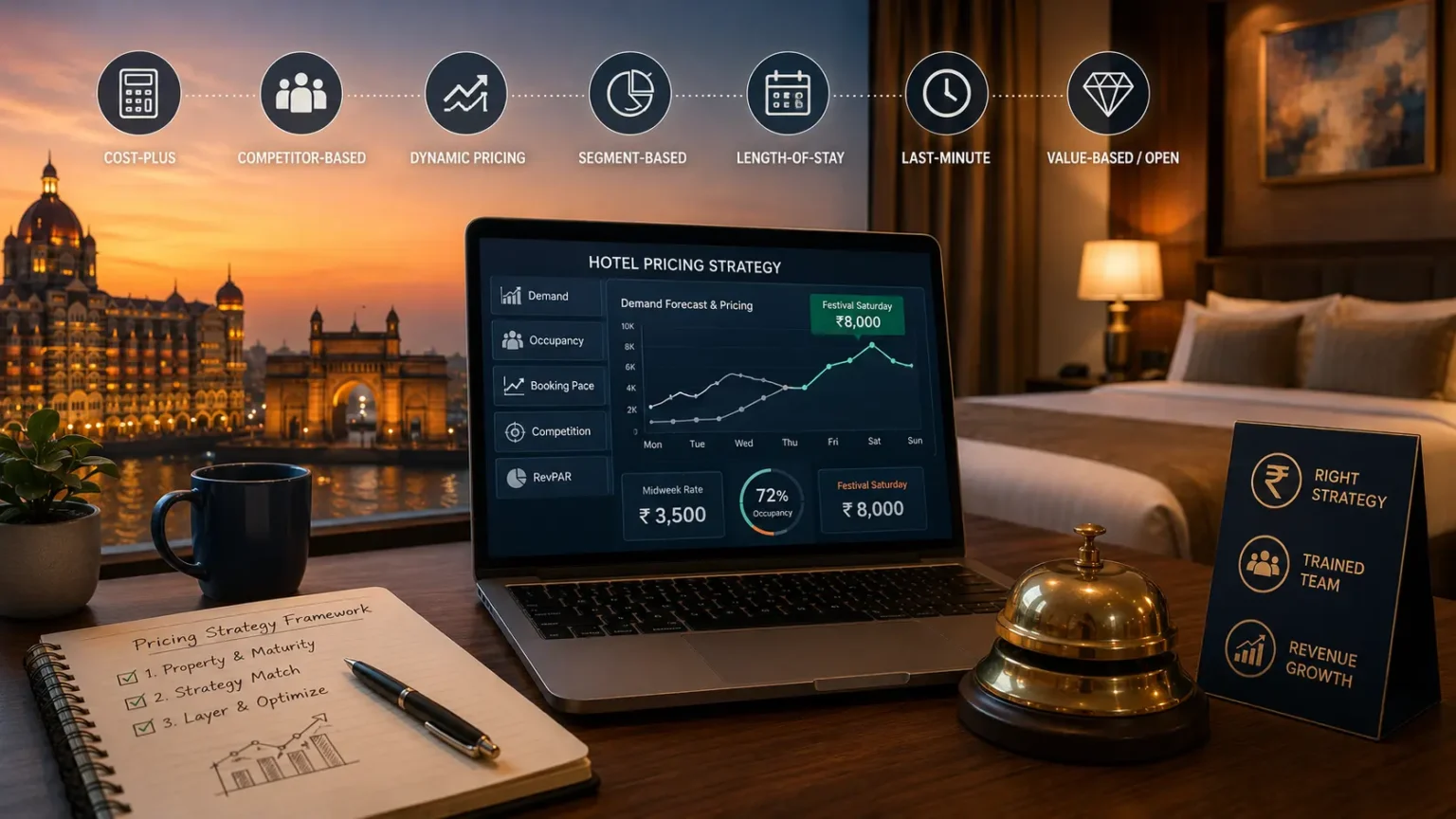
The same room sells for ₹3,500 midweek and ₹8,000 on a festival Saturday. Pricing strategy is the difference between that gap being a deliberate decision and a lucky guess. This guide covers the main types of hotel pricing strategy, and a decision framework for picking the right one. It also covers how soft skills training courses in Bangalore build the rate discipline a strategy needs to actually hold. It connects to the full metric picture in Hotel KPIs: The 12 Most Important Metrics.
TL;DR: A hotel pricing strategy is the deliberate approach a property uses to set room rates, whether cost-based, competitor-based, demand-based, or segment-based. The right choice depends on property type and revenue-management maturity. India’s OTA parity rules add complexity, and execution fails without front-office rate discipline.
Key Takeaways
– Dynamic pricing adjusts rates in real time based on demand; it’s the dominant modern approach but not the only valid one.
– The right strategy depends on property type and segment maturity, not a single universal best practice.
– India’s distribution landscape adds complexity — the CCI penalized MakeMyTrip-Goibibo ₹223.48 crore in 2022 over price parity clauses that limited hotels’ own pricing control.
– A hotel pricing strategy only works if front-office staff are trained to hold rate discipline instead of discounting reflexively.
What Is a Hotel Pricing Strategy?
A hotel pricing strategy is the deliberate approach a property uses to set room rates. It might be based on cost, competitor rates, demand, guest segment, or a combination, rather than pricing reactively or by instinct.
The 7 hotel pricing strategy approaches covered below:
- Cost-plus pricing
- Competitor-based pricing
- Occupancy/demand-based (dynamic) pricing
- Segment-based pricing
- Length-of-stay pricing
- Last-minute pricing
- Value-based and open pricing
| Strategy | How Rate Is Set | Best Fit |
|---|---|---|
| Cost-plus | Cost + target margin | Early-stage properties formalizing pricing |
| Competitor-based | Tracks a defined comp set | Properties wanting competitive positioning |
| Dynamic (demand-based) | Real-time demand signals | Metro hotels with an established RMS |
| Segment-based | Guest type and booking behavior | Properties with distinct corporate/leisure mix |
| Length-of-stay / last-minute | Stay duration or booking proximity | Properties managing turnover and unsold inventory |
| Value-based / open | Perceived guest value | Resorts with strong seasonal demand |
What Is Dynamic Pricing in Hotels?
Dynamic pricing adjusts room rates in real time based on demand signals: booking pace, occupancy forecast, competitor movement. That’s instead of holding a fixed rate for a season. It’s the dominant modern approach because it captures revenue a static rate structure simply can’t. This matters especially around India’s sharp festival and wedding-season demand spikes.
What Are the Main Types of Hotel Pricing Strategies?
Cost-Plus Pricing
Rate is set by adding a target margin on top of the cost of servicing a room. It’s simple to calculate, but blind to what the market will actually bear on a given night.
Competitor-Based Pricing
Rates track against a defined comp set’s pricing. That’s useful for staying competitively positioned, but risky if followed blindly during a comp set’s own pricing mistake.
Occupancy / Demand-Based (Dynamic) Pricing
Rate rises and falls with real-time demand signals, capturing peak-period revenue that a fixed rate structure leaves on the table.
Segment-Based Pricing
Different guest segments — corporate, leisure, group, OTA — are priced differently. The pricing is based on their price sensitivity and booking behavior, rather than one blanket rate for everyone.
Length-of-Stay and Last-Minute Pricing
Rates adjust based on stay duration, discounting longer stays to reduce turnover cost. Or they adjust based on booking proximity, using last-minute rates to fill rooms that would otherwise go unsold.
Value-Based and Open Pricing
Value-based pricing ties rate to the specific value a guest segment perceives (a business traveler’s convenience vs. a leisure guest’s experience); open pricing removes traditional rate-tier restrictions entirely, letting rate move freely with demand.
How Do You Pick the Right Hotel Pricing Strategy?
The right hotel pricing strategy depends heavily on property type and revenue-management maturity. A Tier-2 independent property just starting to formalize pricing should begin with clear cost-plus and competitor-based rules before layering in dynamic pricing. A metro business hotel with an established RMS can run full demand-based dynamic pricing with segment fencing from day one. A resort with strong seasonal demand patterns benefits most from length-of-stay and value-based approaches tied to its peak booking windows.
A 3-Step Framework to Pick a Strategy
- Identify property type and current revenue-management maturity
- Match that maturity to the nearest strategy in the table above
- Layer in a second strategy (e.g., dynamic pricing on top of cost-plus) only once the first is running consistently
How Does Pricing Work in the Indian Market: Seasonality, Festivals, and OTAs?
India’s demand curve is shaped by festival calendars, wedding season, and heavy OTA dependence in ways that don’t map cleanly onto Western pricing models. The distribution landscape adds real friction here. The Competition Commission of India penalized MakeMyTrip-Goibibo ₹223.48 crore, and OYO ₹168.88 crore, in October 2022. It directed MMT-Go to remove parity and exclusivity obligations from hotel contracts that had restricted hotels from pricing independently across channels. That ruling matters for pricing strategy directly. It affects how much genuine rate control a property actually has across its OTA and direct channels, not just what strategy it chooses on paper.
Why Do Pricing Strategies Fail in Execution?
The most sophisticated hotel pricing strategy fails the moment front-office staff discount reflexively to close a booking. That undermines the rate logic a revenue manager spent weeks building. A hotel pricing strategy is only as strong as the team’s discipline in holding it. Leadership and management training trains revenue and front-office managers to hold rate and read demand signals. That’s what separates a strategy that holds from one that collapses under the first occupancy dip. THSC, the Sector Skill Council for Tourism & Hospitality under India’s Ministry of Skill Development & Entrepreneurship, has certified over 100,000 hospitality professionals. That’s exactly the kind of structured, industry-recognized training that turns a hotel pricing strategy from a document into a habit the front desk actually holds.
Conclusion
A hotel pricing strategy isn’t about picking one “best” approach. It’s about matching the right strategy to your property, then training the team to hold rate discipline once it’s set. See real examples on our case studies page, or learn about Adevo.
Train your front-office team to protect rate and sell value, not discounts.
FAQ
Q: What is dynamic pricing in hotels?
A: Adjusting room rates in real time based on demand signals like booking pace and occupancy forecast. It’s instead of holding a fixed rate for a season.
Q: What are the main types of hotel pricing strategies?
A: Cost-plus, competitor-based, occupancy/demand-based (dynamic), segment-based, length-of-stay, last-minute, and value-based or open pricing.
Q: How do I choose the right hotel pricing strategy?
A: Match it to your property type and revenue-management maturity. A Tier-2 independent should start with simpler cost-plus and competitor rules before layering in full dynamic pricing.
Q: How does OTA rate parity affect Indian hotel pricing strategy?
A: The CCI’s 2022 order against MakeMyTrip-Goibibo required removing parity clauses that had restricted hotels from pricing independently. That’s a factor that shapes how much real pricing control a property has across channels.
Q: Why do good pricing strategies fail in practice?
A: Usually because front-office staff discount reflexively to close bookings, undermining the rate logic the strategy was built on. Execution discipline matters as much as strategy design.