A single failed checkpoint — a short-weight delivery accepted without checking, a temperature log filled in after the fact — can trigger a recall, a fine, or a reputational hit that outlasts the incident itself. Most Indian F&B operators treat quality control in food industry operations as a compliance afterthought rather than a daily process. This guide gives you a practical checkpoint framework you can implement this week, plus the hospitality management courses that make each checkpoint someone’s actual job, not a form nobody owns.
Key Takeaways
– Quality control is the checkpoint-by-checkpoint verification that food meets standards; quality assurance is the broader system that designs those checkpoints.
– FSSAI conducted 397,009 inspections and tested 165,747 samples in FY 2025-26, with 17.16% found non-compliant.
– The core checkpoints run receiving → storage → prep → cooking → holding → service, each needing its own verification step.
– Trained staff are the real checkpoint — paperwork only proves a check happened if someone was actually taught how to do it.
What Does This Actually Mean in a Commercial Kitchen?
It’s the set of checkpoint-level checks — verifying raw materials, monitoring preparation, testing finished output — that confirm food meets safety and quality standards before it reaches a guest. It’s distinct from the broader system that designs those checks in the first place, and it operates inside the wider compliance framework covered in Food Safety Standards in India.
Quality Control vs. Quality Assurance — What’s the Difference?
Quality assurance is the proactive system design: the standards, procedures, and training that are supposed to prevent defects. Quality control in food industry operations is the reactive checkpoint verification: the actual checks performed at each stage to confirm those standards were met. A kitchen can have excellent QA documentation and still fail on QC if nobody’s actually running the checks day to day.
What Are the Core Quality Control Checkpoints in Food Operations?
The chain runs in this order, each stage needing its own verification step:
- Receiving — weight, temperature, visible quality against the purchase order
- Storage — FIFO rotation, temperature logging, stock checks
- Preparation and cooking — recipe adherence, cooking temperature, cross-contamination controls
- Finished product / pre-service — final visual and temperature check before it reaches the guest
Raw Material and Supplier Receiving Checks
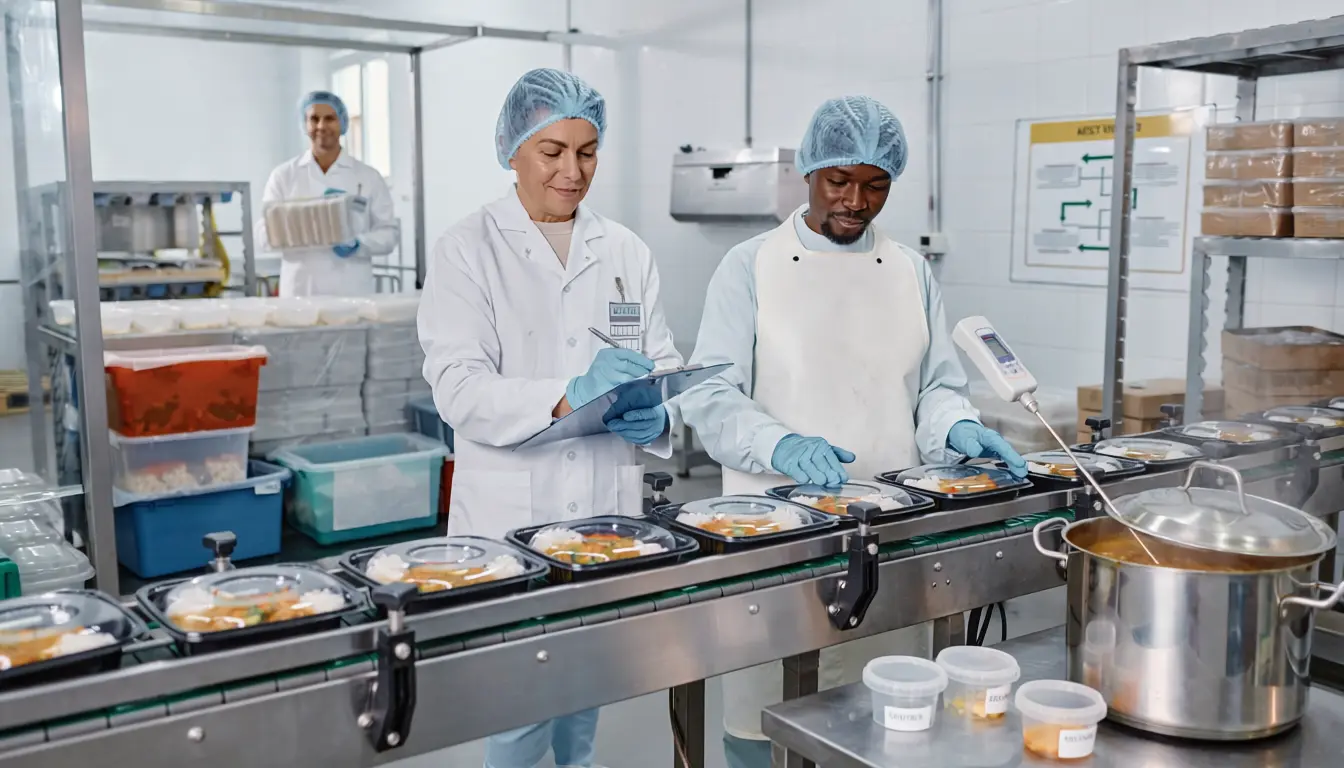
Every delivery should be checked against the purchase order for weight, temperature (for perishables), and visible quality before it’s signed for — the single highest-leverage checkpoint in quality control in food industry operations, since a problem caught at receiving never enters the kitchen.
Storage and Inventory Monitoring
FIFO rotation, temperature logging, and regular stock checks catch spoilage before it becomes a plated dish, not after a guest complaint flags it.
In-Process Preparation and Cooking Checkpoints
Standard recipe adherence, cooking temperature verification, and cross-contamination controls during prep are where most quality variance actually gets introduced or caught.
Finished Product and Pre-Service Checks
A final visual and temperature check before a dish leaves the pass catches the last-mile errors — wrong plating, a dish held too long, a garnish that’s turned — before they reach the guest. This final step is where quality control in food industry operations either holds or quietly breaks down under service pressure.
How Does GMP in Food Industry Fit Into Quality Control?
FSSAI’s Schedule 4 GMP/GHP Requirements for Indian F&B Businesses
GMP sets the facility-level standards — premises, equipment, personnel — that every quality control in food industry checkpoint above depends on. A receiving check means little if the storage area behind it doesn’t meet basic GMP conditions.
GMP vs. HACCP — Where They Overlap
GMP is the prerequisite layer; HACCP identifies the specific hazards and critical control points within that layer. Quality control checkpoints are where HACCP’s control points actually get verified in daily practice, not just documented in a plan.
What Do Food Safety Standards in India Require of F&B Operators?
FSSAI Licensing Tiers and Compliance Obligations
Every F&B operator needs a Basic Registration, State License, or Central License depending on scale, and getting the tier wrong is a common compliance failure inspectors flag early.
What Happens When Checkpoints Fail — Recalls, Fines, Closures
FSSAI conducted 397,009 inspections across food establishments and tested 165,747 samples in FY 2025-26, with 17.16% found non-compliant, according to enforcement data reported by The News Mill — a scale of enforcement that makes checkpoint discipline a real operational risk, not a hypothetical one.
How Do Indian F&B Operators Apply Quality Control Day to Day?
Hotel Kitchen Checkpoint Routines
Larger hotel kitchens typically run quality control in food industry checks at a dedicated receiving dock, with cold-chain verification logged before stock moves to storage — a structured routine that scales across multiple outlets sharing the same kitchen.
Standalone Restaurant Checkpoint Routines
Smaller standalone kitchens usually fold receiving and storage checks into a single staff member’s role, which makes training that person thoroughly even more critical than in a larger operation with dedicated QC staff. India’s food processing industry reached ₹30,49,800 crore (US$354.5 billion) in 2024, contributing roughly 7.9% of manufacturing GVA and 13% of exports, per IBEF — a scale at which even small, repeated checkpoint failures compound into significant national-level cost.
Why Trained Staff Are the Real Checkpoint
A checklist on a clipboard doesn’t catch a short-weight delivery — a receiving clerk trained to actually check weight against the invoice does. Every checkpoint in this framework depends on a specific person understanding why it matters, not just that a form requires a signature. Food and beverage training that builds checkpoint discipline into staff roles, not just documentation, is what makes a quality control system actually function on a busy shift.
What Does a Quality Control Checklist Actually Look Like in Practice?
A practical QC checklist doesn’t need to be long — it needs to be short enough that a receiving staff member actually completes it at every delivery, not just when there’s time. The minimum for a commercial Indian kitchen:
- Receiving checklist — supplier name, delivery date, items checked against PO, temperature of perishables on arrival, any rejections noted and signed
- Daily temperature log — refrigerator and hot-holding temperatures checked and recorded twice per shift, not once at opening
- Prep station cross-contamination check — colour-coded boards in use, raw protein separated from ready-to-eat items, handwashing station stocked
- Pre-service check — final temperature verification on hot dishes, visual check for correct plating and garnish against recipe card
The value isn’t in the checklist itself — it’s in the daily habit of running it. A quality control in food industry framework that exists on paper but gets skipped under pressure three nights a week isn’t protecting anyone.
Hotels running multiple outlets benefit from a centralised QC log reviewed daily by a Food Safety Supervisor, who can spot a pattern of temperature drift in one outlet before it becomes a guest-facing or inspection-level problem. That level of oversight doesn’t require specialist staff — it requires one person with accountability, a structured log, and the training to know what a trend looks like versus a one-off reading.
FAQ
Q: What is quality control in food industry operations?
A: The checkpoint-level checks — receiving, storage, prep, finished product — that verify food meets safety and quality standards before reaching a guest.
Q: What’s the difference between quality control and quality assurance?
A: Quality assurance designs the standards and procedures; quality control is the actual checkpoint verification that confirms those standards were met.
Q: What are the main quality control checkpoints in a commercial kitchen?
A: Receiving, storage, in-process preparation and cooking, and finished product/pre-service checks — each needing its own verification step.
Q: How does GMP relate to quality control checkpoints?
A: GMP sets the facility-level standards each checkpoint depends on; HACCP identifies specific hazards; quality control is where those controls get verified in daily practice.
Q: Why do quality control systems fail even with documentation in place?
A: Because paperwork only proves a check happened if the staff member running it was actually trained to do it correctly, not just told to sign a form.
Conclusion
Quality control in food industry operations isn’t lab testing or software — it’s a chain of checkpoints, each one only as reliable as the staff member running it. Build the framework, then train the people who execute it every shift.
Book a free demo of Adevo’s F&B training modules to build checkpoint discipline into your team.