
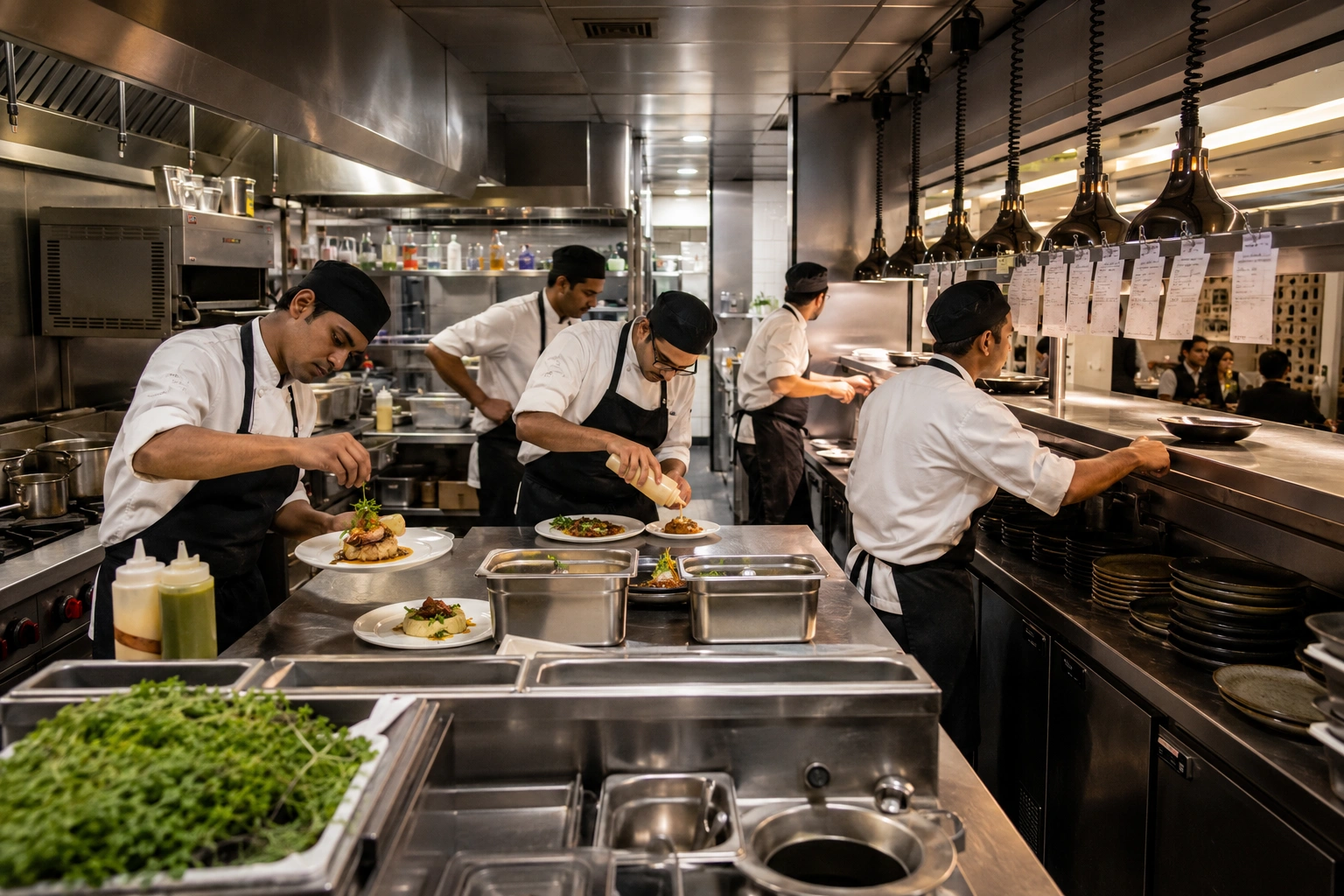
Indian restaurants already run on thin margins, which means food cost creep isn’t a line item to review once a quarter — it’s a leak that compounds every single week it goes unchecked. This guide covers the calculation, where waste actually happens in an Indian kitchen, and the methods — including hospitality management courses — that turn cost control from a policy into a daily habit.
Key Takeaways
– Food Cost % = COGS ÷ Food Sales × 100, tracked weekly against your format’s benchmark.
– Roughly one-third of all food produced in India is wasted or spoilt, worth nearly ₹50,000 crore a year.
– Portion control, FIFO stock rotation, and vendor discipline are the three highest-leverage waste-reduction methods.
– Hotel F&B departments add complexity — banquets, room service, and multi-outlet kitchens each need their own cost-control discipline.
What Is Food Cost Control and Why Does It Decide Your Margin?
Food cost control is the set of practices that keep the ratio of ingredient cost to food revenue inside a sustainable range. It decides your margin more than almost any other line because it’s the largest controllable expense on the P&L — see Food Cost Calculation: The Complete Guide for the full benchmark breakdown by restaurant format.
How Do You Calculate Food Cost Percentage?
The Food Cost Formula
Food Cost % = COGS ÷ Food Sales × 100, where COGS = Beginning Inventory + Purchases − Ending Inventory.
A Worked Example With Beginning and Ending Inventory
A hotel’s standalone coffee shop outlet, tracked over one week:
| Line Item | Amount (₹) |
|---|---|
| Beginning Inventory | 78,000 |
| Purchases (week) | 1,45,000 |
| Ending Inventory | 71,000 |
| Food Sales (week) | 4,90,000 |
COGS = 78,000 + 1,45,000 − 71,000 = ₹1,52,000
Food Cost % = 1,52,000 ÷ 4,90,000 × 100 = 31%
Where Does Food Waste Actually Happen in an Indian Kitchen?
Waste rarely happens in one obvious place — it accumulates across over-ordering against actual footfall, poor storage that lets stock spoil before it’s used, over-portioning against the standard recipe, and prep errors that turn usable ingredients into trim. Roughly one-third of all food produced in India is wasted or spoilt before being eaten, worth nearly ₹50,000 crore a year, according to reporting on India’s food wastage — a scale that makes kitchen-level waste discipline a genuine profit lever, not a minor housekeeping task.
What Cost Control Methods Actually Reduce Waste?
Portion Control and Standardised Recipes
A laminated recipe card at the pass, with exact weights, is the single highest-leverage fix — but only if new hires are actually trained on it, not just handed the card.
FIFO Inventory Management and Stock Rotation
First in, first out rotation, checked and dated at every delivery, stops older stock from spoiling behind newer stock pushed to the front. This needs a daily habit, not a monthly audit, to actually work.
Vendor and Purchasing Discipline
Checking every delivery against the purchase order before signing for it, and reviewing supplier pricing on a regular cycle rather than reactively, closes two of the most common leaks: short-weight deliveries and stale pricing.
Menu Engineering to Price Around True Cost
Pricing dishes against actual plate cost, not against what competitors charge, keeps high-cost items from quietly eroding margin even when they sell well.
How Is Cost Control in the Hotel Industry Different From Standalone Restaurants?
A hotel F&B department runs multiple outlets, banquets, and room service off shared kitchens and shared inventory, which multiplies the number of places waste can hide. A banquet with a fixed per-cover food cost can blow its budget on last-minute guest-count changes; a room-service kitchen holds food at temperature for longer, raising spoilage risk; a multi-outlet property needs inventory tracked by outlet, not just at the property level, or one outlet’s overuse gets buried in an average that looks fine.
Why Staff Training Is the Missing Link in Food Cost Control
Every method above — portioning, FIFO, purchasing discipline, menu pricing — depends on staff executing it consistently under service pressure, not once during onboarding and then never again. Most food cost leakage traces back to untrained kitchen staff, not a broken formula or a bad supplier contract. Kitchen Operations & Culinary training that certifies staff on these exact practices is what turns a cost-control policy into something the kitchen actually follows on a Friday night.
Food Cost Benchmarks by Restaurant Format in India
Knowing whether your food cost percentage is acceptable depends entirely on your format — a QSR at 32% is underperforming; a fine-dining restaurant at 32% may be running well below its typical band.
| Restaurant Format | Typical Food Cost % | Why It Varies |
|---|---|---|
| QSR / Fast food | 25–30% | Standardised, high-volume menus; portion control enforced by equipment |
| Casual dining | 28–35% | Broader menu, higher waste risk; costing discipline more manual |
| Fine dining | 30–40% | Premium proteins, elaborate plating; structural cost, not inefficiency |
| Hotel F&B (multi-outlet) | 28–36% | Banquet waste and room service spoilage add complexity beyond the main restaurant |
These are working benchmarks, not fixed rules. A hotel’s main restaurant might run 30%, while its banquet kitchen runs 38% due to the complexity of batch-cooking for a headcount that changes at 48 hours’ notice. Tracking by outlet — not just at the property level — is what gives a hotel F&B director actionable numbers.
What Systems Support Food Cost Tracking Beyond a Spreadsheet?
Spreadsheets work for a single-outlet standalone restaurant, but they break down for hotels and multi-outlet properties where purchases are shared across kitchens. The minimum useful system is a POS that records cover counts and food revenue per day, a purchase-order system that creates a digital trail for every delivery, and a weekly inventory count method consistent enough to be comparable week over week.
Recipe costing software — whether a standalone tool or a module inside a broader POS — eliminates the manual calculation of per-dish cost and Q factor, and automatically flags recipe items whose supplier prices have moved. For any operation running more than one kitchen or a banquet function, these systems pay for themselves quickly in the first caught overspend.
FAQ
Q: What is food cost control?
A: The set of practices — portioning, inventory rotation, purchasing discipline, and menu pricing — that keep the ratio of ingredient cost to food revenue inside a sustainable, format-appropriate range.
Q: How do you calculate food cost percentage?
A: Food Cost % = COGS ÷ Food Sales × 100, where COGS = Beginning Inventory + Purchases − Ending Inventory, tracked weekly with a physical inventory count.
Q: What is a good food cost percentage for a restaurant in India?
A: It varies by format — QSR runs leaner than casual dining, which runs leaner than fine dining — see Adevo’s food cost calculation guide for the full benchmark table by format.
Q: How is cost control different in a hotel F&B department?
A: Hotel F&B spans multiple outlets, banquets, and room service sharing inventory, which multiplies where waste can hide compared to a single standalone restaurant kitchen.
Q: Why does food cost keep rising even with a good recipe card?
A: A recipe card only works if staff are trained and re-certified on it — without that, portion drift and inconsistent execution quietly erode the number the card was meant to protect.
Adevo’s Food and Beverage training courses provide structured, India-specific training for F&B and hospitality teams.
Conclusion
Food cost control isn’t a spreadsheet exercise — it’s a daily kitchen habit built on portioning, FIFO, purchasing discipline, and staff who are actually trained to follow all three under pressure.