Most Indian kitchens run on memory and habit. The head chef knows where everyone stands. The sous chef knows who to shout at during service. The Commis I knows not to speak unless spoken to. It works, until it doesn’t. A new hire joins and has no idea who to report to. A station gets doubled up during a wedding banquet. Two cooks both claim ownership of the same prep task, and neither finishes it. If you’ve run a kitchen with more than six people, you know exactly what this looks like.
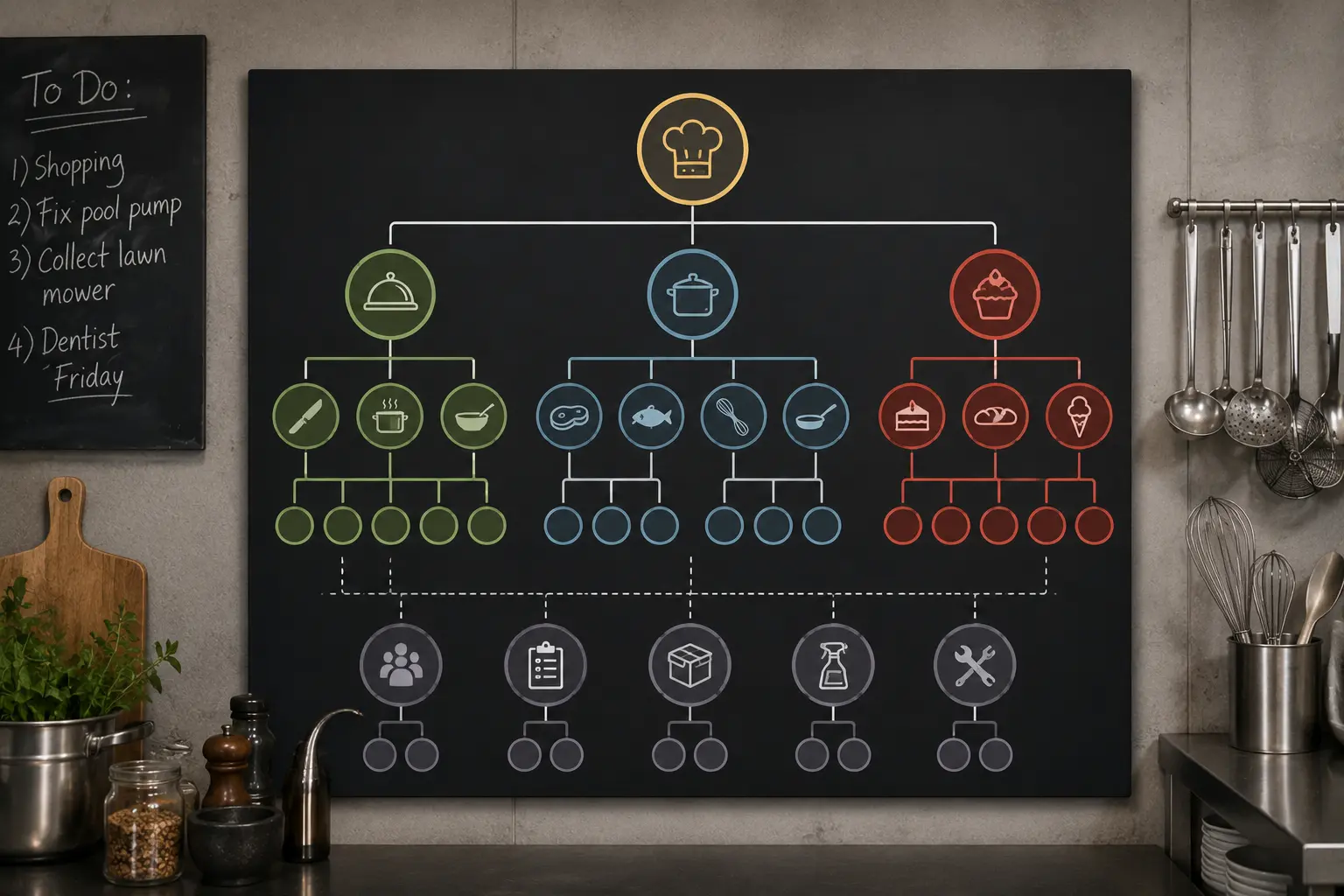
A kitchen organization chart fixes this. Not by adding paperwork, but by making the structure visible. If you want to build hospitality management courses knowledge into your team culture, it starts with clarity: who does what, who reports to whom, and who owns each station. This guide gives you three ready-to-use kitchen organization chart frameworks for different operation sizes, maps Indian kitchen roles to their French brigade equivalents, and walks you through building your own chart from scratch.
Key Takeaways
– A kitchen organization chart isn’t HR paperwork. It’s the operational backbone that keeps 15 people moving in the same direction during a 300-cover Saturday service.
– Most Indian hotel kitchens run 8-12 defined roles, not the 20+ of a classical French brigade. Build your kitchen organization chart for your reality, not a textbook.
– Indian kitchens need unique stations in the chart: tandoor, Indian section (halwai/curry), South Indian, and chaat counter don’t appear in Western brigade templates.
– Every FSSAI-licensed kitchen must have a named Food Safety Supervisor in the org chart. This isn’t optional; it’s a legal compliance requirement.
What Is a Kitchen Organization Chart
A kitchen organization chart is a visual diagram that maps the reporting structure, station assignments, and communication flow in a professional kitchen. It shows who reports to whom – from the Executive Chef down to Commis and Kitchen Stewards – and defines each team member’s operational responsibilities.
It’s not the same as a duty roster or a shift schedule. Those tell people when to show up. A kitchen organization chart tells them where they stand in the team structure and who they answer to when something goes wrong.
Hotels like Taj and Oberoi don’t just suggest kitchen org charts – they require them to be posted in every kitchen. There’s a reason. In a 200-cover property running three cuisine lines simultaneously, verbal command chains break the moment a senior cook calls in sick. The chart is the backup system for the human memory.
The foundation for modern kitchen hierarchy comes from Auguste Escoffier’s brigade de cuisine system, developed in the 1890s. Escoffier took the military command structure and applied it to professional kitchens – every person has a defined role, every role has a defined superior. That principle hasn’t changed. What has changed is that most Indian kitchens adapt it to 8-12 roles instead of 20+. For a comprehensive breakdown of each position and role development, read our complete guide to kitchen hierarchy.
The Kitchen Hierarchy: Every Role Explained
The classical kitchen organization chart runs top to bottom, with clear reporting lines at each level. Here’s how it maps in Indian hotel kitchens, with both French brigade terms and the actual titles you’ll see on appointment letters at ITC Hotels or Lemon Tree properties.
| Role | French Term | Indian Hotel Title | Reports To | Responsible For |
|---|---|---|---|---|
| Executive Chef | Chef de Cuisine | Executive Chef | F&B Manager / GM | Entire kitchen operation, menu, team |
| Deputy/Sous Chef | Sous Chef de Cuisine | Sous Chef | Executive Chef | Day-to-day kitchen operations, shift management |
| Station Chef | Chef de Partie (CDP) | CDP – Indian / Continental / Tandoor / Bakery | Sous Chef | One or more kitchen stations |
| Sauce Chef | Saucier | Curry/Gravy Chef (Indian Section) | CDP | Gravies, curries, sauces |
| Roast Chef | Rotisseur | Tandoor Chef | CDP | Tandoor items, grills, roasts |
| Cold Kitchen | Garde Manger | Cold Kitchen/Salad Chef | CDP | Salads, charcuterie, cold starters |
| Pastry Chef | Patissier | Pastry/Bakery CDP | Sous Chef | Desserts, baked goods, breakfast pastries |
| Junior Cook | Commis I | Commis I | CDP | Station support, prep, mise en place |
| Apprentice | Commis II | Commis II | Commis I / CDP | Basic prep, cleaning stations |
| Trainee | Commis III | Commis III / Kitchen Trainee | Commis II | Learning tasks, assisting senior staff |
| Kitchen Support | Plongeur | Kitchen Steward | Kitchen Supervisor | Warewashing, equipment cleaning, stock movement |
| Food Safety | N/A (French) | Food Safety Supervisor | Executive Chef / GM | FSSAI compliance, food safety audits |
A note on Indian kitchen sections that don’t exist in Western brigade charts: the tandoor station operates separately from the continental section, the halwai (Indian sweet and mithai cook) sits within the Indian section, the South Indian station covers idli, dosa, sambhar, and chutneys, and the chaat counter – present in many hotel all-day dining kitchens – reports to the Indian CDP. Your kitchen organization chart needs to show all of these.
3 Kitchen Organization Charts by Operation Size
No single kitchen organization chart works for every property. A 5-person restaurant kitchen runs completely differently from a five-star hotel kitchen with sub-kitchens for banquets, speciality restaurants, and in-room dining. What follows are three practical frameworks – not textbook diagrams, but the structures that actually function in Indian hotel and restaurant kitchens.
Chart 1: Small Restaurant Kitchen (5-8 Staff)
At 50-80 covers per day, you don’t need a brigade. You need a flat kitchen organization chart where one or two senior cooks cover multiple stations and everyone helps with prep.
Head Chef / Working Chef
├── Cook I (covers 2-3 stations during service)
├── Cook II (prep, support, secondary station)
├── Prep Cook / Kitchen Helper
└── Kitchen Steward
How this works in practice: The Head Chef is also a working chef – they’re on the line, not just calling tickets. The Cook I typically owns the main course station and handles Indian gravies and continental items during service. The Cook II handles tandoor or the secondary station. There’s no CDP layer because the team is too small to justify it.
What to watch for at this size: when your covers push past 80-100 per service session, this chart starts breaking. The Head Chef can’t manage the line and the kitchen at the same time. That’s your signal to add a Sous Chef.
Chart 2: Mid-Size Hotel Kitchen (12-18 Staff)
At 150-250 covers per day across multiple cuisine lines, you need a functional kitchen organization chart with clear station ownership. This is the most common structure in 3-star and budget hotel kitchens in tier-2 Indian cities.
Executive Chef
└── Sous Chef
    ├── CDP - Indian Section
    │   ├── Curry/Gravy Chef (Saucier equivalent)
    │   ├── Tandoor Chef
    │   └── Commis I/II (Indian Section)
    ├── CDP - Continental / Chinese
    │   └── Commis I/II (Continental)
    ├── CDP - Bakery/Pastry (if breakfast operation)
    │   └── Commis I (Bakery)
    └── Kitchen Steward Supervisor
        └── Kitchen Stewards (2-3)
At this size, the Indian section splits into its own CDP line. Tandoor moves out of the “all Indian” bucket and gets its own chef because service demand justifies it. You’ll also notice the Food Safety Supervisor isn’t shown as a separate line – at this size, it’s usually the Sous Chef or Executive Chef who holds the FSSAI Food Safety Supervisor certification. One person wears two roles.
The training flow at this level matters. CDPs are your front-line supervisors, but most haven’t been formally trained to supervise. That gap shows up fast when the Sous Chef is off and a CDP has to manage the section alone.
Chart 3: Large Hotel / Five-Star Kitchen (25-40+ Staff)
At 400+ covers per day, multiple outlets, and banquet operations, your kitchen organization chart needs sub-kitchen structures. The brigade operates as a full hierarchy with dedicated Sous Chefs per outlet or function.
Executive Chef
└── Executive Sous Chef
    ├── Sous Chef - Main Kitchen
    │   ├── Senior CDP - Indian Section
    │   │   ├── Tandoor CDP
    │   │   ├── South Indian CDP
    │   │   └── Halwai / Mithai (Indian Sweets)
    │   ├── Senior CDP - Continental
    │   │   ├── CDP - Sauté / Grill
    │   │   └── CDP - Cold Kitchen / Garde Manger
    │   └── Commis I/II/III (per station)
    ├── Sous Chef - Banquet Kitchen
    │   ├── CDPs (assigned per banquet section)
    │   └── Commis + Kitchen Trainees
    ├── CDP - Bakery / Patisserie
    │   └── Commis I/II (Bakery)
    ├── Food Safety Supervisor (dedicated role)
    └── Kitchen Steward Supervisor
        └── Steward Team
At five-star scale, the Food Safety Supervisor is a dedicated, named role on the kitchen organization chart. Under FSSAI’s Food Safety and Standards Regulations, every licensed food business with more than 100 employees must have a trained Food Safety Supervisor. For properties running over 400 covers per day with banquet operations, a dedicated supervisor isn’t just good practice – it’s a legal requirement.
If you want to understand what that Food Safety Supervisor role actually involves on a daily basis, our post on kitchen staff food safety training in India covers the practical certification and compliance requirements.
Ready to structure your own team at this level? Adevo’s kitchen operations and culinary training programme is designed specifically for Indian hotel kitchens – covering both technical skills and the supervisory competencies your CDPs and Sous Chefs need to make a large brigade function.
How to Build a Kitchen org chart for Your Operation
Knowing what the finished chart looks like is one thing. Building it for your specific kitchen is another. This is the step-by-step process we’ve used with restaurant and hotel kitchen teams across Bangalore, Hyderabad, and Pune.
Step 1: Audit Your Volume and Service Style
Start with numbers. How many covers does your kitchen serve per day? How many meals does that break across – breakfast, lunch, dinner, banquet? Are you running multi-cuisine (Indian + Continental + Chinese) or single-cuisine?
A 200-cover multi-cuisine restaurant in Bengaluru needs a completely different org chart than a 200-cover single-cuisine South Indian restaurant. The multi-cuisine property has at least three concurrent cooking lines. The South Indian property might run everything from one kitchen section with specialist cooks.
Count your current team. Then map those people against your cover volume. If you’re running 150 covers with 8 cooks, you’re understaffed and your org chart will reflect that by showing people doubling up on stations.
Step 2: Map Your Kitchen Stations
List every station that operates during a standard service. Don’t skip the ones you’ve mentally merged into “general kitchen.” If your Commis II switches between two tasks during service, those are two stations, even if one person covers both.
Typical Indian hotel kitchen stations to map:
- Tandoor station
- Indian gravy / curry section
- South Indian station (if applicable)
- Halwai / mithai (if applicable)
- Chaat / live counter (if applicable)
- Continental (sauté, grill, cold)
- Chinese / Asian (if applicable)
- Bakery / pastry
- Cold kitchen / garde manger
- Butchery (for larger operations)
- Stewarding
Once you have the station list, you have the skeleton of your kitchen chart. Every station needs an owner, and ownership defines your CDP layer.
Step 3: Assign Roles to Stations
Each station needs a CDP (Chef de Partie) or station owner and at least one Commis for support. In small kitchens, one person owns two or three stations. In large kitchens, each station has a dedicated team.
The rule: match the number of owners to your busiest service period. If your Tandoor station runs flat-out during dinner, you need a dedicated Tandoor CDP for dinner service, not someone who doubles as the Indian gravy cook and tries to manage two stations simultaneously.
What happens when a kitchen org chart doesn’t reflect station ownership honestly? Peak-service chaos. Two people think they own the same station. Nobody thinks they own a third. Both are problems that a clear org chart prevents.
Step 4: Define Reporting Lines
The communication chain in a professional kitchen is: Executive Chef to Sous Chef to CDP to Commis. Not Executive Chef to everyone.
This matters most during service. If every Commis can ask the Executive Chef questions directly during a busy dinner service, the Chef stops cooking and starts managing questions. That’s how service slows.
In Indian kitchens, the Aboyeur (expeditor) role – the person who calls out tickets and coordinates food timing between stations – is often absorbed by the Sous Chef. In large hotel kitchens, it’s a separate function. When you draw your kitchen chart, decide who calls the pass. One person calls the pass. Not three.
Define reporting lines separately for service and for prep. During prep, a Commis might move between stations. During service, they report only to their station CDP.
Step 5: Add Compliance and Support Roles
Two roles belong in every FSSAI-licensed kitchen org chart that most operators miss:
Food Safety Supervisor: Under FSSAI regulations, food businesses above a certain size must have a trained, named Food Safety Supervisor. This person isn’t just a certificate on the wall. They own the temperature logs, hygiene audits, and pest control documentation. In your chart, they report to the Executive Chef or F&B Manager.
Stewarding Supervisor: The steward team handles warewashing, kitchen cleanliness, equipment movement, and the physical infrastructure that keeps service running. A kitchen without a stewarding structure in the org chart is a kitchen where senior chefs spend time on tasks below their pay grade.
For large operations, a Training Coordinator sits in the org chart as well. At 30+ staff, you’re onboarding people constantly. Someone needs to own that process.
How the Kitchen Org Chart Changes as You Scale
One of the most common mistakes in growing restaurants and hotels: operators keep the same kitchen structure as the team doubles. The kitchen chart that worked at 80 covers breaks at 150, and completely collapses at 300. Here’s the scaling map:
| Operation Size | Daily Covers | Staff Count | Key Structural Change |
|---|---|---|---|
| Small restaurant | 50-100 | 4-8 | Flat chart; Head Chef is working chef; CDPs merged |
| Growing restaurant | 100-150 | 8-12 | Add dedicated Sous Chef; split Indian and Continental CDPs |
| Mid-size hotel kitchen | 150-250 | 12-18 | Tandoor splits from Indian section; bakery gets own CDP |
| Large hotel kitchen | 250-400 | 18-30 | Executive Sous Chef added; South Indian gets dedicated line |
| Five-star / full brigade | 400+ | 30-50+ | Sub-kitchens for banquet, speciality, main; dedicated Food Safety Supervisor |
Three specific triggers to watch for:
- 100+ covers per day, Head Chef still doing mise en place: you need a Sous Chef. The Head Chef’s job at that scale is management and quality control, not station prep.
- Indian and Continental sections both running 50+ covers per service, one CDP supervising both: split them. The CDP who’s watching two sections isn’t managing either of them properly.
- Banquet volume reaching 3-4 large events per month: create a separate banquet kitchen team within your kitchen org chart. Banquet service rhythms are completely different from a la carte service, and the same team trying to do both simultaneously is a quality control problem.
Common Kitchen Org Chart Mistakes (and How to Fix Them)
No clear second-in-command. The most common gap in small and mid-size org charts is no Sous Chef or no one who formally holds the second-in-command role. When the Head Chef is out, who’s running the kitchen? If the answer is “whoever is senior that day,” you don’t have a kitchen chart. You have a suggestion.
Flat structure in a 20+ person kitchen. Some kitchen owners resist hierarchy because it feels bureaucratic. But in a kitchen with 20 people and no clear reporting lines, every problem goes to the top chef. That chef spends their entire shift resolving communication issues instead of running food quality.
Ignoring the stewarding layer. Stewards don’t appear in many kitchen org charts because operators see them as support staff rather than kitchen team members. Wrong. A steward supervisor who reports clearly in the chart creates accountability for kitchen hygiene, equipment availability, and service support.
No Food Safety Supervisor in the chart. FSSAI requires named, trained Food Safety Supervisors for licensed food businesses. If your org chart doesn’t show this role, you’re not just missing a box on a diagram. You’re non-compliant.
Chart exists on paper but not in practice. This is the most common problem. The org chart is in a file somewhere. Nobody has seen it in two years. New staff don’t know it exists. The solution is simple: post the kitchen chart on the kitchen notice board, review it whenever a new senior role is filled, and update it any time a team structure changes.
Frequently Asked Questions: Kitchen org chart
Q: What is the hierarchy in a hotel kitchen?
A: A hotel kitchen hierarchy runs from Executive Chef at the top, followed by Executive Sous Chef (in large properties), Sous Chef, Chef de Partie (CDP) by section, Commis I/II/III, Kitchen Trainees, and Kitchen Stewards at the base. In Indian hotels, a dedicated Food Safety Supervisor also sits within this structure, typically reporting to the Executive Chef.
Q: How many positions are in an org chart?
A: A full classical brigade de cuisine has 20+ positions, but most Indian hotel kitchens operate with 8-12 defined roles. Small restaurant kitchens can function effectively with 4-6. The right number depends on your daily cover volume, number of cuisine lines, and outlet count.
Q: What is the difference between a brigade de cuisine and a kitchen hierarchy?
A: A brigade de cuisine is the classical French kitchen structure created by Escoffier, with 20+ specific titles from Chef de Cuisine down to Apprenti. A kitchen hierarchy is the broader term for any structured reporting chain in a kitchen. Most Indian hotel kitchens use a modified brigade system adapted to local cuisine stations, cover volumes, and Indian role nomenclature.
Q: What is the organizational structure of a five-star hotel kitchen?
A: A five-star hotel kitchen operates multiple sub-kitchens under an Executive Chef and Executive Sous Chef. Separate Sous Chefs manage the main kitchen, banquet kitchen, and speciality restaurants. Each kitchen has CDP layers by cuisine section (Indian, Continental, Bakery, Garde Manger), with Commis teams beneath. A dedicated Food Safety Supervisor and Stewarding Supervisor complete the structure.
Q: Do small restaurants need a kitchen chart?
A: Yes. Even a kitchen with 5 staff benefits from a simple kitchen org chart. It doesn’t need to be a complex brigade structure. A flat one-page diagram showing who reports to whom and who owns each station prevents the ambiguity that causes errors during service. As you grow, the chart grows with you.
Q: How does the tandoor station fit in an Indian kitchen org chart?
A: In small kitchens, the Tandoor Chef reports to the Head Chef directly. In mid-size hotel kitchens, tandoor is typically managed as a sub-station under the Indian Section CDP. In large five-star kitchens, the Tandoor Chef holds their own CDP-level role, particularly when tandoor items run across multiple outlets or banquet events simultaneously.
Conclusion
An org chart isn’t a formality for large hotels. It’s the document that turns a collection of cooks into a functioning team. Whether you’re running 50 covers from a 5-person kitchen or managing a 400-cover five-star brigade across sub-kitchens, the principle is the same: everyone knows their role, their station, and who they answer to.
The Indian context adds complexity that Western brigade templates ignore. Tandoor stations, South Indian sections, halwai roles, and FSSAI compliance requirements all belong in your kitchen chart from day one. The three scalable frameworks in this guide give you a starting point – adapt them to your specific cuisine lines, cover volumes, and team size.
Build the chart. Post it. Update it when roles change. The kitchens that operate smoothly aren’t the ones with the most experienced chefs. They’re the ones with the clearest structures.
For deeper context on how kitchen organization fits into the broader types of organizational structure, the classical brigade is the hierarchical model adapted for Indian multi-cuisine operations.