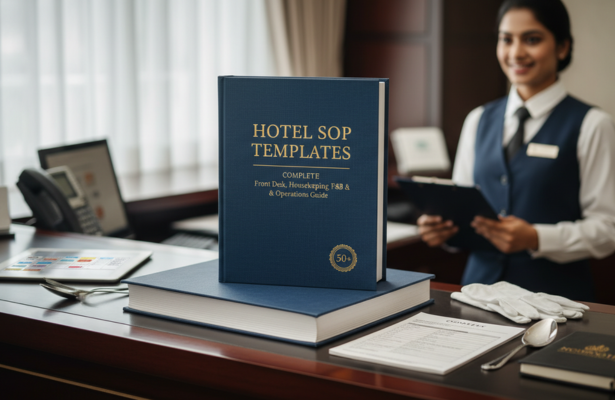
Most hotels have SOPs. Most staff have never read them. The problem is rarely that the documents don’t exist, it is that they are written for auditors, not for the people who actually run service. Hospitality management courses teach teams to write SOPs that work on the floor, not just in the compliance folder. Below are 50 structured hotel SOP templates across the three highest-impact departments, built for daily operational use.
Key Takeaways – Hotel SOPs fail not because of bad writing but because they are designed for auditors instead of the staff who execute them; effective SOPs are short, visual, and role-specific – The highest-value SOP categories are check-in and check-out (front desk), room turnover and chemical handling (housekeeping), and mise en place and food safety (F&B) – An SOP that takes more than 90 seconds to read during a shift handover will not be followed; brevity and bullet structure are the core design principles
Why Do Most Hotel SOPs Fail in Practice?
The most common failure mode is length. An SOP that runs to four pages, written in paragraph form, is a document that a supervisor will reference once during onboarding and never look at again. Effective hotel SOPs are single-page, bullet-structured, and written so that a new hire who joined two weeks ago can execute the task without asking anyone.
The second failure mode is generality. A generic “check-in procedure” SOP that applies equally to a business traveller, a family group, and a walk-in is too broad to be useful. High-performing properties write scenario-specific SOPs: check-in for pre-registered FIT guests, check-in for walk-ins, check-in for VIPs, check-in during system outage. Each is a separate document.
The Ministry of Tourism’s National Hospitality Standard framework emphasizes that SOPs should be operationally granular, specific enough to be tested. If you cannot observe whether a team member followed an SOP or not, it is not operational enough.
What Front Desk SOP Templates Does Every Hotel Need?
Front desk SOPs cover the full guest journey from pre-arrival to departure. The 18 highest-impact templates:
Pre-arrival and reservation: – SOP 1: Pre-arrival communication, room confirmation, preferences, transport – SOP 2: VIP pre-arrival checklist, room setup, amenity placement, team briefing – SOP 3: Group booking pre-arrival, rooming list coordination, key packets – SOP 4: Walk-in inquiry handling, rate quoting, availability check, upgrade protocol
Check-in: – SOP 5: Standard FIT check-in, ID verification, key card issue, directional orientation – SOP 6: Early arrival handling, luggage storage, amenity access, room priority queue – SOP 7: System outage check-in, manual registration card, room assignment backup – SOP 8: Oversold/walk situation, guest management, relocation protocol, compensation matrix
During stay: – SOP 9: Guest request handling, logging, escalation, closure confirmation – SOP 10: Complaint management, de-escalation script, HEAR protocol, escalation triggers – SOP 11: In-house wake-up call, scheduling, backup procedure, missed call protocol – SOP 12: Key re-issue procedure, ID check, security log, room change flagging
Check-out: – SOP 13: Express check-out, bill pre-preparation, folio review, payment confirmation – SOP 14: Standard check-out, key return, final folio, loyalty points update – SOP 15: Disputed bill handling, review window, adjustment authority levels, documentation – SOP 16: Late check-out, rate framework, room status impact, housekeeping communication
Operational: – SOP 17: Shift handover, logbook entry, pending follow-ups, cash float reconciliation – SOP 18: Cash handling and float management, denomination breakdown, discrepancy protocol
What Housekeeping SOP Templates Matter Most?
Housekeeping SOPs drive the largest consistency gains of any department. The 18 templates that matter most:
Room turnover: – SOP 19: Checkout room turnover, sequence, inspection checklist, status update – SOP 20: Stayover room service, do-not-disturb protocol, bed-making standard, replenishment – SOP 21: VIP room preparation, amenity placement checklist, supervisor sign-off – SOP 22: Deep clean procedure, quarterly rotation, furniture movement, linen replacement
Linen and laundry: – SOP 23: Linen count and storage, par levels, spoilage logging, vendor returns – SOP 24: Laundry processing, sorting, temperature settings, stain treatment, turnaround SLA – SOP 25: Guest laundry handling, collection, processing, delivery, damage documentation
Chemical handling (FSSAI-adjacent compliance): – SOP 26: Chemical storage, segregation, labelling, ventilation requirements – SOP 27: Dilution and dispensing, ratio card, personal protective equipment, spill protocol – SOP 28: MSDS reference and emergency response, chemical incident, first aid, reporting
Public area: – SOP 29: Lobby cleaning frequency and standards, peak hours, appearance check cycle – SOP 30: Banquet hall setup and clear-down, pre-function checklist, post-event standard – SOP 31: Elevator and stairwell maintenance, frequency, inspection sign-off – SOP 32: Swimming pool area, chemical test log, safety equipment check, incident log
Staff and supervisory: – SOP 33: Trolley preparation and restocking, par list, layout, room assignment sequence – SOP 34: Lost and found handling, logging, security, guest notification, disposal timeline – SOP 35: Room inspection, supervisor walkthrough checklist, failure escalation – SOP 36: Pest sighting protocol, immediate response, maintenance notification, guest communication
How to train your team on SOPs and ensure compliance covers the implementation side in detail, the communication cadence, supervisor accountability loops, and documentation formats that make the difference between SOPs that are followed and SOPs that are filed.
Which F&B SOP Templates Are Operationally Critical?
F&B SOPs span kitchen, service, and compliance. The 14 most operationally critical:
Kitchen and food safety: – SOP 37: Mise en place checklist, station-specific, service readiness sign-off – SOP 38: Temperature logging, receiving, storage, hot-holding, cool-down intervals – SOP 39: Receiving and quality check, vendor delivery inspection, rejection protocol – SOP 40: FSSAI food safety supervisor daily checklist, FoSTaC compliance log, audit ready – SOP 41: Allergen handling, labelling, cross-contamination prevention, staff briefing
Service: – SOP 42: Restaurant opening procedure, cover setup, mise en place, briefing checklist – SOP 43: Table service sequence, greeting, order taking, coursing, bill presentation – SOP 44: Buffet setup and replenishment, labelling, temperature monitoring, replenishment trigger – SOP 45: Bar opening and closing, inventory count, wastage log, equipment sanitisation
Banqueting and events: – SOP 46: Banquet service sequence, pre-event setup, service flow, clear-down – SOP 47: Event BEO briefing, kitchen-service coordination, timing, contingency protocol – SOP 48: Room service order handling, taking, dispatch, tray setup, collection
Operational: – SOP 49: End-of-day reconciliation, covers, revenue, void log, tip distribution – SOP 50: Staff meal management, timing, cost control, hygiene standard
How Do You Implement Hotel SOP Templates Effectively?
Writing the SOP is the easy part. The operational challenge is embedding it into daily behaviour.
The most effective implementation sequence across Indian hotel operations follows four phases:
- Phase 1, Adapt, not adopt: Take any template from this list and localise it. Remove steps that don’t apply to your property; add steps that are specific to your setup. A template is a starting point, not a final document.
- Phase 2, Train before you laminate: Run the SOP through a role-play or live walkthrough before printing and posting it. The walkthrough reveals gaps; the laminated version should reflect the final procedure, not the first draft.
- Phase 3, Embed in shift briefings: Every shift starts with a 5-minute briefing. Use that time to focus on one SOP per week. Over three months, a 50-SOP library becomes part of muscle memory.
- Phase 4, Audit and refresh: Review each SOP quarterly or when a guest complaint reveals a procedural gap. SOPs that have not been reviewed in 18 months are probably out of date.
Conclusion
Fifty SOPs is a starting point, not a ceiling. The value is not in having the documents, it is in having a team that understands why each step exists and can execute without supervision. If you need support building, localising, or training your team on SOP frameworks, Adevo works with hotel and F&B teams across India. Start with our leadership and management skills training to understand the leadership-level frameworks that make SOP adoption stick.
Frequently Asked Questions: Hotel SOP Templates
Q: What should a hotel SOP template include? A: An effective hotel SOP template includes a one-line purpose statement, a clearly defined scope (which role, which situation), step-by-step instructions in bullet form, quality standards or observable outcomes for each step, and escalation triggers. SOPs longer than one page rarely get followed consistently.
Q: How many SOPs does a hotel need? A: A mid-scale hotel typically requires 80–120 SOPs across all departments to cover daily operations, emergency situations, and compliance requirements. The 50 templates above cover the highest-impact areas across front desk, housekeeping, and F&B. A full SOP library would add engineering, security, finance, and HR procedures to this foundation.
Q: How often should hotel SOPs be updated? A: SOPs should be reviewed quarterly for high-frequency procedures (check-in, checkout, temperature logging) and annually for lower-frequency processes. Any guest complaint that reveals a procedural gap should trigger an immediate SOP review for that procedure. The review date should be printed on every SOP document.
Q: Who is responsible for writing hotel SOPs? A: Department heads own SOP authorship for their areas, with input from the most experienced supervisors who actually execute the procedures. The GM or Training Manager reviews for consistency and format. SOPs written only at the senior management level, without input from floor staff, routinely miss critical operational steps.
Q: What is the difference between a hotel SOP and a checklist? A: An SOP defines how to complete a task, the steps, standards, and decision points. A checklist verifies that an SOP was followed. The best hotel operations use both: the SOP for training and onboarding, and a companion checklist for daily verification. The pre-flight checklist that airlines use is a compliance tool, not a training document, hotel checklists work the same way.